


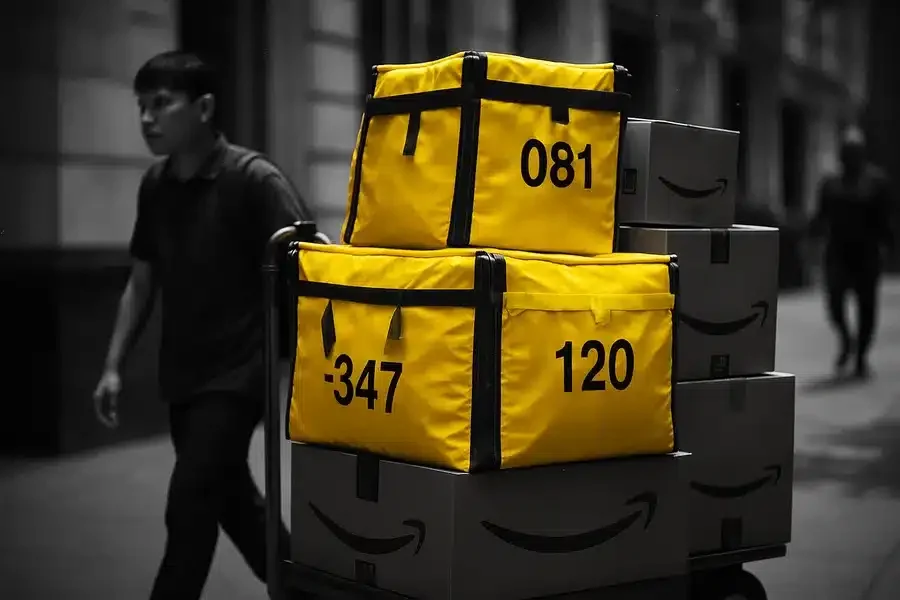
Amazon (AMZN) revealed on Tuesday its rollout of the lightning-fast Amazon Now delivery platform across multiple U.S. metropolitan areas, providing 30-minute delivery service at $3.99 for Prime subscribers. This strategic expansion heightens rivalry with gig economy companies such as DoorDash (DASH) and Instacart (CART) while potentially boosting customer retention and purchase frequency.
Key Takeaways
- Amazon Now expands to dozens of cities with 30-minute delivery
- Service costs $3.99 for Prime members, $13.99 for non-members
- Uses specialized micro-fulfillment centers to enable ultra-fast shipping
Market Context and Competitive Landscape
This service rollout marks Amazon’s boldest entry into the rapid commerce sector currently led by platforms including Uber Eats (UBER), DoorDash, and Instacart 1. Despite Amazon shares declining 0.66% Tuesday, this logistics enhancement leverages the company’s $575 billion revenue foundation and may create pressure on smaller delivery rivals.
The Amazon Now platform operates through specialized micro-fulfillment facilities spanning 5,000 to 10,000 square feet, strategically located nearer to consumers than conventional distribution centers 2. These “dark stores” maintain inventory of roughly 3,500 items spanning groceries, electronics, and household necessities.
Operational Strategy and Pricing
The platform employs Amazon’s Flex delivery network, providing round-the-clock availability across most service territories 3. Prime subscribers incur $3.99 per delivery plus an extra $1.99 charge for purchases below $15, whereas non-Prime customers encounter a $13.99 delivery fee alongside the minimum order surcharge.
CEO Andy Jassy has highlighted in previous shareholder communications that expedited delivery infrastructure increases conversion metrics and shopping transaction volume 4. The organization targets serving “tens of millions of customers” before year-end, scaling up from current millions with service access.
Geographic Expansion and Timeline
Amazon Now presently functions in Seattle, Philadelphia, Atlanta, and Dallas-Fort Worth, with upcoming launches scheduled for Austin, Denver, Minneapolis, Phoenix, Houston, New York, and Oklahoma City 5. The platform initially debuted internationally across India, Brazil, Mexico, Japan, the United Arab Emirates, and the United Kingdom.
“You can get everything from groceries for dinner, to AirPods before a flight, to household essentials like laundry detergent or toothpaste delivered right to your door,” said Udit Madan, Amazon’s senior vice president of worldwide operations 6.
Competitive Response and Industry Impact
DoorDash highlighted its merchant collaboration approach, declaring it provides “over half a million grocery and retail items in under an hour across the country” 7. Independent retail analyst Bruce Winder observed Amazon’s logistics expertise provides competitive advantages over smaller platforms without comparable infrastructure scale.
Walmart (WMT) currently provides Express Delivery with packages frequently arriving within 30 minutes for a $10 surcharge, demonstrating the escalating speed rivalry in retail fulfillment 8. This expansion follows Amazon’s comprehensive logistics investments, including recent 1-hour and 3-hour delivery launches throughout additional U.S. territories.
Long-term Implications
This ultra-rapid delivery initiative may transform customer expectations and compel rivals to enhance their logistics infrastructure. Nevertheless, historical 30-minute delivery commitments have encountered operational obstacles, exemplified by Domino’s discontinued promise in 1993 due to safety issues.
Amazon’s existing infrastructure and capital resources enable it to maintain this service sustainably, potentially gaining market share from specialized delivery services while reinforcing customer retention through enhanced convenience.
Not investment advice. For informational purposes only.
References
1Annie Palmer (May 12, 2026). “Amazon accelerates delivery race with 30-minute dropoffs in dozens of U.S. cities”. CNBC. Retrieved May 12, 2026.
2Fox Business (May 12, 2026). “Amazon’s 30-minute delivery push raises stakes in race for speed”. Fox Business. Retrieved May 12, 2026.
3CNBC (May 12, 2026). “Amazon accelerates delivery race with 30-minute dropoffs in dozens of U.S. cities”. X (formerly Twitter). Retrieved May 12, 2026.
4Ground News (May 12, 2026). “Amazon Looks to Redefine a Need for Speed with 30-Minute Deliveries”. Ground News. Retrieved May 12, 2026.
5Anne D’Innocenzio (May 12, 2026). “Amazon looks to redefine a need for speed with 30-minute deliveries”. San Francisco Chronicle. Retrieved May 12, 2026.
6Amazon Staff (December 1, 2025). “Amazon Now is testing 30-Minute Delivery in Seattle and Philadelphia”. About Amazon. Retrieved May 12, 2026.
7Facebook (May 12, 2026). “Amazon is rapidly opening store-sized delivery hubs in dozens of U.S. and foreign cities”. Facebook. Retrieved May 12, 2026.
8Frank “Khing Jus Wurk” Monroe (May 12, 2026). “New Technology post on CNBC: Amazon accelerates delivery race with 30-minute dropoffs in dozens of U.S. cities”. X (formerly Twitter). Retrieved May 12, 2026.