


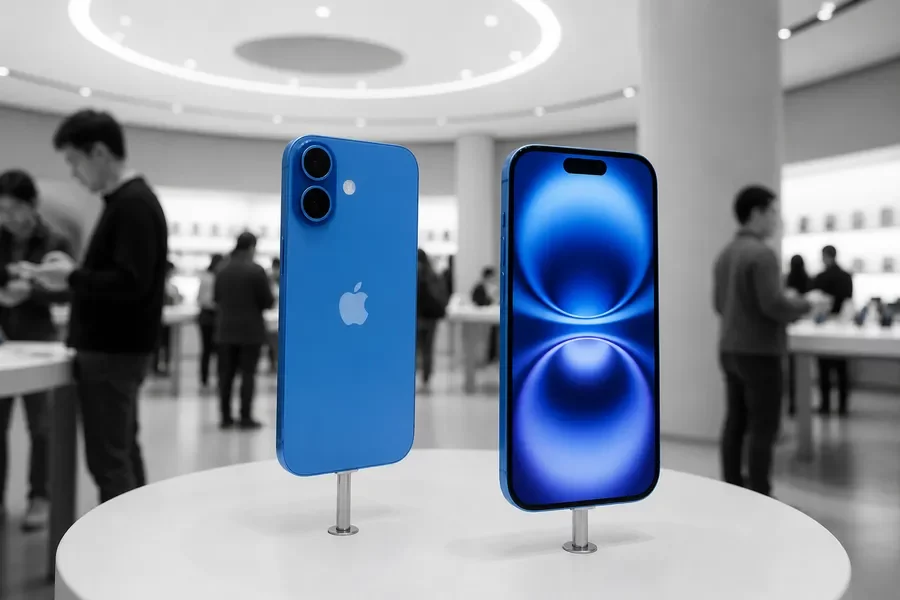
Rothschild & Co Redburn analysts said Apple (AAPL) could see its stock climb as much as 30% if the iPhone maker deploys Nvidia’s open-source AI models to shore up what they called “subpar” foundational AI capabilities.
For long-horizon investors, the call matters because Apple’s ability to compete in generative AI directly shapes iPhone upgrade cycles, services-revenue growth, and the durability of its premium pricing power in a market where rivals are accelerating spending.
Key Takeaways
- Rothschild sees 30% AAPL upside if an Nvidia AI model deal materialises.
- Apple’s own AI models described as “far from frontier” by analysts.
- Apple already relies on Alphabet’s Gemini to fill its generative AI gap.
Market Context & Competitive Standing
Apple briefly reclaimed the title of world’s most valuable company from Nvidia (NVDA) last month, yet the Rothschild note highlights a widening capability gap in the AI race that underpins that rivalry 12. While Microsoft, Alphabet, Meta, and Amazon have each committed hundreds of billions of dollars to AI infrastructure, Apple’s AI investment has been comparatively modest – a divergence that analysts said leaves its foundation models trailing frontier peers by a meaningful margin.
The firm’s existing workaround – a licensing arrangement with Alphabet to surface Gemini-powered generative AI features on Apple devices – reflects the depth of that shortfall. Rothschild analysts characterised Apple’s independent AI efforts as “disappointing,” a rare rebuke for a company whose hardware ecosystem commands near-unrivalled customer loyalty.
The Nvidia Thesis
The Rothschild thesis centres on Nvidia’s growing portfolio of open-source AI models, which Apple could theoretically deploy across its silicon-optimised hardware without bearing the full cost of frontier model development from scratch. Apple’s custom chips – the M-series for Mac and the A-series for iPhone – are widely regarded as among the most efficient inference platforms available, meaning capable third-party models could run with material performance advantages on Apple devices.
An Nvidia partnership would therefore offer Apple a dual benefit: closing the model-quality gap rapidly while leveraging existing hardware differentiation to deliver a user experience that rivals struggle to replicate on commodity silicon. Rothschild analysts argue that scenario alone could justify a re-rating worth roughly 30% on the current share price 1.
Apple’s recent efforts to expand AI partnerships in key growth markets add further context. The company has also been exploring AI collaborations in China with Alibaba’s support, signalling a broader willingness to rely on external model providers where its own capabilities fall short.
Analyst View
Apple’s foundation models are “far from the frontier” level and “subpar,” Rothschild & Co Redburn analysts said, adding that the company has not spent nearly as much money as fellow Big Tech companies on AI.
The note did not specify whether any Nvidia discussions are under way, and neither Apple nor Nvidia has confirmed any partnership talks. The 30% upside figure represents an analyst projection contingent on a deal materialising, not a current market move.
What It Means for Long-Term Investors
For investors with a multi-year horizon, the stakes extend beyond a single partnership announcement. Apple’s services segment – its highest-margin revenue line – depends increasingly on AI-enhanced features to justify subscription pricing and drive attach rates across its 2-billion-device installed base.
If Apple remains structurally behind on AI model quality, the risk is not immediate revenue erosion but a gradual erosion of switching costs, particularly among enterprise and power users who are already evaluating AI-native alternatives. Conversely, a credible AI upgrade cycle – whether powered by Nvidia models, continued Gemini access, or proprietary advances – could act as a meaningful catalyst for the next leg of iPhone refresh demand. The Rothschild note suggests the market is not yet pricing in the more optimistic scenario, leaving what analysts see as a significant valuation gap to close. Nvidia’s own shifting AI strategy, including infrastructure spending patterns, adds another variable worth tracking for investors assessing the feasibility of such a deal – see how recent Nvidia funding decisions are reshaping investor focus.
Conclusion
Apple’s AI deficit is well-documented, but Rothschild’s analysis frames it as an opportunity rather than a terminal disadvantage – provided management moves decisively to close the gap through external partnerships. Whether an Nvidia deal is realistic remains an open question, but the potential 30% re-rating underscores how much investor sentiment has already priced in AI underperformance, and how sharply that calculus could shift.
Not investment advice. For informational purposes only.
References
1William Gavin (Aug. 17, 2026). “Apple’s stock could rise 30% if it strikes an Nvidia deal for AI, this analyst says”. MarketWatch. Retrieved Aug. 17, 2026.
2(Jul. 21, 2026). “Apple Stock Hits a New All-Time High: Is It Still a Buy?”. The Motley Fool. Retrieved Aug. 17, 2026.