

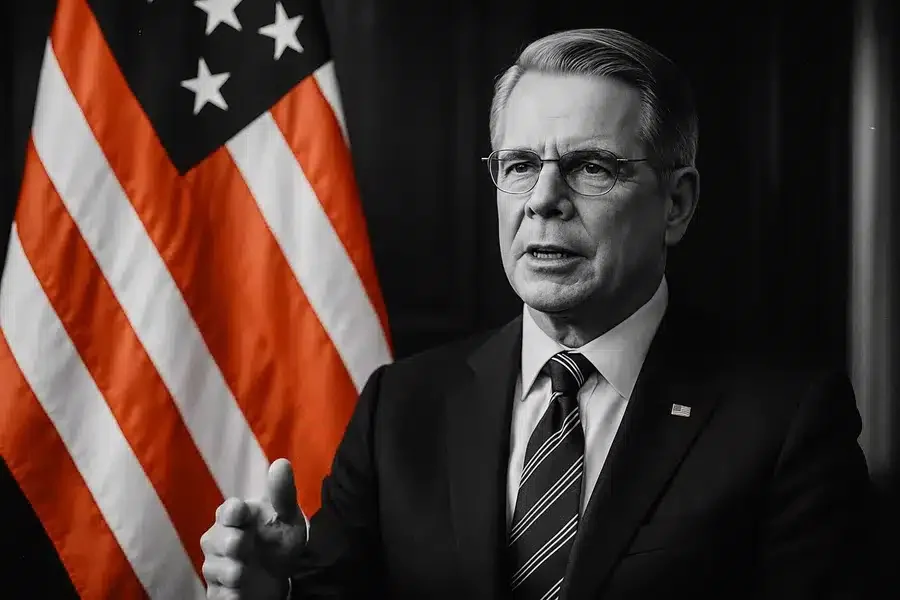
Treasury Secretary Scott Bessent said Monday the administration has no plans to intervene in oil commodities markets and lacks authority to do so, as speculation mounted about government action to curb rising energy prices.
The clarification comes as crude oil trades near $100 per barrel amid ongoing Middle East tensions, raising investor concerns about potential inflationary pressures and economic impacts.
Key Takeaways
- Bessent denies Treasury intervention in oil futures markets
- Oil prices calmed with WTI down 1.9% to $96.86
- Administration questions legal authority for market intervention
Market Context and Price Action
Oil prices retreated Monday following Bessent’s comments, with U.S. crude trading 1.9% lower at $96.86 per barrel and international benchmark Brent crude edging higher at $103.15 1. The pullback provided some relief after crude touched $100 for only the third time in the past decade, following similar spikes during Russia’s invasion of Ukraine.
Energy markets have been volatile as the conflict in Iran disrupts key shipping routes through the Strait of Hormuz, a critical chokepoint for global oil supplies.
Treasury’s Position on Market Intervention
Speaking on CNBC’s “Squawk Box,” Bessent addressed persistent market rumors about potential government intervention in oil futures markets. “That rumor’s in the market,” Bessent said during the interview 1.
“When there’s big dynamic price action, that always happens. We haven’t done that,” he added, emphasizing the administration has taken no such steps.
Legal Authority Questions
When pressed about whether such intervention was under consideration, Bessent expressed uncertainty about the government’s legal framework for such action. “I’m not sure under what authority or what auspices” the Treasury could intervene, he said 1.
The comments distinguish between traditional Strategic Petroleum Reserve releases, which presidents including Donald Trump have authorized during energy sector stress, and direct financial market intervention, which would be unprecedented.
Broader Energy Policy Context
Bessent’s remarks came during broader discussions about U.S. energy policy amid the Iran conflict. He revealed that Iranian oil tankers are being allowed through the Strait of Hormuz to help supply global markets, describing this as a temporary measure to “promote stability in global energy markets” 2.
The Treasury Secretary also disclosed that the administration provided a 30-day waiver for Russian oil already at sea, involving approximately 130 million barrels, as part of efforts to maintain market stability.
Market Implications
The denial of intervention rumors may have contributed to oil’s Monday decline, as traders had speculated about potential government action to suppress prices. Financial markets have been closely watching for any signals about unconventional policy responses to the energy crisis.
Energy sector equities have outperformed broader markets in recent weeks as oil prices surged, with investors positioning for sustained higher prices amid supply disruptions.
Not investment advice. For informational purposes only.
References
1Jeff Cox (March 16, 2026). “Bessent says Treasury is not intervening in oil commodities markets and has no authority to do so”. CNBC. Retrieved March 16, 2026.
2De Rich (March 13, 2026). “US Treasury Secretary Scott Bessent said it is a temporary measure to promote stability in global energy markets during the war”. Facebook/Onua Maakye. Retrieved March 16, 2026.
3“CNBC Transcript: U.S. Treasury Secretary Scott Bessent Speaks with CNBC’s Brian Sullivan on Squawk Box Today” (March 16, 2026). CNBC. Retrieved March 16, 2026.
4“Bessent says Treasury is not intervening in oil commodities markets and has no authority to do so” (March 16, 2026). CNBC on X. Retrieved March 16, 2026.
5“Bessent says Treasury is not intervening in oil commodities markets and has no authority to do so” (March 16, 2026). CNBC LinkedIn. Retrieved March 16, 2026.