

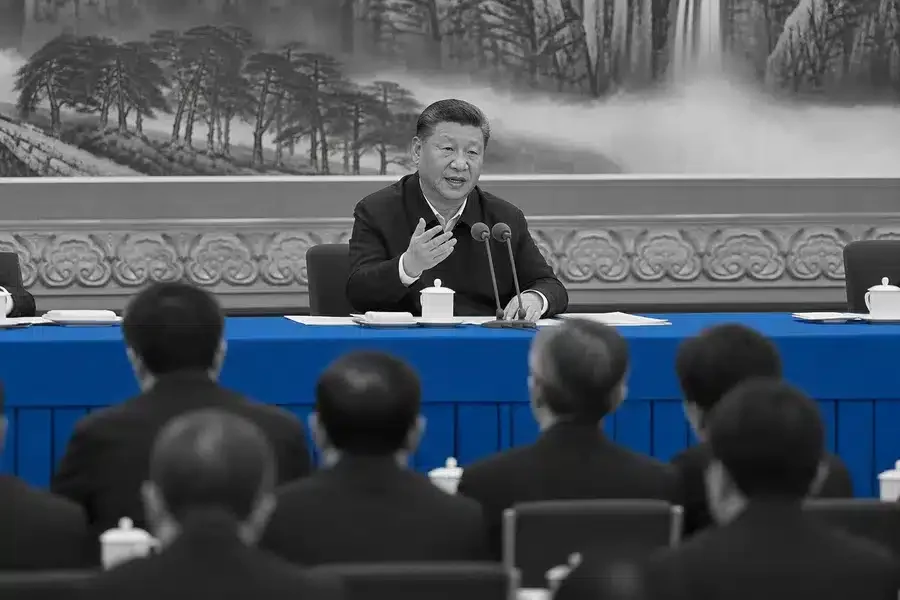
Chinese President Xi Jinping is set to address the World Artificial Intelligence Conference in Shanghai on Friday, marking Beijing’s most high-profile bid yet to shape global AI governance while Huawei debuts a flagship computing cluster designed to sidestep U.S. chip sanctions.
For long-horizon investors, the dual signal – state-level diplomatic positioning paired with a concrete hardware milestone – underscores how quickly China is building an AI ecosystem independent of Nvidia (NVDA.O), with direct implications for semiconductor market share and the global regulatory landscape that will govern AI-driven revenue streams for years.
Key Takeaways
- Xi’s WAIC debut signals AI governance as a top geopolitical priority for Beijing.
- Huawei’s Atlas 950 SuperPoD offers a sanctions-circumventing alternative to Nvidia clusters.
- U.S.-China AI governance talks loom, raising regulatory uncertainty for global tech firms.
Market Context & Hardware Stakes
Nvidia’s H100 and successor chips remain the global benchmark for large-scale AI training, but Huawei’s Atlas 950 SuperPoD – linking thousands of Ascend AI processors through high-speed interconnects to function as a unified cluster – represents the clearest challenge yet to that dominance in China’s domestic market 1. DeepSeek’s latest V4 model has already been adapted to run entirely on Huawei Ascend-based clusters, a proof-of-concept that analysts say validates the ecosystem’s readiness for frontier workloads 2.
Chinese chipmakers Biren and MetaX are also expected to unveil new “supernode” computing clusters at the July 17-20 forum, signalling that the domestic alternative-chip sector is broadening beyond a single vendor.
Governance Battle Lines
WAIC is no longer simply a technology showcase. Washington and Beijing set out starkly competing visions at a UN AI dialogue last week: the U.S. argued that sweeping regulation would stifle innovation, while Beijing framed its low-cost, open-source models as a public good capable of narrowing the global AI divide 1.
The Shanghai forum coincides with a High-Level Meeting on Global AI Governance where Beijing is expected to announce progress on its proposed World AI Cooperation Organisation (WAICO) – a body floated at last year’s WAIC that has yet to attract formal member states.
“Against this backdrop, WAIC has become more than a technology showcase; it is now a geopolitical stage where Beijing seeks to articulate its vision of AI as both a national priority and a diplomatic instrument,” said George Chen, chair of digital practice at the Asia Group 1.
The forum’s attendance list reinforces that framing: UN Secretary-General Antonio Guterres, Kazakh President Kassym-Jomart Tokayev, and Thai Prime Minister Anutin Charnvirakul will all be present, alongside nine Turing Award and Nobel laureates including deep learning pioneers Yoshua Bengio and Richard Sutton. Notably absent is significant representation from major U.S. technology firms.
Open-Source Strategy & Emerging-Market Reach
Beijing’s emphasis on open-source AI models as a low-cost alternative to proprietary Western systems is a deliberate bid for influence in the Global South, a market that incumbent U.S. platforms have been slower to penetrate at scale 1. “China has been making inroads with Southeast Asian countries in terms of AI capacity-building, and portrays itself as speaking up for developing countries who are being left behind in the AI race,” an Asian diplomat told Reuters on condition of anonymity 1.
A People’s Daily commentary published this week reinforced the official line: “The development of AI must never move toward a technological monopoly that walls itself in, but should always be anchored to the fundamental goal of serving humanity” 1.
Outlook for Investors
Xi has previously compared AI to “an epoch-making, major technological transformation following the steam engine,” and Beijing has explicitly tied future GDP growth to AI diffusion across its economy and self-sufficiency in frontier semiconductor supply chains 1. For investors with exposure to global AI infrastructure – whether through Nvidia, cloud hyperscalers, or emerging Chinese tech names – the pace at which the Huawei-led domestic stack matures will be a key variable in assessing long-term addressable market size and pricing power.
The upcoming first government-level U.S.-China AI talks under the Trump administration add a further layer of regulatory uncertainty. How those talks conclude could materially affect export-control policy and, by extension, the competitive landscape for AI chip suppliers worldwide.
Not investment advice. For informational purposes only.
References
1Laurie Chen (July 16, 2026). “China’s Xi to outline AI diplomacy vision at key Shanghai forum”. Reuters. Retrieved July 16, 2026.
2(July 16, 2026). “China’s Xi to outline AI diplomacy vision at key Shanghai forum”. AOL / Reuters. Retrieved July 16, 2026.
3Embajada de China en México (July 13, 2026). “Foreign Ministry Spokesperson Lin Jian’s Regular Press Conference on July 13, 2026”. Facebook / Chinese Embassy in Mexico. Retrieved July 16, 2026.