

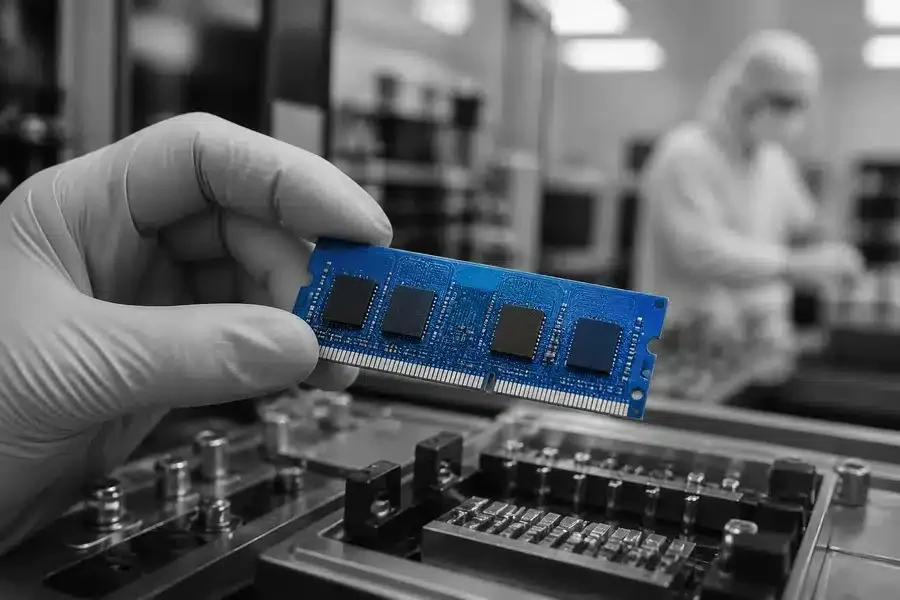
SK Hynix (000660.KS) is in exploratory talks with Intel (INTC.O) to manufacture memory chips on U.S. soil for the first time, a move that could reshape North American semiconductor supply chains and ease Intel’s financial pressure.
For long-horizon investors, the discussions signal a structural reorientation of memory chip production away from Asia – a shift that carries significant cost, regulatory, and geopolitical risk but could lock in premium U.S. demand from hyperscale cloud buyers for years.
Key Takeaways
- SK Hynix may lease Intel’s Ohio fab or form a cloud-backed joint venture.
- Seoul’s approval required if “national core technology” is involved.
- A deal would be Intel’s first major third-party tenant at its Ohio site.
Market Context & Competitive Landscape
SK Hynix is the world’s second-largest memory chipmaker and the dominant supplier of high-bandwidth memory (HBM) used in AI accelerators – a market where demand is outpacing supply. Its closest rival, Micron Technology (MU.O), has already committed to expanding U.S. fabrication capacity, and the broader memory sector is navigating a historic inflection driven by AI infrastructure investment.
An SK Hynix U.S. fab would be the first by a Korean memory maker, placing it alongside TSMC and Samsung – both of which have already broken ground on American facilities – in responding to Washington’s reshoring agenda.
What the Deal Structures Look Like
Three people familiar with the discussions told Reuters that two deal frameworks are under consideration. Under the first, SK Hynix would lease a portion of Intel’s long-delayed Ohio chipmaking complex, where production has been pushed back to 2030 and 2031 from an original 2025 target 1.
Under the second scenario, the companies could form a joint venture with major cloud providers eager to secure dedicated memory supplies – a structure that would spread capital costs and align incentives across the AI supply chain. One source described the talks as exploratory, stressing no decisions have been made.
Intel announced in 2022 that it would invest up to $100 billion in the Ohio site, potentially creating the world’s largest chipmaking complex 1. A tenancy or venture agreement with SK Hynix would inject commercial momentum into a project that has faced repeated delays and cost headwinds.
The Regulatory Fault Line: Seoul vs. Washington
Any agreement involving advanced memory – particularly HBM or leading-edge DRAM – could face opposition from the South Korean government, which classifies such technologies as sensitive under its Industrial Technology Protection Act, all three sources said 1.
South Korea’s trade ministry confirmed that any decision rests with the company but added that technologies designated as “national core” would be subject to government review. The tension reflects a broader tug-of-war: Seoul has simultaneously been urging SK Hynix and Samsung Electronics (005930.KS) to accelerate construction of a domestic chip cluster in South Korea’s southwest.
U.S. Commerce Secretary Howard Lutnick has threatened tariffs of up to 100% on South Korean and Taiwanese chipmakers unless they commit to expanded American production, adding urgency to the negotiations 1. South Korea also faces pressure to deploy an undecided $200 billion portion of a $350 billion investment commitment made to Washington in exchange for lower tariffs.
Cost Realities and Strategic Rationale
Manufacturing semiconductors in the U.S. costs substantially more than in South Korea, two sources said, citing higher labour and construction expenses and an Asian-centric supply chain that inflates import costs. Despite the economics, SK Hynix has strategic reasons to proceed.
The company completed a secondary Nasdaq listing in July 2026 and has a $4 billion chip packaging facility under construction in Indiana – establishing a U.S. operational footprint that a full fab would extend 1. SK Group Chairman Chey Tae-won said in July that the company faces “enormous pressure and lobbying from customers and countries to supply more chips,” adding:
“I think we need to build a factory in the United States. If possible, I believe we should build it.”
Outlook
SK Hynix said in a statement that it is “reviewing various measures, including establishing additional production bases, to strengthen the competitiveness of its memory business,” but that “no matters have been determined at this stage” 1. Intel declined to comment on what it called speculation, though it confirmed ongoing Ohio site investments.
The type of chips SK Hynix might produce in Ohio – whether commodity DRAM, NAND flash, or strategically sensitive HBM – remains undisclosed, a detail that will likely determine whether Seoul grants approval and how U.S. officials respond. For investors tracking memory supply chains, the outcome of these talks could define the competitive and cost structure of the North American AI infrastructure build-out for the rest of the decade.
Not investment advice. For informational purposes only.
References
1Yang, H., Jin, H., Alper, A., and Nellis, S. (September 16, 2026). “SK Hynix in talks with Intel about deal to make memory chips in the US for the first time, sources say”. Reuters. Retrieved September 16, 2026.