


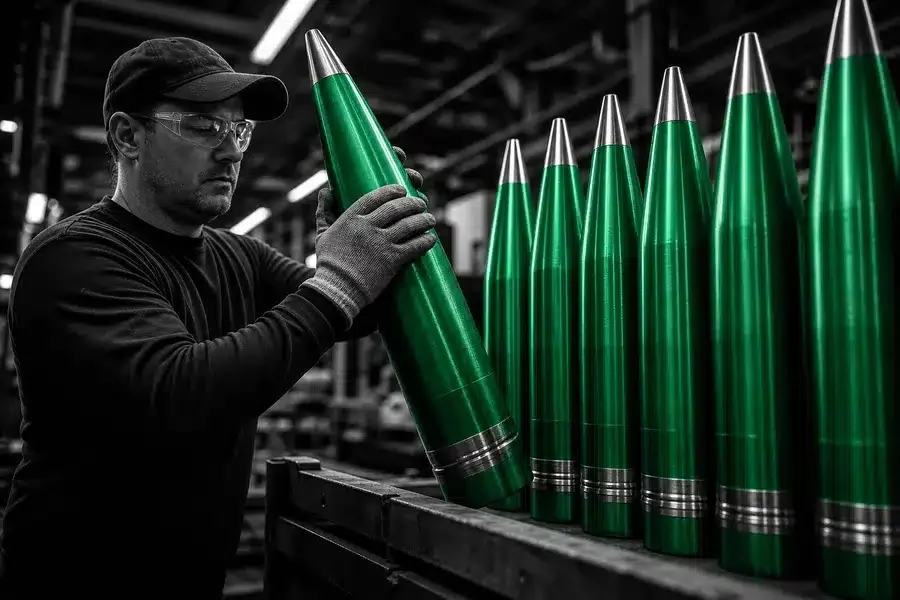
President Trump invoked the Defense Production Act on June 11 to address critical capacity constraints in U.S. munitions supply chains, a move that could accelerate procurement contracts for defense manufacturers supplying solid rocket motors, igniters, and guidance systems.
For long-horizon investors holding positions in the defense industrial base, the directive signals sustained government demand pressure on a supply chain already strained by years of underinvestment – a dynamic that historically translates into multi-year contract backlogs and improved pricing power for tier-one and tier-two suppliers.
Key Takeaways
- Trump signed DPA memo June 11, made public June 16.
- Solid rocket motors and guidance systems identified as most constrained.
- Pentagon delegated authority to seek voluntary industry agreements.
Market Reaction & Context
The June 16 disclosure arrives as Washington escalates pressure on weapons manufacturers to close the gap between order books and actual production throughput – a concern sharpened by U.S. munitions drawdowns linked to the ongoing conflict with Iran 1. Major defense primes such as RTX, LMT, and NOC have flagged solid rocket motor lead times and guidance component shortages in recent earnings calls, making this DPA invocation a direct policy response to constraints that are already showing up in quarterly guidance.
The Trump administration has now invoked the DPA multiple times in 2026, having previously used it five times on a single day in April to designate fossil-fuel infrastructure as defense-critical – a breadth of application that Rice University’s Baker Institute described as a significant departure from historical norms 2. The munitions-focused memo represents a narrower, operationally specific use of the same authority.
Detailed Analysis
The June 11 memorandum – addressed to the Secretary of Defense – cites “limited production capacity, fragile supply chains, long-lead dependencies, and related production bottlenecks” as the triggering conditions 1. Under the Defense Production Act’s Title VII provisions, the authority delegated to the Pentagon allows it to enter voluntary agreements with private industry rather than issue compulsory production orders – a distinction that limits legal risk but also caps coercive leverage.
Solid rocket motors are a particularly acute chokepoint: they feed into a wide array of legacy systems as well as next-generation precision munitions, meaning the bottleneck cuts across both near-term replenishment requirements and longer-term modernization programs. Guidance systems – increasingly software-defined but still reliant on specialized hardware – face similar lead-time pressures that voluntary agreements alone may not resolve quickly.
The Pentagon already exercises DPA authority approximately 300,000 times per year for routine military procurement prioritization 2. This memo’s public character, however, signals that the administration views the current shortfall as sufficiently acute to warrant a visible policy signal to markets and industry partners.
Outlook & Management Quote
Trump said directly in the memorandum:
“I hereby find that conditions exist which may pose a direct threat to the national defense or its preparedness programs.”
That presidential determination is the legal prerequisite for DPA Title VII voluntary agreements, and its formal invocation opens a pathway for Pentagon officials to convene industry working groups without the usual antitrust constraints on competitor coordination. Whether voluntary frameworks produce measurable throughput gains within investor-relevant timeframes – typically one to three years – remains the key uncertainty, as the Baker Institute noted that DPA tools “work most effectively when they are operationally specific, tied to clear production targets, and backed by accountability structures.” 2
Conclusion
For investors with long time horizons in defense supply-chain equities, the DPA invocation reinforces a structural theme: government demand is outpacing industrial capacity, and policy tools are now being deployed to close that gap. The critical watch items are whether voluntary agreements produce binding production commitments, and how quickly tier-two suppliers – particularly those in solid rocket motor propellant and guidance electronics – can ramp capacity without proportional cost inflation that compresses program margins.
Not investment advice. For informational purposes only.
References
1Jones, Ryan Patrick; Stone, Mike; Chiacu, Doina (June 16, 2026). “Trump invokes Defense Production Act for munitions, supply chains”. Reuters via Yahoo News. Retrieved June 16, 2026.
2Arrington, Gabe (May 14, 2026). “The Defense Production Act’s Expanding Role in Energy”. Rice University Baker Institute for Public Policy. Retrieved June 16, 2026.
3(April 20, 2026). “Presidential Determination Pursuant to Section 303 of the Defense Production Act of 1950, as Amended, on Grid Infrastructure, Equipment, and Supply Chain Capacity”. The White House. Retrieved June 16, 2026.
4Denean, Austin (March 16, 2026). “Trump invokes Defense Production Act as war with Iran disrupts oil markets”. Fox Baltimore / The National News Desk. Retrieved June 16, 2026.