

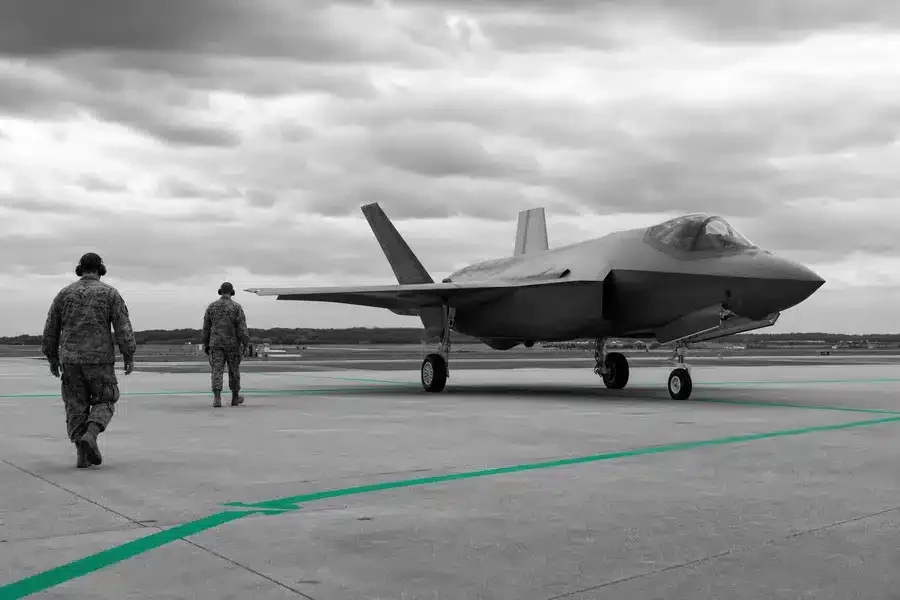
President Donald Trump said Tuesday he would lift sanctions on Turkey and actively consider selling Ankara F-35 fighter jets, a move that reshapes the U.S.-Turkey defense relationship and carries direct implications for Lockheed Martin (LMT) and the broader aerospace supply chain.
A formal F-35 sale to Turkey – the world’s second-largest NATO army by personnel – would represent one of the largest potential single-country additions to the program’s order book in years, with per-unit costs running roughly $80 million to $110 million depending on variant, making the revenue implications material for prime contractor Lockheed Martin and its tier-one suppliers.
Key Takeaways
- Trump to lift CAATSA sanctions tied to Turkey’s Russian S-400 purchase.
- F-35 sale under consideration despite existing congressional ban.
- Decision could unlock a multi-billion-dollar defense procurement pipeline.
Market Reaction & Context
Lockheed Martin (LMT), the sole manufacturer of the F-35, has seen its shares broadly track U.S. defense-spending headlines in 2026; the stock gained roughly 12% year-to-date through early July, outpacing the S&P 500 Aerospace & Defense sub-index. Any confirmed Turkish re-entry into the F-35 program would expand the program’s total addressable customer base, potentially adding several dozen airframes to the production queue over a multi-year period. 1
Turkey was originally a program partner and production participant but was formally removed in 2019 after Ankara purchased Russia’s S-400 surface-to-air missile system, triggering sanctions under the Countering America’s Adversaries Through Sanctions Act (CAATSA). That exclusion disrupted Turkish aerospace firms that had supplied components to the program, and a reversal would reopen those subcontracting relationships.
Detailed Analysis
Trump made the remarks at the opening of a bilateral meeting with Turkish President Recep Tayyip Erdogan on the sidelines of the NATO summit in Ankara on July 7, 2026. 2 He said the U.S. would “certainly” consider readmitting Turkey to the F-35 program, characterizing Ankara as having been more “loyal” than many other allies. 3
The path to an actual sale, however, faces a significant legislative hurdle: Congress imposed a statutory ban on F-35 transfers to Turkey specifically because of the S-400 acquisition, and executive action alone may not be sufficient to override that prohibition. Legal analysts have noted that lifting CAATSA sanctions is within presidential discretionary authority, but greenlighting the jet sale would likely require congressional action or a national-security waiver – neither of which is guaranteed. 1
The New York Times reported ahead of the summit that Trump was expected to signal readiness to restore Turkey’s access to the program, citing the S-400 issue as the central sticking point that Washington would need to resolve. 4 Turkey has not indicated it plans to return or decommission the Russian system, a condition some U.S. lawmakers have said is non-negotiable.
Outlook & Management Quote
Trump said directly at the bilateral session that Turkey had proven its reliability within the alliance, language that previews the diplomatic framing the administration is likely to use to push the sale through Washington.
“We will certainly give it consideration,” Trump said of the F-35 question, according to pool reports from the Ankara meeting. 2
For long-horizon investors monitoring Lockheed Martin’s forward production rates and margin trajectory, the key variable is timing: even if political obstacles are cleared, integrating a new customer into the F-35 supply chain and certification process typically spans 18 to 36 months before deliveries begin, meaning near-term earnings impact would be limited while backlog metrics could improve sooner.
Conclusion
Trump’s dual signals – sanctions relief and a potential F-35 opening – mark the most significant warming in U.S.-Turkey defense relations since Ankara’s S-400 purchase fractured the relationship in 2019. The durability of any deal will depend on whether the administration can navigate the congressional ban and whether Turkey makes any concessions on the Russian missile system. Investors in defense primes and their Tier-1 suppliers should monitor both the legislative calendar and any formal foreign military sales notification filings with Congress, which would be the earliest visible indicator that a transaction is advancing.
Not investment advice. For informational purposes only.
References
1Choi, Hannah (July 7, 2026). “Trump considering selling F-35 fighter jets to Turkey and plans to lift sanctions”. CNN. Retrieved July 7, 2026.
2(July 7, 2026). “Trump Says He’ll Consider Selling F-35s to Turkey”. Bloomberg Television via YouTube. Retrieved July 7, 2026.
3(July 7, 2026). “WATCH: Trump says in Erdogan meeting that U.S. will lift Turkey sanctions, consider selling F-35s”. PBS NewsHour via YouTube. Retrieved July 7, 2026.
4(July 6, 2026). “Trump Expected to Tell Turkey He Is Ready to Restore Access to F-35 Jets”. The New York Times. Retrieved July 7, 2026.