


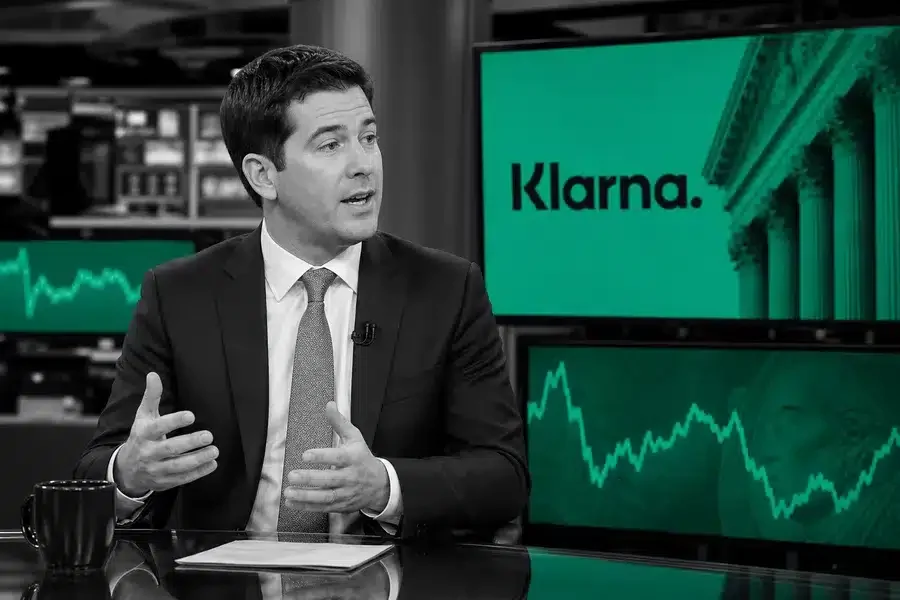
Klarna (NYSE: KLAR) filed for an FDIC-insured Utah bank charter on Monday, a move that could fundamentally reshape the Swedish fintech’s U.S. cost structure and long-term margin profile by replacing expensive wholesale funding with cheaper customer deposits.
For long-horizon investors, the application marks a potential inflection point: a successful charter would allow Klarna to internalize funding costs, expand into higher-margin banking products, and reduce its reliance on third-party partner banks – changes that could materially improve unit economics over time.1
Key Takeaways
- Klarna applied to Utah regulators and the FDIC for its own U.S. bank subsidiary.
- A charter would let Klarna fund loans with deposits, cutting wholesale borrowing costs.
- KLAR shares trade near half their $40 IPO price, set in September 2025.
Market Context & Stock Performance
Shares of Klarna rose approximately 1.75% on Monday following the disclosure, trading around $20 – roughly half the $40-per-share IPO price at which the company debuted on the New York Stock Exchange in September 2025.1 The muted longer-term performance reflects broader investor skepticism about buy now, pay later valuations, though the charter news positions KLAR alongside a small cohort of fintechs pursuing deeper regulatory integration.
Fintech peer Mercury received conditional approval to establish its own bank earlier this year, highlighting a sector-wide pivot away from the partner-bank model.1 Owning a charter is increasingly viewed as a structural competitive advantage in a landscape where reliance on third-party banks introduces both cost drag and operational fragility.
What the Charter Would Actually Change
The proposed entity, to be called Klarna Bank USA, would operate as a wholly owned subsidiary chartered under Utah’s industrial bank framework – the same structure used by other fintech-affiliated depositories.2 If approved by both the Utah Department of Financial Institutions and the FDIC, Klarna could accept insured deposits, use them to fund its installment loans and credit products, and bring payments and merchant services infrastructure in-house.
That last point matters for margin durability. Currently, Klarna routes U.S. deposits through partner WebBank – an arrangement that became visible last month when the company launched high-yield savings accounts for U.S. customers using WebBank as the holding institution.1 Internalizing those deposits would eliminate a layer of intermediary cost and give Klarna direct control over the customer relationship.
Management Quote & Strategic Framing
“We’ve seen firsthand the appetite for a fairer, more transparent approach in the U.S., and our own banking license is the natural next step,” said Sebastian Siemiatkowski, co-founder and chief executive of Klarna.
Siemiatkowski said the charter would give U.S. customers tools to “borrow responsibly and build financial confidence,” while introducing more competition and choice to the market.1 The company named Gary Harding – former chief executive of Milestone Bank and Prime Alliance Bank – as president and CEO of Klarna Bank USA.2
Risks and Timeline
Bank charter applications are lengthy and uncertain; approval timelines typically stretch 12 to 24 months and are subject to regulatory discretion.1 Klarna must demonstrate adequate capital, a credible management team, and compliance infrastructure before regulators will grant a final license.
Rejection or prolonged delay would leave the company dependent on its current partner-bank arrangements, capping the margin improvement thesis that underpins part of the bull case for KLAR at current prices. Investors should weigh the application as a long-dated option on structural cost reduction, not a near-term earnings catalyst.
Conclusion
Klarna’s Utah bank charter filing is less a product announcement than a balance-sheet strategy: if regulators approve, the company gains a deposit-funded cost of capital that could underpin sustainable profitability across payments, lending, and merchant services at scale. The path from application to operational bank remains long and uncertain, but the direction of travel – away from partner dependency and toward a vertically integrated financial platform – is now explicit.1
Not investment advice. For informational purposes only.
References
1Hugh Son (July 6, 2026). “Klarna seeks U.S. bank charter in latest push beyond buy now, pay later”. CNBC. Retrieved July 6, 2026.
2Moz Farooque ACCA (July 6, 2026). “Klarna seeks U.S. bank charter in Utah”. Yahoo Finance / GuruFocus. Retrieved July 6, 2026.