

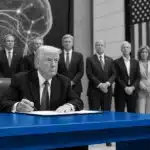

President Donald Trump said Saturday he will create an “AI Force” and appoint a new AI czar, signalling a pro-growth federal posture that could reduce regulatory headwinds for publicly traded AI infrastructure and software companies.
For long-horizon investors, the key question is whether a dedicated federal AI body accelerates government contract spending on AI platforms-a market that consultancy IDC has forecast could exceed $300 billion annually by 2028-or whether the absence of enforceable safety rules introduces liability uncertainty that weighs on enterprise adoption.
Key Takeaways
- Trump pledges “AI Force” and a new AI czar with no timeline given.
- White House opposes new federal AI rules; favors existing legal frameworks.
- Announcement precedes Trump-Xi summit Thursday; US-China AI rivalry intensifies.
Market Reaction & Context
Trump’s social media post landed on a Saturday, limiting immediate price discovery, though AI-adjacent names including Nvidia (NVDA.O), Palantir (PLTR.N) and Microsoft (MSFT.O) had already outperformed the S&P 500 by a wide margin in 2026 amid sustained enterprise demand. 1 The administration’s consistent anti-regulation stance has been cited by analysts as a structural positive for US hyperscalers competing against Chinese rivals such as Huawei and Baidu.
Trump’s post follows his September 14 remarks in which he downplayed concerns about AI data centers, arguing that fears amounted to what he called a “sick conspiracy” against the industry. 1 That rhetoric has kept Washington from advancing the kind of mandatory disclosure or model-audit rules seen in the European Union’s AI Act.
Detailed Analysis
The proposed “AI Force” appears modelled on Space Force, which Trump created during his first term as a dedicated military branch. 2 No legislative framework, budget figure, or organisational chart has been released, meaning the initiative remains aspirational at this stage.
If Trump follows through, it would be his second AI czar appointment. Venture capitalist David Sacks previously held the role before stepping down in spring 2026 and moving to an external advisory position. 1 Sacks said at a Politico event on September 16 that AI developers should bear responsibility for product safety and that new federal rules are unnecessary-a view that aligns closely with the White House position. 1
Safety advocates counter that self-regulation is insufficient. Earlier this month, former Anthropic researcher Jacob Coxon said that “people building AI earnestly believe that it could kill us all by the end of the decade,” a statement that sharpened the debate in Washington over whether existing civil and criminal statutes are adequate guardrails. 1
Trump addressed that concern directly on Truth Social, writing:
“We will not in any way hinder or stifle the Growth of this incredible Industry. Rather, we will cherish it, help it, and watch over it, as it grows! However, we will also be looking for BAD, and we can do that, very easily, with our already existing Criminal and Civil Justice System.”
Geopolitical Backdrop
The announcement carries strategic weight ahead of Trump’s scheduled meeting with Chinese President Xi Jinping on Thursday, as both governments view AI supremacy as central to economic and military competitiveness. 1 Separately, Treasury Secretary Scott Bessent was set to meet Chinese Vice Premier He Lifeng at JPMorgan Chase (JPM.N) headquarters in New York on Sunday to discuss AI security alongside trade and critical-minerals issues. 1
Investors tracking defence-adjacent AI plays-contractors building autonomous systems, surveillance infrastructure, and battlefield analytics-may view a formalised “AI Force” as a potential procurement catalyst, though no funding commitments have been made public.
Outlook
The White House did not immediately respond to a request for comment on Trump’s post, leaving structural details unresolved. 1 Until a czar is named and an organisational mandate is published, the announcement functions primarily as a policy signal rather than an actionable regulatory development.
Long-horizon investors should monitor whether the forthcoming czar appointment brings any clarity on government AI procurement priorities or modifies the administration’s position on export controls-the one area where Washington has already moved to restrict China’s access to advanced semiconductors.
Not investment advice. For informational purposes only.
References
1Reuters (September 19, 2026). “Trump says he will appoint a new AI adviser, without providing details”. Reuters. Retrieved September 20, 2026.
2CNN Newsource Staff (September 20, 2026). “Trump vows to create ‘AI Force’ and appoint AI czar”. WAFB / CNN Newsource. Retrieved September 20, 2026.