


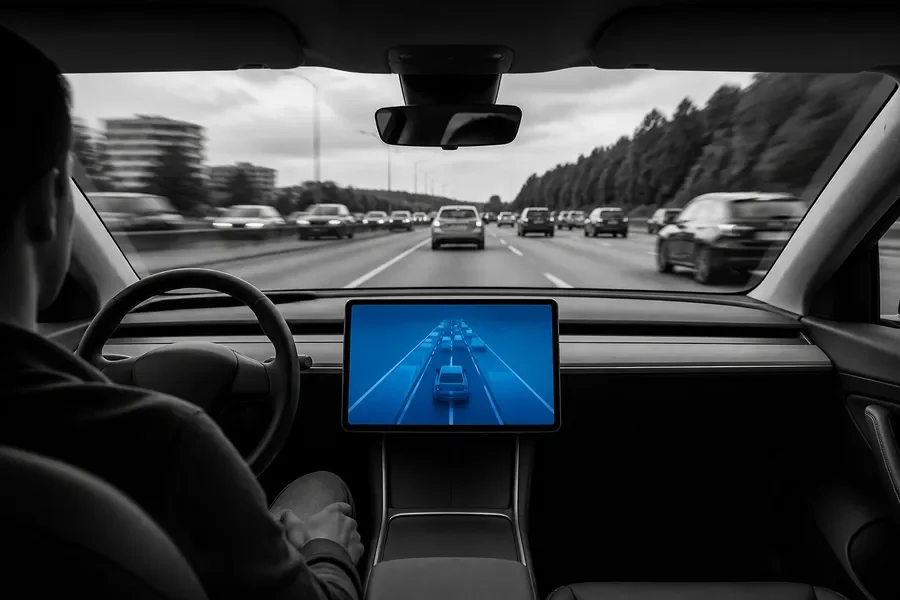
A US appeals court on Friday blocked California Tesla (TSLA.O) customers from pursuing class action claims over alleged Full Self-Driving misrepresentation, removing a potentially costly litigation overhang for the EV maker.
The ruling materially reduces Tesla’s near-term legal liability exposure tied to its autonomous driving revenue story – a segment that long-horizon investors have flagged as central to the company’s premium valuation thesis.
Key Takeaways
- Appeals court overturns order permitting California FSD class action.
- Ruling removes a major consolidated litigation risk for TSLA.
- FSD monetisation remains critical to Tesla’s long-term margin story.
Market Reaction & Context
The decision arrived as Tesla shares have underperformed the broader Nasdaq Composite over the past 12 months amid investor scrutiny of its autonomous driving timeline and competitive pressure from rivals including Waymo and General Motors’ Cruise unit. 1
For a company whose market capitalisation still commands a significant premium over traditional automakers, litigation risk tied to FSD claims has been a persistent drag on sentiment. Eliminating the class-action pathway – at least at this stage – removes one variable that analysts had flagged as capable of yielding substantial damages awards.
Detailed Analysis
The US appeals court vacated a lower court order that had certified a class of California customers alleging Tesla misled them about FSD’s capabilities. 1 Class certification is a critical procedural threshold: without it, plaintiffs must sue individually, dramatically reducing the financial and reputational pressure on a defendant.
Tesla has long marketed Full Self-Driving as a premium software subscription, currently priced in the hundreds of dollars per month, and has positioned the technology as a future profit engine through robotaxi deployment. Any finding of systematic misrepresentation could have forced refunds or pricing adjustments at scale, directly compressing that margin lever.
The allegations centred on whether Tesla overstated how close FSD was to delivering genuine autonomous capability. Critics and some plaintiffs have argued that the “Full Self-Driving” label itself constitutes a misleading claim, given that the software still requires active driver supervision. This autonomous revenue risk framing has repeatedly surfaced in regulatory and investor discussions about Tesla’s growth narrative.
By blocking the class mechanism, the appeals court does not necessarily resolve the underlying legal questions about Tesla’s marketing language – it simply forces any future challenges to proceed on an individual, case-by-case basis, which is far less economically viable for plaintiffs’ attorneys.
Outlook & Management Quote
Tesla has consistently defended FSD’s marketing as accurate and forward-looking, arguing that customers were informed the technology remained in a supervised, beta state. The company has not issued a fresh public comment on Friday’s ruling, per available sources.
Analysts have noted that a favourable litigation environment could give Tesla more latitude to continue aggressive FSD pricing and expansion, reinforcing its software-and-services margin trajectory as vehicle sales growth moderates in key markets.
Conclusion
Friday’s ruling is a meaningful procedural win for Tesla, narrowing the legal surface area around its most strategically important product line. For investors with a long horizon, the key question shifts back to execution: whether FSD can achieve the capability milestones needed to justify its role as a recurring, high-margin revenue stream – independent of what the courts ultimately decide about past marketing claims.
Not investment advice. For informational purposes only.
References
1(2026, October 16). “US appeals court blocks class actions over Tesla’s self-driving claims”. Reuters. Retrieved October 16, 2026.