


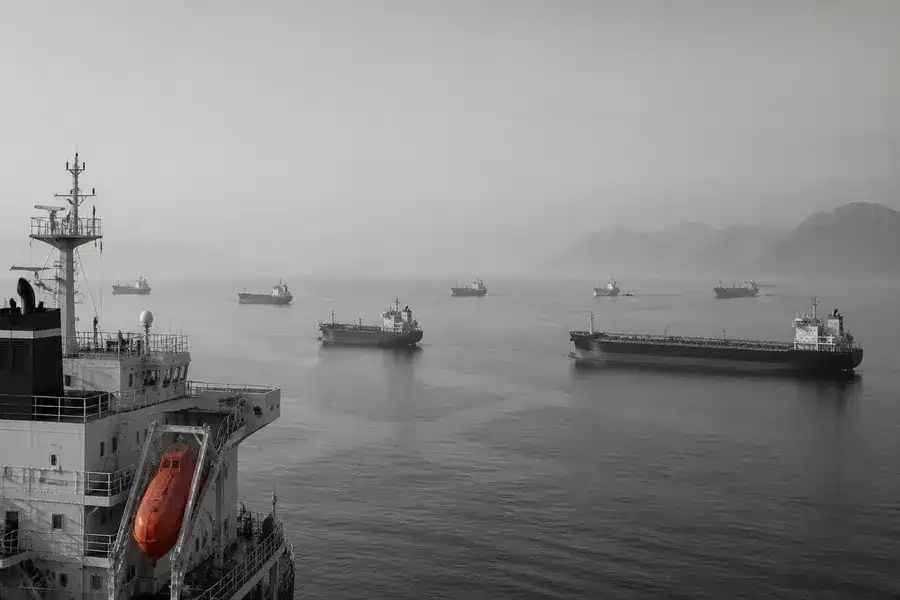
Iran’s Persian Gulf Strait Authority flatly rejected U.S. claims of dominance over the Strait of Hormuz on Wednesday, as vessel transits fell to near three-month lows – a gap between rhetoric and reality that carries direct consequences for global energy supply chains.
With roughly 20% of the world’s seaborne oil historically flowing through the strait, long-horizon investors in energy, shipping, and refining sectors face an increasingly murky timeline for any supply normalisation.
Key Takeaways
- Daily ship transits through Hormuz down ~90% from pre-war levels.
- Iran and U.S. both claim control; peace talks remain stalled.
- Iran demands sanctions relief, troop withdrawal, and war reparations.
Market Context: Traffic Data Tells a Different Story
Vessel transits through the Strait of Hormuz averaged roughly 13 per day on a five-day rolling basis as of Tuesday, Aug. 12 – nearly the lowest reading since May 12, according to trade intelligence firm Kpler data cited by CNBC 1. That figure represents a roughly 90% collapse from the pre-war daily average of approximately 130 ships, which included oil tankers, cargo vessels, and bulk carriers.
Al Jazeera separately reported that just eight ships transited the strait on Tuesday alone, below the prior ten-day average of around 12 2. For investors tracking energy portfolio risk in the region, the critical exposure through the Hormuz chokepoint shows no sign of easing near term.
Competing Claims, Stalled Diplomacy
President Donald Trump said on Truth Social that “The U.S.A. has total control over the Strait of Hormuz. I THINK WE WILL KEEP IT!” – a claim he had also made to reporters a day earlier 2. Iran’s Persian Gulf Strait Authority responded directly, saying in a post on X:
“Claims and repeated posts by U.S. officials that the Strait of Hormuz is no longer blocked do not change the reality: the Strait of Hormuz remains blocked and will not be reopened until Iran’s conditions are accepted.” 1
Iran’s Supreme National Security Council has outlined sweeping terms for reopening the waterway, including an end to the U.S. naval blockade, full sanctions relief, American troop withdrawals, and war reparations 1. Washington, for its part, has also demanded reparations from Tehran, leaving both sides effectively deadlocked.
Peace Process Under Strain
A Memorandum of Understanding signed in June between the U.S. and Iran collapsed in mid-July, with both sides resuming attacks shortly after 2. Broader peace talks have largely been paused as Iran pursues separate negotiations with Oman over future management of the strait – talks that explicitly exclude Washington 2.
Pakistan said Wednesday it was working to bring both parties back to the negotiating table, with its deputy prime minister having held talks with officials from Iran, Saudi Arabia, and Kuwait on Aug. 10 2. The Trump administration has continued to signal interest in an off-ramp, analysts say, partly due to the conflict’s political unpopularity ahead of U.S. midterm elections in November.
Analyst Pushback on Official Data
U.S. Energy Secretary Chris Wright said Tuesday that the seven-day average for oil leaving Hormuz was “up to almost 9 million barrels per day,” suggesting fossil fuel deliveries were approaching pre-war levels 2. That figure drew sharp pushback from independent analysts.
Brett Erickson, an analyst at Obsidian Risk Advisors, said on X there is “zero evidence that 9Mbpd is exiting the Strait of Hormuz per day – zero, not ‘maybe’, not ‘potentially.'” 2 Dennis Citrinowicz, a senior researcher at the Institute for National Security Studies, separately warned that “the United States does not control the Strait of Hormuz,” adding that Iran “retains sufficient capabilities to disrupt maritime traffic through the strait.” 2
Iran’s Strategic Calculus
Mohammad Reza Naqdi, a top advisor to the IRGC commander, told PBS on Tuesday that “victory is on our side” and characterised U.S. military operations as “a war without a strategy,” noting shifting American objectives throughout the conflict 1. When asked whether Iran planned to drag the conflict out until Trump leaves office, Naqdi said the goal was for Iran to “attain deterrence.” 1
That framing – attrition over resolution – suggests investors should not price in a swift reopening. Prior analysis of how Trump’s Iran posture reshapes crude valuations illustrates how prolonged ambiguity in the strait continues to distort energy pricing models.
Conclusion
With ship traffic at multi-month lows, peace talks sidelined, and both governments hardening public positions, the Strait of Hormuz remains a live variable in global energy supply calculations. Investors with exposure to oil producers, tanker operators, or refining margins dependent on Persian Gulf flows should monitor Kpler transit data and any movement in the Iran-Oman talks as the clearest near-term signals of when – or whether – normalisation begins.
Not investment advice. For informational purposes only.
References
1Spencer Kimball and Deena Zaidi (2026-08-13). “‘Hormuz remains blocked’: Iran disputes Trump claims as traffic sinks to near 3-month lows”. CNBC. Retrieved 2026-08-13.
2Al Jazeera Staff (2026-08-12). “As Strait of Hormuz transit drops, Trump again says US has ‘control'”. Al Jazeera. Retrieved 2026-08-13.