

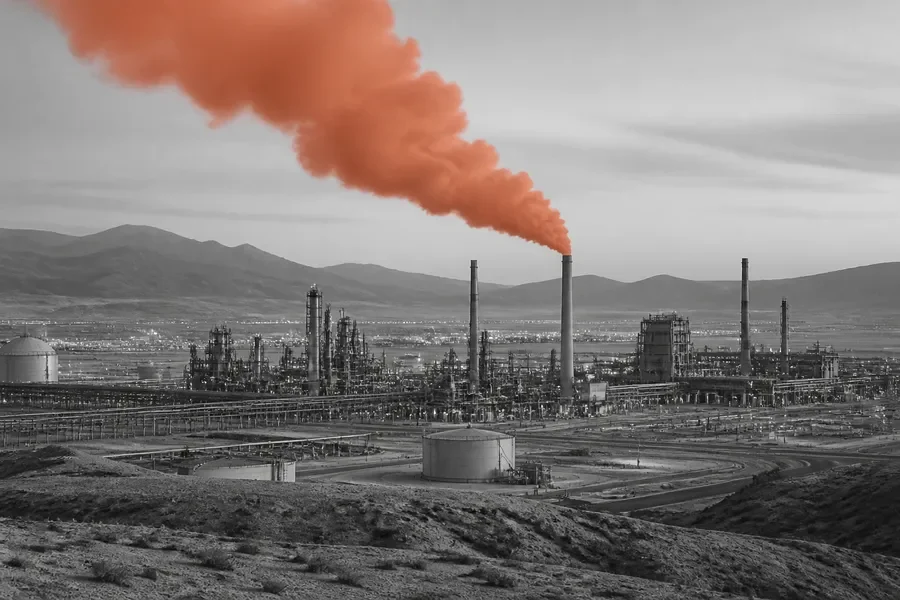
Oil prices climbed Monday after Yemen’s Houthi rebels launched ballistic missiles and drones at Saudi Aramco facilities near Riyadh and the Khurais field, stoking fresh fears over the stability of the world’s largest crude exporter.
For long-horizon investors, the attack underscores a persistent geopolitical premium baked into global energy supply chains – one that can compress refining margins, inflate input costs across sectors, and test the durability of output commitments from the Gulf’s anchor producer.
Key Takeaways
- Houthis targeted Saudi Aramco sites in Riyadh and Khurais field.
- Oil prices rose Monday on supply-disruption concerns.
- Saudi Arabia remains the region’s top crude exporter.
Market Reaction & Context
Crude benchmarks moved higher at the Asian open as traders priced in the risk of production disruption at Saudi Aramco, the state-owned giant that accounts for a dominant share of global oil supply. The move extended a pattern of geopolitical risk spikes that have periodically lifted Brent crude well above its fundamental equilibrium over the past two years – a dynamic explored in earlier coverage of Iran sanctions escalating crude price tensions.1
The Khurais oil field, one of Saudi Arabia’s largest producing assets, processes hundreds of thousands of barrels per day, making any confirmed damage there a material supply event rather than a symbolic one. Aramco shares were not immediately available for Monday trading commentary, but the company’s output capacity is closely watched as a ceiling on global spare capacity.
Detailed Analysis
The Houthi movement, backed by Iran, said the operation involved both ballistic missiles and drone munitions – a combination that complicates air-defence responses and signals a qualitative escalation in the group’s strike capabilities. This follows a broader pattern of Houthi military action targeting energy and maritime infrastructure, including the Houthi port seizure that earlier threatened oil supply stability in the Red Sea corridor.1
Aramco’s Khurais complex has been a target before – a 2019 attack temporarily knocked out roughly five percent of global oil supply, an episode that remains the benchmark for assessing worst-case disruption scenarios. Whether Monday’s strike caused comparable damage had not been confirmed by Saudi officials at the time of publication.
For investors tracking energy equities, the key variable is not the price spike itself but how quickly Aramco’s redundant infrastructure absorbs any damage. Saudi Arabia has historically restored capacity faster than markets initially priced, tempering the long-run earnings impact on downstream consumers but sustaining a structural risk premium for upstream producers.
Outlook & Analyst Commentary
Analysts note that repeated infrastructure targeting by Houthi forces, even without confirmed major damage, gradually erodes confidence in the reliability of Gulf supply – a concern that feeds directly into capital allocation decisions for energy majors and their long-term offtake agreements.
“Raising concerns about production at the top exporter in the region,” Reuters reported, capturing the market’s core anxiety even before damage assessments were completed.1
The episode also adds pressure on OPEC+ cohesion, as any unplanned Saudi output reduction would interact unpredictably with the group’s existing production management framework, potentially forcing accelerated quota adjustments among member states.
Conclusion
Monday’s oil price move reflects a market that is increasingly pricing geopolitical tail risk as a semi-permanent feature of Gulf supply rather than an isolated shock. Long-horizon investors should monitor official Saudi damage assessments and any Aramco production guidance updates as the clearest signal of whether this event carries lasting earnings implications for the global energy complex.
Not investment advice. For informational purposes only.
References
1(2026-10-04). “Oil climbs after Yemeni Houthis attack Saudi Aramco sites”. Reuters. Retrieved October 4, 2026.