


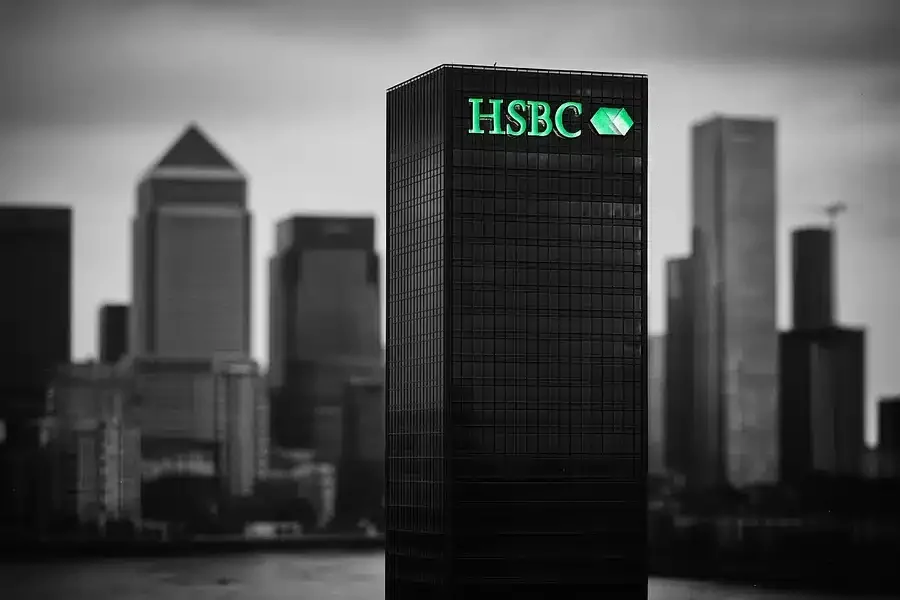
HSBC Holdings (HSBC.L) has largely finished reviewing its lending protocols after establishing a $400 million fraud provision that sent shares tumbling 6% on Tuesday 1.
This unforeseen charge underscores mounting risks within the $3.5 trillion private credit sector and prompts concerns regarding banks’ vulnerability to complex lending arrangements.
Key Takeaways
- HSBC established $400 million provision for UK fraud exposure
- Bank finalized thorough lending policy review after incident
- Fraud connected to failed mortgage lender Market Financial Solutions
Market Reaction & Context
HSBC’s stock plummeted 6% during London trading following the bank’s provision disclosure in its first-quarter earnings announcement 1. This decline exceeded the broader FTSE 100’s minimal fluctuations, demonstrating investor unease regarding the bank’s risk oversight.
At Friday’s annual meeting, Chairman Brendan Nelson informed shareholders that the bank had scrutinized comparable facilities but determined the fraud was an isolated incident rather than widespread 1. The provision related to Market Financial Solutions, a British mortgage lender that failed earlier this year under accusations of double-pledging collateral 2.
Fraud Details & Exposure
The $400 million charge originates from HSBC’s involvement in what sources characterized as a “fraud-related, secondary securitisation exposure with a financial sponsor in the UK” 2. Market Financial Solutions, which offered short-term property purchase financing, secured funding from private-credit funds and banks prior to its failure.
HSBC’s involvement occurred through financing to Apollo Global Management’s Atlas SP Partners, which had assumed MFS assets when Apollo purchased Credit Suisse’s asset-backed lending unit 2. Atlas’s complete MFS exposure totaled approximately $540 million, per company disclosures.
Management Response & Outlook
Nelson stressed that recovery efforts continue and the bank has not yet recorded an actual loss.
“We haven’t booked a loss yet, at the moment it is just a provision, there is a long way to go before we determine the actual amount lost,” Nelson said 1.
The bank revealed its overall private credit exposure totals $22 billion, comprising 2% of its lending portfolio, with $3 billion tied to securitization financing resembling the MFS arrangement 2. HSBC indicated it would enhance due diligence processes following this event.
Industry Implications
This fraud case illuminates wider apprehensions about banks’ indirect participation in the expanding private credit marketplace. Regulators have heightened oversight of this sector after prominent losses and transparency questions.
HSBC’s situation illustrates how conventional banks maintain connections to private credit through lending arrangements, despite regulations steering them from direct risky lending post-2008 financial crisis. This incident compounds similar issues experienced by other institutions, including Barclays, which wrote off roughly $300 million in MFS exposure 2.
Financial Performance Context
Notwithstanding the provision, HSBC posted first-quarter net profit remaining essentially unchanged at $6.94 billion, though falling short of analyst projections of $7.02 billion 2. The bank additionally established a $300 million provision concerning Middle East conflict uncertainty.
The fraud charge constitutes a substantial yet manageable impact for HSBC, which continues implementing extensive organizational modifications while preserving strong market positions in Hong Kong and UK wealth management.
Not investment advice. For informational purposes only.
References
1Lawrence White (2026-05-08). “HSBC has reviewed lending policies after $400 million fraud provision, chairman says”. Reuters. Retrieved May 8, 2026.
2Joe Wallace and Margot Patrick (2026-05-05). “HSBC Takes $400 Million Hit From Private-Credit Alleged Fraud”. The Wall Street Journal. Retrieved May 8, 2026.