


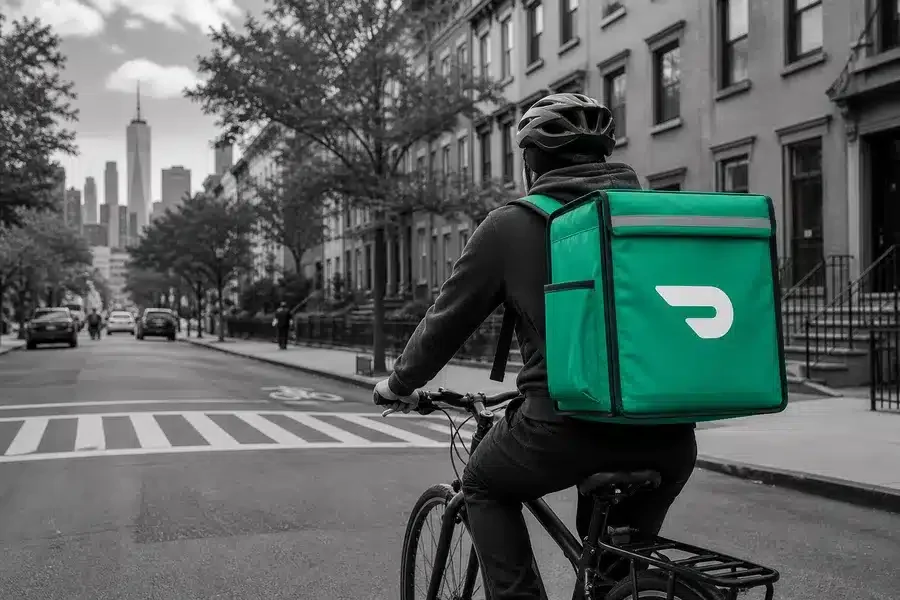
DoorDash (DASH) surged into advanced acquisition talks for grocery platform Instacart (CART), sending CART shares up roughly 8% and DASH falling about 6% Monday, as a potential $17 billion deal would create a dominant force in food and grocery delivery.
For long-horizon investors, the deal’s strategic logic centres on whether combining DoorDash’s vast restaurant-delivery network with Instacart’s entrenched retailer relationships can generate sustainable margin improvement in a sector squeezed by rising labour costs and fading pandemic-era tailwinds.
Key Takeaways
- Deal could value Instacart at ~$17 billion, a 30%+ premium to Friday’s close
- Finalisation targeted as early as Wednesday; no guarantee talks succeed
- Instacart’s Uber talks are no longer active, narrowing the bidder field
Market Reaction & Context
Instacart, which carried a market capitalisation of roughly $13 billion as of Friday’s close, jumped approximately 8% in regular Monday trading on the news 1. That compares with a 9% gain Friday, when The Information first reported Instacart was exploring a sale, meaning CART has now added close to 17% in two sessions.
DoorDash, by contrast, shed around 6% – a classic acquirer discount reflecting investor concern about deal price and integration risk 2. Rival Uber (UBER), which had also been in preliminary discussions with Instacart, saw those talks go quiet, leaving DoorDash as the sole active bidder according to a source cited by Reuters.
Strategic Rationale for Long-Term Investors
The food-delivery sector has been navigating a post-pandemic reset, grappling with elevated labour costs, tighter gig-worker regulation, and intensifying competition from Amazon Fresh and Walmart’s delivery arm 3. Consolidation has emerged as the primary lever for operators seeking scale economies: DoorDash has already acquired UK-based Deliveroo, while Uber absorbed Postmates and Delivery Hero.
An Instacart acquisition would give DoorDash direct access to a mature grocery marketplace with deep retailer integrations – assets that would be expensive and time-consuming to build organically. The combination could allow DASH to offer a single subscription covering restaurant, grocery, and convenience delivery, potentially lifting average revenue per user and reducing customer-acquisition costs over time.
The two companies previously explored a deal in 2021 when Instacart’s valuation peaked at an estimated $40 billion to $50 billion; those talks collapsed partly over regulatory concerns 4. At a proposed $17 billion, the current offer represents a far lower entry price, though antitrust review of overlapping grocery and restaurant-delivery businesses remains a material risk.
Analyst Perspective
“Strategically, DoorDash looks like the more natural fit for Instacart, given the complementary strengths of its restaurant delivery network and Instacart’s grocery expertise,” said Nick Smith, co-founder of growth strategy consultancy Manifesto Growth Architects. “For Uber, the opportunity would be to deepen its position as an everyday convenience platform. But an acquisition only makes sense if it delivers incremental customer value and profitable growth – not simply greater scale.” 1
BTIG analysts echoed that view, noting that DoorDash appears “better positioned” than Uber in any bidding scenario given its subscriber base and driver network, though they flagged the potential for significant antitrust scrutiny given overlapping delivery businesses 4.
Instacart’s Business in Transition
Separately, Instacart disclosed in a regulatory filing Monday that it will wind down its Caper Cart smart shopping-cart unit by the end of the second quarter of 2027, expecting pre-tax charges of $55 million to $80 million 1. The move signals management was already streamlining the business ahead of a potential sale, potentially reducing integration complexity for an acquirer.
Instacart has faced slowing growth since its 2023 initial public offering, with its pre-report market value of approximately $12-$13 billion sitting well below its private-market peak, making a sale at $17 billion an attractive outcome for existing shareholders despite the discount to former highs 4.
Outlook
A deal could be formalised as soon as Wednesday, though sources stress there are no guarantees the transaction will close 1. Regulatory review timelines and final price negotiations remain the key variables to watch.
For patient investors, the more consequential question is whether a combined entity can convert scale into margin – a challenge the delivery industry has struggled with for years. The answer may not be visible for several quarters after any closing.
Not investment advice. For informational purposes only.
References
1Sanskriti Shekhar and Anuja Bharat Mistry (2026-10-26). “DoorDash in talks to buy Instacart in roughly $17 billion deal, source says”. Reuters via San Luis Obispo Tribune. Retrieved 2026-10-27.
2MacKenzie Sigalos (2026-10-26). “DoorDash is in advanced talks to acquire delivery rival Instacart: WSJ”. CNBC. Retrieved 2026-10-27.
3Echo Wang and Milana Vinn (2026-10-26). “DoorDash in talks to buy Instacart in roughly $17 billion deal, source says”. Reuters via WMBD Radio. Retrieved 2026-10-27.
4(2026-10-26). “DoorDash in advanced talks to acquire Instacart, WSJ reports”. Investing.com. Retrieved 2026-10-27.
5(2026-10-26). “DoorDash in talks to buy Instacart, WSJ reports”. Reuters. Retrieved 2026-10-27.