


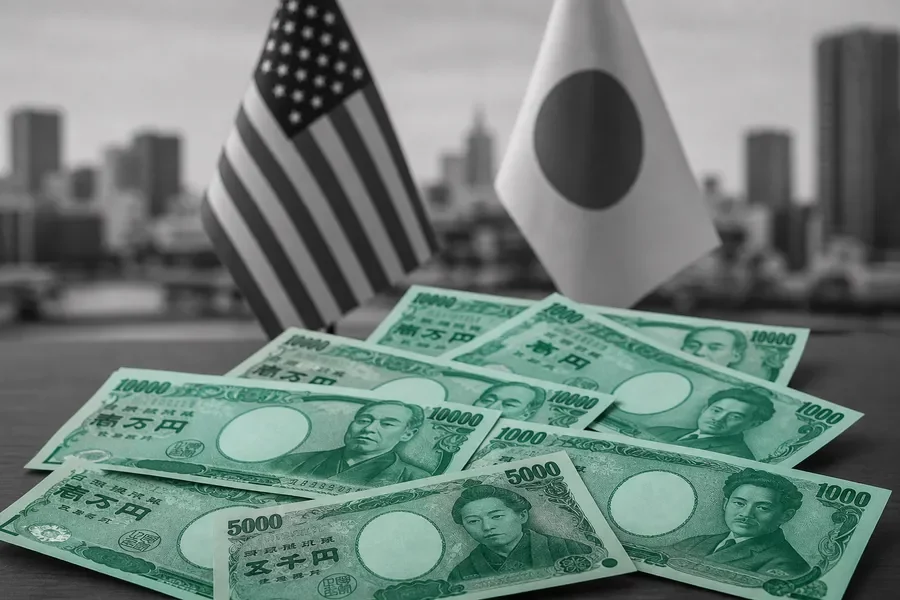
The U.S. and Japan confirmed a joint yen-buying intervention on Friday, a rare bilateral currency move that signals Washington’s willingness to defend exchange-rate stability alongside its closest Asian ally.
For long-horizon investors, the development reshapes the risk calculus on dollar-denominated assets, Japan-exposed equities, and any multinational whose earnings guidance assumes a weak yen tailwind persisting through 2026.
Key Takeaways
- U.S. and Japan jointly bought yen Friday in a coordinated intervention.
- Tokyo vows further action; Washington signals sustained policy alignment.
- Yen volatility poses direct margin risk for exporters and multinationals.
Market Reaction & Context
Coordinated G7 currency interventions are historically rare – the last widely cited bilateral yen-support operation dates to the aftermath of the 2011 Tōhoku earthquake – making Friday’s action an outlier that currency markets are unlikely to dismiss quickly 1. The yen had been under sustained depreciation pressure in 2026, a trend that mirrors the dollar-strength episodes of 2022 and 2023 when USD/JPY briefly breached 150.
Japan’s Finance Ministry said it “will not hesitate to conduct further coordinated interventions in the future” and confirmed it remains in close communication with the U.S. Treasury 1. That language is deliberately open-ended, designed to suppress speculative short positions on the yen without committing to a specific exchange-rate floor.
Detailed Analysis
The significance of U.S. involvement cannot be overstated. Washington has historically maintained a strong-dollar rhetoric and treated unilateral Japanese yen-buying as a sovereign matter; active co-participation shifts that posture materially. Analysts view the move as consistent with broader G7 concerns about disorderly currency markets undermining global trade flows.
For equity investors, the yen’s trajectory has direct earnings implications. Japanese exporters – automakers, electronics manufacturers, and industrial conglomerates – have benefited from yen weakness, which inflates overseas revenues when repatriated. A sustained yen recovery would compress those translation gains and could force downward revisions to operating-profit guidance across the sector. Notably, the Japanese auto industry’s competitive posture in markets like the U.S. is already being challenged on multiple fronts; BYD’s Racco is pressing into Japan’s historically insulated kei-car segment, adding structural pressure even before currency effects are considered.
On the U.S. side, a stronger yen effectively means a softer dollar against JPY – a nuanced signal for investors in U.S. multinationals with large Japanese revenue bases, who could see modest foreign-exchange tailwinds reverse.
Outlook & Policy Signals
Japan’s Finance Ministry said the two governments remain in “close communication,” a phrase that typically precedes additional coordinated action if market conditions deteriorate 1. The open-ended commitment functions as a standing warning to speculative traders betting on further yen weakness.
“Japan will not hesitate to conduct further coordinated interventions in the future.” – Japan Finance Ministry, August 2, 2026 1
The policy signal is broadly dovish for yen volatility in the near term, but the durability of intervention effects historically depends on whether underlying interest-rate differentials between the Federal Reserve and Bank of Japan narrow. Without a convergence in monetary policy, analysts caution that even coordinated interventions tend to smooth rather than reverse structural currency trends.
Conclusion
Friday’s joint intervention marks a meaningful escalation in U.S.-Japan currency policy coordination and introduces a new variable for investors assessing Japanese equities, U.S. multinationals with yen exposure, and global fixed-income positioning. Long-horizon investors should monitor whether the Bank of Japan’s rate trajectory and Federal Reserve guidance move closer together – that convergence, more than intervention alone, would determine whether yen stability becomes durable rather than episodic.
Not investment advice. For informational purposes only.
References
1Japan Finance Ministry / U.S. Treasury (2026-08-02). “U.S., Japan confirm coordinated yen intervention, signal readiness for more”. TomorrowInvestor Source Feed. Retrieved August 2, 2026.