

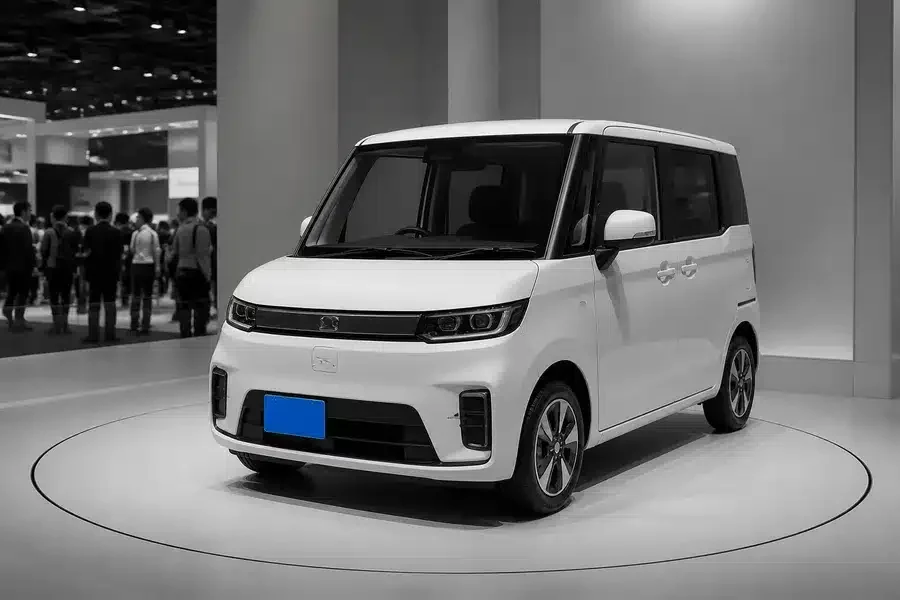
China’s BYD Co. launched its first electric kei car, the Racco, in Japan on Tuesday, targeting a segment where two domestic mini-EVs alone command more than 40% of all electric-vehicle sales in the country.
For long-horizon investors, the launch is a litmus test of whether BYD’s cost advantage in battery manufacturing can overcome Japan’s deep-rooted preference for domestic brands and gasoline-electric hybrids – a barrier that has limited the Chinese automaker to roughly 4% of Japan’s EV market since it entered the passenger-car segment in 2023.
Key Takeaways
- Racco is BYD’s fifth Japan model, first in the kei segment.
- Kei cars account for roughly 40% of Japan’s new-vehicle sales.
- Racco priced near ¥2.6 million ($17,000), matching Nissan Sakura.
Market Context: A Segment Worth Watching
Japan’s kei-car market is formidable: approximately 1.55 million units sold in 2024, representing around 40% of all new vehicles purchased in the country 1. The Nissan Sakura and Mitsubishi eK X electric mini-cars alone accounted for more than 40% of Japan’s total EV sales last year, underscoring how thoroughly domestic manufacturers have defined the segment’s parameters.
BYD sold just 2,223 EVs in Japan in 2024 – a figure that highlights the scale of the opportunity but also the depth of the challenge ahead 3. By contrast, the Honda N-Box, Japan’s best-selling kei car for three consecutive years, illustrates the entrenched loyalty BYD must displace.
The Racco’s Strategic Rationale
The Racco’s debut pricing of approximately ¥2.6 million (around $17,000) places it in direct competition with the Nissan Sakura, which starts at ¥2.59 million 3. BYD’s proprietary Blade battery technology, already supplied to Tesla, Toyota, Hyundai, and Mercedes-Benz, gives the company a structural cost edge that could allow it to defend or even undercut that price point over time.
The model marks BYD’s fifth vehicle on sale in Japan, following the Atto 3 SUV, Dolphin, Seal, and Sealion 7 1. Each prior launch has expanded name recognition, yet none has materially shifted BYD’s single-digit share in a market still dominated by domestic brands. The Racco represents a more targeted approach: going after the volume category rather than the premium end of the EV spectrum.
Competitive Threat to Japanese Automakers
Industry observers have flagged BYD’s kei-car entry as a potential inflection point for incumbents including Suzuki, Subaru, Honda, and Nissan, all of which rely heavily on the kei segment for domestic revenue. Suzuki, for instance, derives a substantial portion of its Japan sales from mini vehicles.
“Young people do not have a negative view of BYD. It would be a huge threat if the company launches cheap models in Japan,” a Suzuki dealer said, as reported by Nikkei 3.
That demographic dynamic matters to investors: younger Japanese consumers, less tethered to brand legacy, may prove more receptive to a competitively priced Chinese EV than older cohorts. The competitive dynamics mirror pressure BYD has already exerted in Europe and Southeast Asia, patterns worth monitoring for investors tracking how incumbent automakers respond to Chinese EV competition in key markets.
Hurdles Remain Significant
Japan’s auto market has long resisted foreign penetration. Gasoline-electric hybrids from Toyota and Honda maintain a grip on consumer preference, and kei-car buyers often prioritise after-sales service networks and residual value – areas where BYD’s Japan footprint is still nascent 1. The country’s EV adoption rate itself remains comparatively low, meaning BYD is competing for a relatively small slice of an already modest electric segment.
Additionally, kei-car regulations in Japan are precise – vehicles must measure no more than 3,400 mm in length, 1,480 mm in width, and 2,000 mm in height, with engine output capped at 47 kW – and BYD has had to engineer the Racco specifically to these standards rather than adapt an existing platform 3.
Outlook
BYD’s broader international expansion strategy, which has seen it enter more than 70 markets globally, suggests Japan is viewed as a prestige proving ground rather than a volume driver in the near term. Demonstrating competitiveness in the world’s third-largest auto market – against some of its most sophisticated manufacturers – could carry significant signalling value for investor confidence in BYD’s global ambitions.
Whether the Racco can meaningfully shift BYD’s Japan market share from the low single digits will depend on pricing sustainability, charging-infrastructure expansion, and the pace of kei-car electrification overall – a transition that domestic brands are simultaneously accelerating 2.
Not investment advice. For informational purposes only.
References
1(Oct 29, 2025). “BYD set to launch first electric mini kei car in Japan”. Automotive News. Retrieved July 27, 2026.
2The Electric Viking (Oct 29, 2025). “BYD Reveal Cheap Kei Car – The Brands Cheapest EV EVER”. YouTube. Retrieved July 27, 2026.
3Peter Johnson (May 7, 2025). “BYD’s new mini EV is ‘a huge threat’ to Japanese automakers and it’s coming soon”. Electrek. Retrieved July 27, 2026.
4Reuters (Oct 28, 2025). “BYD’s mini-car ambitions may be a wake-up call for Japan”. Reuters via Facebook. Retrieved July 27, 2026.