


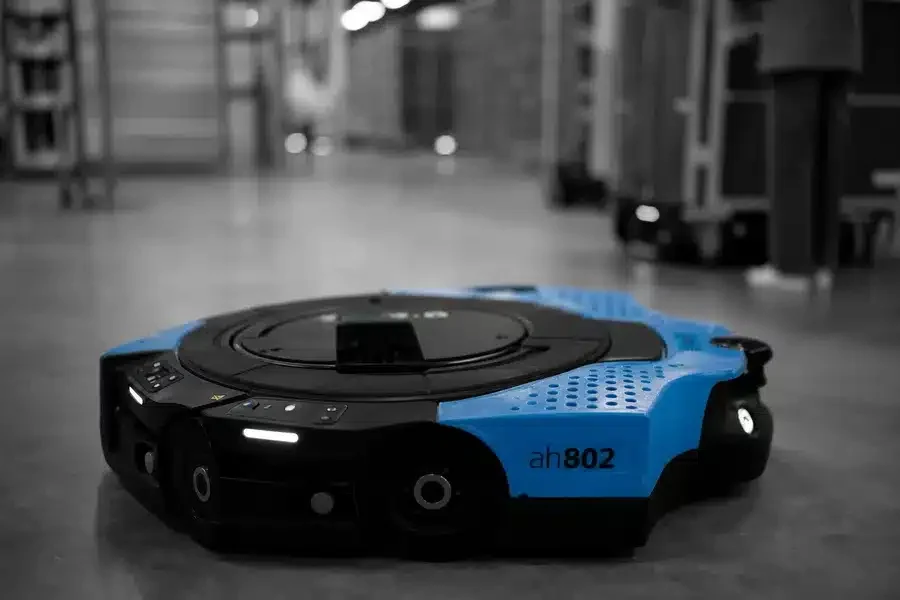
Amazon (AMZN) unveiled a next-generation warehouse robot that accepts plain-language instructions on Thursday, even as the company has shed roughly 30,000 corporate roles in eight months, sharpening the automation-versus-employment tension for long-horizon investors.
For shareholders focused on margin durability, the dual signal – accelerating robotics deployment alongside a $200 billion annual capital budget weighted toward AI and data centres – raises direct questions about where labour-cost savings will flow and on what timeline.
Key Takeaways
- New Proteus robot targets European warehouses by first half of 2027.
- Amazon has cut ~30,000 corporate staff since October amid AI restructuring.
- A $1 billion upskilling pledge offsets only a fraction of displacement costs.
Market Context & Capital Allocation
Amazon’s $200 billion capital expenditure programme for the current year dwarfs the $190 billion Microsoft (MSFT) is spending, according to testimony before Seattle’s Land Use and Sustainability Committee on Thursday 1. Both figures underscore a sector-wide shift in which big-tech capex is being redirected from headcount to infrastructure and automation, a dynamic that compresses near-term free cash flow but is expected by management to widen operating margins over a multi-year horizon.
Amazon’s robotics division already operates more than one million deployed units across 25 U.S. sites 2. The next-generation Proteus robot, currently in lab pilots, extends that footprint across entire warehouse floors rather than dock areas alone, a capability shift that analysts say meaningfully broadens the addressable labour-cost pool.
What the New Technology Does – and What It Costs
The updated Proteus responds to conversational instructions without a programming interface, removing the technical barrier that previously confined robot interaction to specialist operators 1. “You tell it what needs to be done. It figures out the priority, the route, the timing,” said Scott Dresser, vice president of Amazon Robotics. “It becomes your assistant for material movement.”
Amazon also showcased STARK, a tote-handling system piloted in Barcelona set to expand to 15 European sites by 2027, and Vulcan, described as the company’s first robot with a sense of touch, capable of picking and stowing approximately 75% of stored items at speeds comparable to human workers 1. The announcements were made at Amazon’s “Delivering the Future” event in Dartford, England, framed within a €10 billion ($11.6 billion) European fulfilment investment.
The Corporate Workforce Reduction in Numbers
Amazon has trimmed approximately 30,000 corporate employees since an initial round of roughly 14,000 cuts in October, with a further 16,000 removed in January and at least 100 additional white-collar roles confirmed in the robotics division itself in March 23. CEO Andy Jassy has told employees directly that AI adoption is expected to reduce the total corporate workforce in the near term, even as new role categories emerge.
The March robotics cuts coincided with Amazon halting development of its Blue Jay multi-armed robotic system, signalling that internal project rationalisation – not just efficiency gains – is also driving headcount reductions 2. The layoffs represent nearly 10% of Amazon’s white-collar workforce, though hourly fulfilment staff – estimated at roughly 1.5 million – remain the bulk of the total employment base.
Upskilling Pledge: Floor or Ceiling?
Amazon paired Thursday’s robotics announcement with a $1 billion commitment to its Career Choice upskilling programme, part of a broader $2.5 billion Future Ready 2030 pledge covering cybersecurity, software development, mechatronics, logistics and renewable energy 1. The company said it has helped more than 700,000 employees globally through Career Choice since 2019 and plans to grow its European fulfilment workforce by 25,000 in coming years.
That figure sits against internal strategy documents, reported by The New York Times, indicating Amazon aims to automate 75% of its operations by 2033, potentially avoiding the need to hire more than 600,000 additional workers 4. For long-horizon investors, the gap between the upskilling spend and the scale of projected displacement is a key variable in modelling future selling, general and administrative costs.
Outlook
Amazon’s own fulfilment data offers a qualified counterpoint: its advanced Louisiana facility, launched in late 2024, required 30% more employees in various roles specifically because of advanced robotics, suggesting net employment effects remain site- and task-dependent 1. John Boumphrey, Amazon UK Country Manager, said the company concluded it needed to build skilled talent internally. “We couldn’t find enough skilled people for the roles we need, so we made a decision: we’re going to develop them ourselves,” Boumphrey said.
The Proteus European deployment timeline of H1 2027 gives investors at least three reporting cycles before material warehouse labour-cost data should be visible in Amazon’s fulfilment segment disclosures. Whether the capital-heavy automation cycle translates into structurally lower cost-per-unit shipped – or simply front-loads capex with delayed payback – remains the central question for assessing long-run margin impact on AMZN.
Not investment advice. For informational purposes only.
References
1Matthew Sellers (4 June 2026). “Amazon launches worker robot that takes conversational instructions”. Human Resources Director. Retrieved 5 June 2026.
2Greg Bensinger (4 March 2026). “Amazon Cuts More Jobs in Robotics Unit Amid Broader Layoffs”. Global Banking & Finance Review. Retrieved 5 June 2026.
3(28 October 2025). “Amazon is implementing AI to downsize corporate ranks; 14,000 jobs cut”. WKMG News 6 ClickOrlando via YouTube. Retrieved 5 June 2026.
4(21 October 2025). “Amazon’s Next Big Move: Replacing Over 500,000 Jobs With Robots”. GoElite. Retrieved 5 June 2026.
5(21 October 2025). “Inside Amazon’s Plans to Replace Workers with Robots”. The New York Times. Retrieved 5 June 2026.