


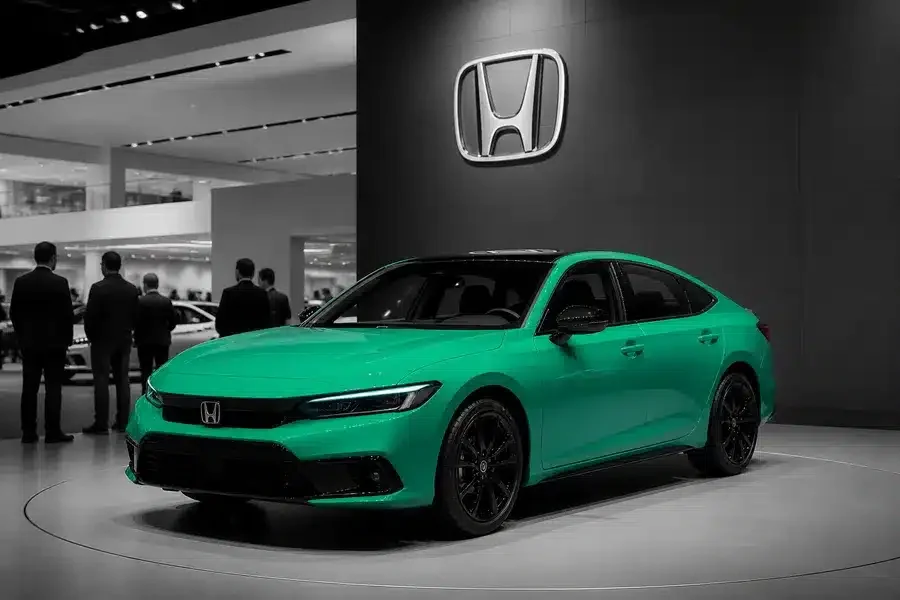
Honda Motor (7267.T) is finalising plans to build a hybrid vehicle plant in Ohio at a cost of up to $2.53 billion, a capital commitment that anchors the automaker’s North American manufacturing strategy through the end of the decade.
For long-horizon investors, the investment signals that Honda is doubling down on hybrid technology as a durable revenue bridge between internal-combustion vehicles and full electrification – a stance with direct implications for multi-year earnings visibility and capacity utilisation.
Key Takeaways
- Honda to spend up to $2.53 billion on a new Ohio hybrid plant.
- Production is targeted to begin in 2030, per Nikkei reporting.
- Investment reinforces hybrid-first strategy over near-term full-EV pivot.
Market Context & Peer Positioning
Honda’s planned outlay of ¥300 billion to ¥400 billion ($1.90 billion to $2.53 billion at ¥157.88 per dollar) places it among the largest single-site auto manufacturing investments announced in the United States this year 1. The commitment comes as rival Japanese automakers – including Toyota and Nissan – also expand hybrid production capacity, while U.S. and European peers grapple with slower-than-expected consumer uptake of battery-electric vehicles.
Ohio already hosts multiple Honda manufacturing facilities, making the state a logical hub for incremental capacity and supply-chain integration. That geographic concentration can compress per-unit logistics costs, a margin benefit that analysts typically view favorably in capital-intensive manufacturing cycles.
Detailed Analysis: Why Hybrid, Why Now
Honda’s decision to anchor new capacity in hybrid technology rather than pure battery-electric production reflects a calculated read on demand durability. Hybrid vehicles have sustained stronger global sales momentum than fully electric models in key markets including the United States and Japan, offering automakers a more predictable revenue profile over a five-to-ten year horizon.
The 2030 production start date means the plant will not contribute to revenues or earnings before the end of this decade, requiring investors to assess the project on a long-dated return-on-capital basis. However, locking in U.S.-based manufacturing capacity now may also serve as a hedge against tariff and trade-policy risk – a consideration that has grown more prominent as Washington tightens rules on imported vehicles 1.
The scale of the investment – at the upper end potentially exceeding $2.5 billion – also suggests Honda intends the Ohio site to serve as a flagship hybrid production center rather than a supplementary line, which could meaningfully shift the company’s North American cost structure once operational.
Outlook
The Nikkei business daily, which first reported the plans on Thursday, said Honda is in the “final stages of preparations” for the project, implying a formal announcement could follow in the near term 1. Honda had not issued an official statement confirming the figures at the time of publication.
No direct management quotation was available from the primary source. Honda has not publicly commented on the Nikkei report.
Conclusion
A confirmed $2.5 billion hybrid plant in Ohio would represent one of Honda’s most significant single-site capital commitments in North America and cement the automaker’s hybrid-first posture at a time when the broader industry is reassessing the pace of EV adoption. Investors focused on long-duration manufacturing assets and margin stability will likely watch the formal announcement – and any accompanying production-volume targets – closely.
Not investment advice. For informational purposes only.
References
1Sugiyama, Satoshi (2026-09-24). “Honda plans to invest $2.5 bln to build hybrid vehicle plant in Ohio, Nikkei says”. Reuters. Retrieved 2026-09-24.