


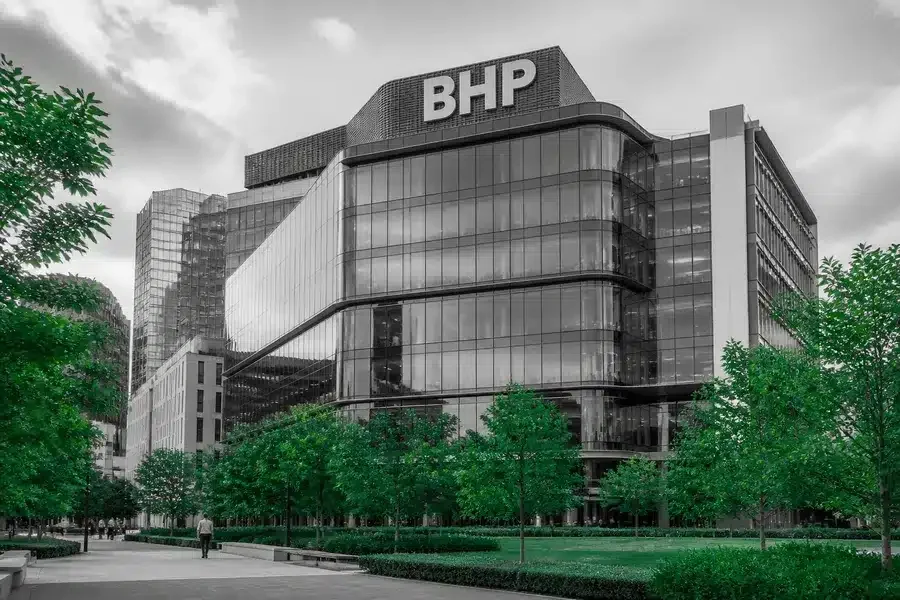
BHP Group (BHP.AX) shares surged 4.2% to a two-month high after the world’s largest listed miner posted a 30% jump in full-year underlying profit and declared its richest annual dividend in four years, powered by copper prices hitting record territory above $14,000 per metric ton.
For long-horizon investors, the result marks a structural shift: copper has now decisively overtaken iron ore as BHP’s primary earnings engine, reshaping the company’s long-term revenue mix and validating its years-long pivot toward energy-transition metals.
Key Takeaways
- Full-year underlying profit of $13.20 billion beat consensus by roughly $540 million.
- Copper division generated $18.19 billion in operating earnings, topping iron ore.
- Annual dividend of $1.72 per share is the highest since fiscal year 2022.
Earnings Result & Dividend
BHP reported underlying attributable profit of $13.20 billion for the twelve months ended June 30, 2026 – a 30% year-on-year rise and comfortably ahead of the Visible Alpha consensus estimate of $12.66 billion. 1
The miner declared a final dividend of 99 cents per share, lifting the full-year payout to $1.72 apiece – the highest in four years and a figure that Argo Investments portfolio manager Andy Forster called “a big beat.” BHP’s net debt fell to $8.69 billion at June 30, sitting below both its own $10-$12 billion target band and the Visible Alpha consensus of $9.10 billion.
Market Reaction & Context
BHP.AX rallied as much as 4.2% to A$64.79 on the session, outpacing the broader Australian materials sector and underscoring how sharply sentiment has swung toward copper-heavy miners. Rival diversified miners with greater iron ore exposure have generally lagged as iron ore prices softened, making BHP’s growing copper weighting a relative differentiator in the peer group. 1
Copper prices have climbed to record highs above $14,000 per metric ton in 2026, driven by the power-hungry buildout of AI data centres and accelerating electrification globally – dynamics that are also lifting revenue outlooks across the technology supply chain.
Copper Overtakes Iron Ore
BHP’s copper division – which includes byproducts such as gold and uranium – generated $18.19 billion in operating earnings for the year, eclipsing Western Australia Iron Ore’s $14.67 billion. 1 That iron ore figure was itself up 2% year-on-year and broadly in line with estimates, but the gap with copper widened meaningfully.
The milestone matters to long-term investors because copper’s structural demand outlook is considerably stronger: BHP projects global copper demand will grow from roughly 34 million metric tons today to more than 50 million metric tons annually by 2050. To capture that upside, new CEO Brandon Craig said BHP’s project pipeline could expand copper production capacity by as much as 40% by 2035, even as near-term output dips during the investment ramp-up.
Outlook & Management Commentary
Craig, who assumed the CEO role last month, framed copper, iron ore, steelmaking coal and potash as the commodities most central to the global development story.
“Copper, iron, steelmaking coal and potash are foundational to the way the world is developing. That is why we are moving as fast as we can and bringing these commodities to market,” Craig told reporters.
He cautioned, however, that acquiring copper assets in the current market costs roughly five times more than building them organically – a signal that BHP’s preferred growth route remains greenfield and brownfield development rather than M&A. Capital expenditure is expected to rise by more than $1 billion in the coming year, and final investment decisions on major projects have not yet been made.
Secondary Narratives: Coal, Uranium & Port Hedland
Craig pushed back on reports that BHP might review its Queensland metallurgical coal assets for a sale within the next one to five years, saying the operations would remain a core part of the portfolio if commodity markets develop as expected. Separately, Reuters reported that Canadian uranium miner NexGen Energy (NXE.TO) is in active discussions with BHP about its Rook I uranium project in Saskatchewan – a conversation Craig acknowledged without elaboration, saying BHP would “continue to study” other commodity options. 1
On the operational front, industrial action at Port Hedland – the first major strikes at the iron ore export hub in decades – is ongoing, though Craig said BHP does not expect a material negative impact while talks continue. BHP also noted it retains $3.5 billion of further value it can unlock through active capital and asset management, part of a $10 billion opportunity it had previously identified; Global Infrastructure Partners recently committed $2 billion for a minority stake in BHP’s inland Western Australia power network.
Conclusion
BHP’s fiscal 2026 results offer long-duration investors a clear signal: the company’s earnings mix is structurally rebalancing toward copper, a commodity with a multi-decade demand runway anchored in electrification and digital infrastructure. The record dividend and strong balance sheet – net debt below the lower end of the target range – provide near-term reward while management channels capital into a pipeline that could deliver a 40% copper production uplift by 2035.
With copper now the lead earnings driver and the balance sheet in its tightest shape in years, BHP’s fundamental case for patient investors rests squarely on whether that production pipeline translates into volumes – and whether copper prices hold their historic highs.
Not investment advice. For informational purposes only.
References
1Burton, Melanie and Manekar, Sameer (2026-08-17). “BHP profit tops estimates as copper powers growth, to pay highest dividend in 4 years”. Reuters. Retrieved 2026-08-18.