

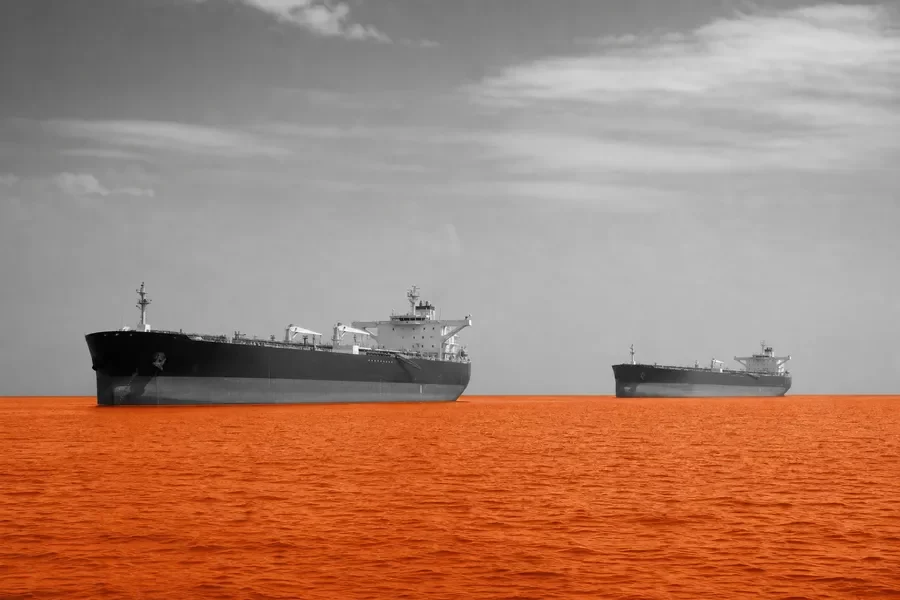
Iranian attacks on tankers have slashed ship-to-ship oil transfers in the Gulf of Oman to near zero, cutting total Hormuz throughput to roughly two-thirds of pre-conflict volumes and raising fresh supply-chain risk for energy investors.
For long-horizon investors holding positions in oil majors, tanker operators, or Gulf-dependent refiners, the deterioration of the U.S.-assisted transfer corridor represents a structural threat to the export infrastructure that has underpinned crude price stability since May.
Key Takeaways
- Supertanker crossings fell from eight per day to just two.
- Satellite data shows ship-to-ship transfers near a standstill.
- U.S. claims ~14 million barrels daily still flowing, disputes public data.
The Collapse in Transfer Activity
Satellite imagery reviewed by Reuters on July 18 showed only one pair of tankers conducting ship-to-ship (STS) transfers off Oman’s coast – down from three pairs visible on July 11 1. Two maritime sources told Reuters that just two or three STS transfers were believed to have taken place across the preceding several days, a steep drop from the pace that had defined the corridor since early May.
Since the Iran war began in late February, STS transfers had served as the operational backbone of Gulf oil exports, allowing vessels waiting in open water to load crude without navigating the strait directly or seeking insurer approval. The erosion of that corridor now threatens oil supply stability in ways that go beyond short-term price volatility.
Market Context: Supertanker Traffic Craters
Ship broker Clarksons said supertanker sailings through the Strait of Hormuz averaged just two per day over the past week, compared with five the prior week and eight daily crossings recorded in late June and early July 1. Each supertanker holds up to 2 million barrels – meaning the weekly decline from eight to two vessels represents a potential loss of up to 12 million barrels of daily export capacity at the strait alone.
For context, the Gulf’s pre-conflict oil output had been a key swing factor in OPEC supply management; the current disruption has already been described as the largest-ever interruption to global oil and gas supplies. Benchmark crude prices have been partially insulated by the U.S.-guided transfer operation, but that cushion is now narrowing.
Washington Disputes the Numbers
U.S. Energy Secretary Chris Wright pushed back on public shipping-data narratives in an ABC News interview on Sunday, saying the figures he had reviewed were “incorrect.” 1
“The seven-day trailing average right now is just under 7 million barrels a day flowing through the waterway and just under 7 million barrels a day additional flow through the bypass pipelines. So, we’re at a little under 14 million barrels a day – that’s two-thirds of pre-conflict traffic, dramatically up from where we were back in March,” Wright said.
Wright added that Washington would continue to assure traffic through the strait “without Iran’s cooperation,” signalling the administration intends to sustain the military-guided transit scheme despite mounting shipping-company defections.
Why Shipping Companies Are Walking Away
Iran’s Revolutionary Guards said on Monday that two oil tankers had “exploded” and were immobilised after attempting to transit the strait via what Tehran called an “unsafe” route – the same corridor the U.S. military has been guiding vessels through 1. The announcement underscored why some operators are opting out: the safety calculus has shifted materially since the attacks intensified.
Sources told Reuters last week that several shipping companies had begun refusing U.S. military-guided transits, citing safety concerns – a development that, if it widens, could further erode the transfer volumes the Biden-era operation had built up from May onwards. Investors tracking war-risk insurance costs and tanker-route disruptions will note that insurer reluctance predates the current flare-up and is now compounding it.
Investment Outlook
The U.S.-assisted STS corridor had enabled the export of tens of millions of barrels since early May, providing a meaningful offset to what would otherwise have been a far sharper supply shock. Whether that buffer can be rebuilt depends on whether Iranian attack tempo eases and whether insurers re-engage with the guided-transit scheme.
Satellite outages and restricted tracking data mean the full export picture remains opaque – a material information asymmetry for investors in crude-exposed equities and commodity funds. The longer-term portfolio implications of sustained Hormuz disruption hinge on whether Washington’s stated commitment to maintaining the corridor translates into sustained operational throughput.
Not investment advice. For informational purposes only.
References
1Jonathan Saul (2026-07-20). “Oil transfer activity in Gulf of Oman slows following ship attacks, data shows”. Reuters. Retrieved 2026-07-20.
2Jonathan Saul (2026-07-20). “Oil transfer activity in Gulf of Oman slows following ship attacks, data shows”. Internazionale / Reuters. Retrieved 2026-07-20.
3Reuters (2026-07-20). “Oil transfer activity in Gulf of Oman slows following ship attacks, data shows”. Threads/@reuters. Retrieved 2026-07-20.
4(2026-07-20). “Oil transfer activity in Gulf of Oman slows following ship attacks, data shows”. MarketScreener. Retrieved 2026-07-20.