

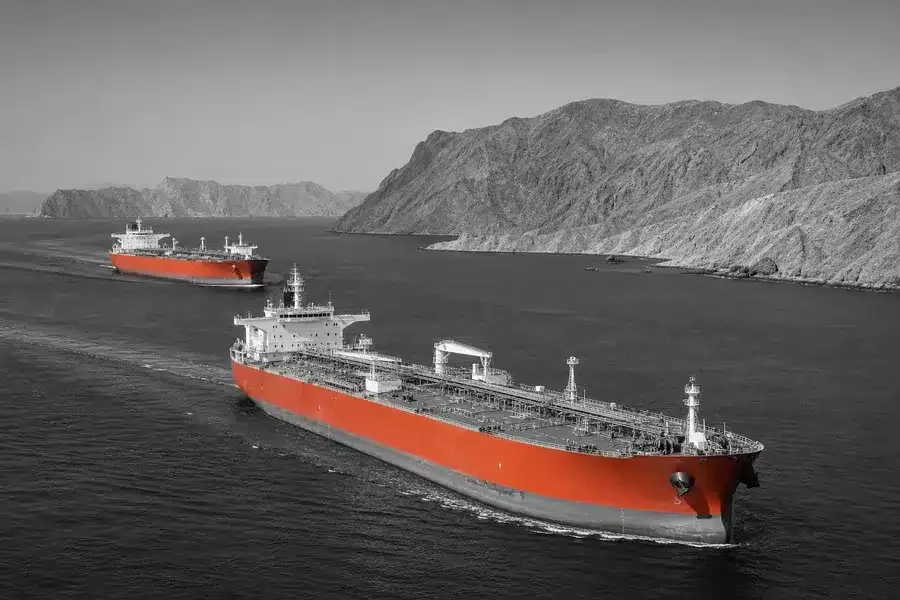
Daily tanker transits through the Strait of Hormuz fell sharply on Friday after U.S. and Iranian forces exchanged strikes this week, pushing oil prices toward a 5% weekly gain and deepening uncertainty over global energy supply chains that investors had hoped were stabilising.
For long-horizon energy investors, the deterioration matters because the strait-a chokepoint for roughly one-fifth of global oil supply before the current conflict-had only just begun recovering traffic, and a renewed blockade or sustained hostility could erase months of hard-won throughput gains and lift war-risk insurance premiums across the tanker sector.
Key Takeaways
- Tanker throughput dropped from 40 daily sailings; pre-war average was 125-140.
- Oil prices on track for a 5% weekly gain after U.S.-Iran exchange of fire.
- Qatari mediators in Tehran Friday seeking to revive navigation agreement.
Market Reaction & Context
Oil prices eased modestly on Friday but remained on course for their best weekly performance in months, reflecting persistent supply-risk premiums baked in by traders 1. Prior to this week’s tanker attacks, daily throughput in the strait had climbed to approximately 40 vessels – a war-era high – yet that figure still represents less than one-third of the 125-to-140 daily sailings recorded before the conflict began in February 2026.
The gap between current and pre-war traffic levels underscores the structural damage already inflicted on global seaborne crude and LNG flows. For investors tracking integrated energy majors and tanker operators, the spread between spot and forward freight rates is likely to widen further if diplomatic efforts fail this weekend.
The route disruptions in Hormuz have already rattled oil supply stability over recent months, and this week’s flare-up represents a fresh setback to any normalisation timeline.
Detailed Analysis
The immediate trigger for Friday’s slowdown was a series of attacks earlier in the week on three Qatari and Saudi commercial tankers, which Washington attributed to Iranian forces 2. The U.S. responded with strikes on Iranian military sites; Iran retaliated on Thursday with attacks on U.S. installations in neighbouring Gulf states – a cycle that analysts say Tehran has used previously to extract concessions at the negotiating table.
No attacks were reported on Friday, and the United Nations shipping agency’s governing council condemned Iranian efforts to impose sovereignty over the strait and Tehran’s creation of a body to unilaterally control traffic through it 1. Iran has warned that the waterway will reopen only on its terms, and that any U.S. intervention will draw what it called a “crushing response.”
The confrontation is rooted in a broader, months-long conflict that has killed thousands and throttled energy supplies since late February. A June interim deal – under which the U.S. ended its naval blockade of Iranian ports and Iran pledged safe passage for commercial vessels – now appears increasingly fragile. The end of Iran oil sanctions had raised expectations of a supply rebound, but those hopes are now being reassessed by portfolio managers.
President Donald Trump said on Friday that Iran had requested a continuation of talks and the U.S. had agreed, but made clear the June truce was no longer operative.
Diplomatic Outlook & Key Quote
“The Islamic Republic of Iran has asked us to continue ‘talks.’ We have agreed to do so, but the United States has stated to them, in no uncertain terms, that the Cease Fire is OVER!” – President Donald Trump, Truth Social, July 10, 2026 2
Qatari negotiators were meeting Iranian officials in Tehran on Friday to address the implementation of the U.S.-Iran memorandum of understanding and the navigation disputes that triggered the latest escalation, a source with direct knowledge of the talks told Reuters 1. Iran’s semi-official Tasnim news agency confirmed a Qatari delegation’s visit, characterising it as part of Doha’s effort to consolidate its mediator role.
The talks aim to re-anchor safe-passage commitments and, if successful, could allow tanker volumes to resume their tentative recovery. Failure, however, would likely push freight rates and oil prices materially higher heading into the second half of 2026.
Conclusion
For patient, long-horizon investors, the Hormuz situation is less a short-term trading event and more a structural variable in energy supply modelling. With throughput still less than a third of pre-war levels and diplomatic guardrails visibly fraying, any portfolio exposure to global oil supply assumptions – from integrated majors to LNG exporters to tanker operators – warrants a fresh stress-test against a prolonged disruption scenario.
The next 48 hours of Qatari-mediated diplomacy will be a key signal. A restored navigation agreement would revive the gradual traffic recovery; a breakdown would reset the supply-risk calendar entirely.
Not investment advice. For informational purposes only.
References
1Elimam, A., Abouhassira, E., and Mills, A. (July 10, 2026). “Trump says US agreed to Iran’s request to continue talks, but ceasefire is over”. Reuters. Retrieved July 10, 2026.
2(July 10, 2026). “Trump Says US Agreed to Iran’s Request to Continue Talks, but Ceasefire Is Over”. U.S. News & World Report. Retrieved July 10, 2026.
3(July 10, 2026). “Tanker traffic slows in Strait of Hormuz after US and Iran clashes”. Reuters via Facebook. Retrieved July 10, 2026.
4(July 10, 2026). “Tanker traffic slows in Strait of Hormuz after US and Iran clashes”. Reuters via X (formerly Twitter). Retrieved July 10, 2026.