


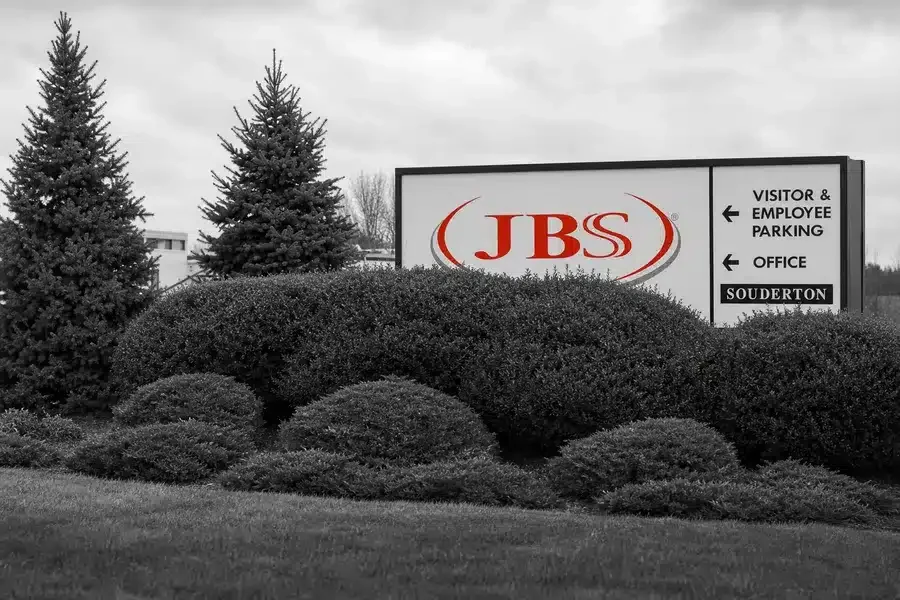
JBS USA, the world’s largest meatpacker, will permanently close its Swift Beef Company facility in Riverside, California, on February 2, 2026, as a historic cattle shortage squeezes processing margins across the industry.
For long-horizon investors, the closure signals a structural reset in U.S. beef processing capacity that could reshape per-unit costs, import dependency, and competitive dynamics for years ahead.
Key Takeaways
- JBS closes Riverside plant Feb. 2, cutting 374 jobs.
- U.S. cattle herd at lowest level in decades, lifting costs.
- Tyson posted $426M beef operating loss in fiscal 2025.
Market Reaction & Context
The Riverside closure follows Tyson Foods’ decision in late November 2025 to shutter its Lexington, Nebraska, beef plant – capable of slaughtering up to 5,000 head per day, nearly 5% of total U.S. daily beef slaughter – and reduce operations at its Amarillo, Texas, facility to a single shift 1. Taken together, the two announcements represent a meaningful contraction of domestic beef processing infrastructure at a moment when cattle supplies are at multi-decade lows.
By contrast, Cargill said in late November it has “no intention to close any primary beef processing plants right now,” adding that it is actively investing in its eight North American primary beef facilities 1. The divergence between operators reflects how differently companies are positioned relative to their cattle procurement costs and plant utilization rates.
Detailed Analysis
Beef prices set record highs in 2025 after persistent drought forced ranchers to slash the U.S. cattle herd to its smallest size in decades, drying up the pasture land needed to sustain larger herds 2. A concurrent U.S. halt on Mexican cattle imports – imposed to block a flesh-eating parasite – tightened available supply further, forcing packers to bid aggressively for every head that reached the market.
The Riverside plant is a value-added, case-ready facility rather than a slaughter operation, meaning it packages beef cuts destined for grocery-store meat cases 2. JBS said the closure is part of a “strategic initiative to optimize its value-added and case-ready business and simplify operations across its network,” and that production will shift to other facilities, with affected workers eligible for transfers 1.
Despite the headwinds, JBS Beef North America reported record revenue of $7.2 billion in the third quarter of 2025, crediting “resilient domestic demand” even as input costs rose 2. That performance stands in sharp contrast to Tyson, whose beef segment recorded an adjusted operating loss of $426 million in fiscal 2025 – on top of a $291 million loss in fiscal 2024 – with cattle costs up nearly $2 billion year over year 2.
The USDA in December 2025 trimmed its 2026 steer price forecast to $235 per hundredweight, down 4.5% from its prior estimate, citing reduced slaughter capacity heading into the new year 1. Even so, that figure would still represent a roughly 5% increase over the projected 2025 average, underscoring the persistent cost pressure facing processors.
Import Relief & Structural Shift
Washington has sought to cushion elevated domestic prices partly through trade policy: President Trump in late November lifted tariffs on Brazilian beef, a move expected to cool ground-beef prices over time 1. The USDA consequently raised its 2026 beef import outlook by 10% to 5.45 billion pounds, reversing prior forecasts of a year-over-year decline and signaling greater structural reliance on foreign supply.
University of Nebraska-Lincoln researchers said the Tyson-Lexington closure may reflect a broader structural shift, noting that when cattle supplies are tight, plants operating below full capacity face rising variable costs and, if margins deteriorate sufficiently, permanent closure can become the rational choice to “utilize remaining capacity more efficiently” 2.
Outlook & Management Quote
“The company remains focused on delivering high-quality products and dependable service while strengthening its operational footprint to meet evolving market demands.” – JBS spokesperson 1
Tyson is projecting an additional adjusted operating loss of $400 million to $600 million in its beef segment for fiscal 2026, suggesting the margin squeeze is far from over for higher-cost operators 2. JBS has not issued comparable forward guidance on its U.S. beef margins.
Conclusion
For investors with long time horizons, the wave of facility closures points to a beef-processing industry in the early stages of a capacity rationalization cycle driven by structural cattle scarcity rather than a temporary demand slump. Companies with lower per-head procurement costs, flexible multi-facility networks, and access to import channels appear best positioned to preserve margins until herd rebuilding – a process analysts expect to unfold over multiple years – restores supply. The divergence in financial performance between JBS and Tyson already illustrates how decisive that positioning can be.
Not investment advice. For informational purposes only.
References
1Ryan Hanrahan (Dec. 15, 2025). “JBS Closing Beef Plant in California”. Farm Policy News. Retrieved June 12, 2026.
2Kristin Bakker (Dec. 18, 2025). “JBS to close California beef plant”. Beef Magazine. Retrieved June 12, 2026.
3Tom Polansek (Dec. 12, 2025). “JBS to close California beef plant over low U.S. cattle supply”. Reuters. Retrieved June 12, 2026.
4“JBS Souderton, Inc.”. USDA Food Safety and Inspection Service. Retrieved June 12, 2026.