

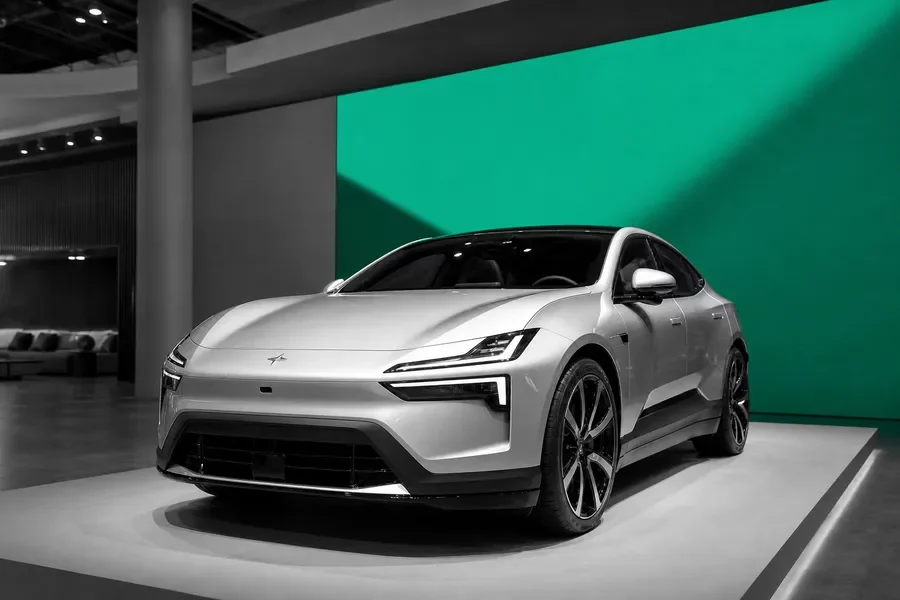
The U.S. Commerce Department banned majority Chinese-owned Polestar from selling new electric vehicles in the United States, forcing the Volvo spin-off to exit the world’s second-largest auto market entirely.
The ruling removes one of the few Chinese-affiliated EV brands with an established U.S. retail footprint, raising fresh questions about the long-term revenue mix for any automaker carrying material Chinese ownership – and signalling that Washington’s trade perimeter around connected-vehicle technology is hardening fast. 1
Key Takeaways
- Commerce Department bans Polestar from all new U.S. car sales.
- Ruling targets Chinese majority ownership, not vehicle origin.
- Broader Chinese EV ban already visible along the U.S.-Mexico border.
Market Reaction & Context
Polestar (PSNY) shares had already lost the vast majority of their value over the past two years amid persistent profitability concerns, leaving the stock well below the broader EV peer group that includes Tesla (TSLA) and Rivian (RIVN). The Commerce action removes what remained of the company’s near-term U.S. volume story, which analysts had viewed as critical to any path toward positive unit economics.
The ruling fits a broader pattern of Washington restricting Chinese-linked auto technology from the domestic market. A January 2025 Commerce rule had already moved to effectively bar Chinese-connected vehicle software and hardware, citing national-security risks embedded in the data systems of modern EVs. 2
Detailed Analysis
Polestar was spun out of Volvo Cars, itself owned by China’s Geely Holding, giving the brand a corporate lineage that U.S. regulators have deemed disqualifying under the new ownership-based framework. The ban covers new vehicle sales; the company said it would exit the U.S. market as a result.
The action underscores a structural shift in how Washington assesses foreign-owned EV players: the test is now ownership chain, not assembly location. That distinction matters for any legacy or start-up automaker that has accepted Chinese investment or entered joint-venture arrangements with Chinese partners.
Meanwhile, the competitive pressure that U.S. policymakers are trying to contain is already visible a few miles from the border. Just across from El Paso in Ciudad Juárez, Mexican dealerships sell Geely, BYD, and Great Wall Motor vehicles that are blocked from American consumers. 1 Geely’s all-electric EX2 starts at roughly $20,000 – a price point that undercuts most U.S.-market EVs by a substantial margin.
“If they were allowed to be sold in the United States,” said Luis Hernandez, a Geely salesman in Ciudad Juárez, “they would destroy the American car market.” 1 U.S. automotive executives, for their part, do not entirely disagree: some said in interviews that the arrival of affordable, high-tech Chinese vehicles could upend an industry contributing $1.3 trillion annually to the U.S. economy.
Outlook & Ownership Risk
For long-horizon investors, the Polestar ban serves as a stress test for any portfolio position tied to automakers with Chinese ownership stakes or deep supply-chain dependencies on Chinese battery and software suppliers. The ownership-chain standard, if applied consistently, could eventually reach other brands operating in grey-area corporate structures.
The ban also narrows the competitive set for purely domestic and allied-nation EV makers, potentially improving the addressable market for Tesla, GM’s EV lineup, and Korean manufacturers such as Hyundai and Kia – all of which already have or are building U.S. manufacturing capacity. Investors in those names may view the regulatory tightening as a medium-term demand tailwind, even as the broader EV adoption rate remains uneven.
Conclusion
Washington’s decision to remove Polestar from the U.S. market marks a significant escalation of the trade wall around Chinese-affiliated EVs, moving from tariffs and software restrictions to an outright sales prohibition based on corporate ownership. The episode clarifies the regulatory risk embedded in any auto investment with Chinese capital at its core, and signals that further enforcement actions targeting similarly structured companies remain plausible.
Not investment advice. For informational purposes only.
References
1Felton, Ryan (Apr. 28, 2026). “The U.S. Wants to Ban China’s High-Tech Cars, but They’re Already Here in El Paso”. The Wall Street Journal. Retrieved June 25, 2026.
2(Jan. 14, 2025). “US Finalizes Rule to Effectively Ban Chinese Connected Vehicles”. Reddit/r/Polestar. Retrieved June 25, 2026.