


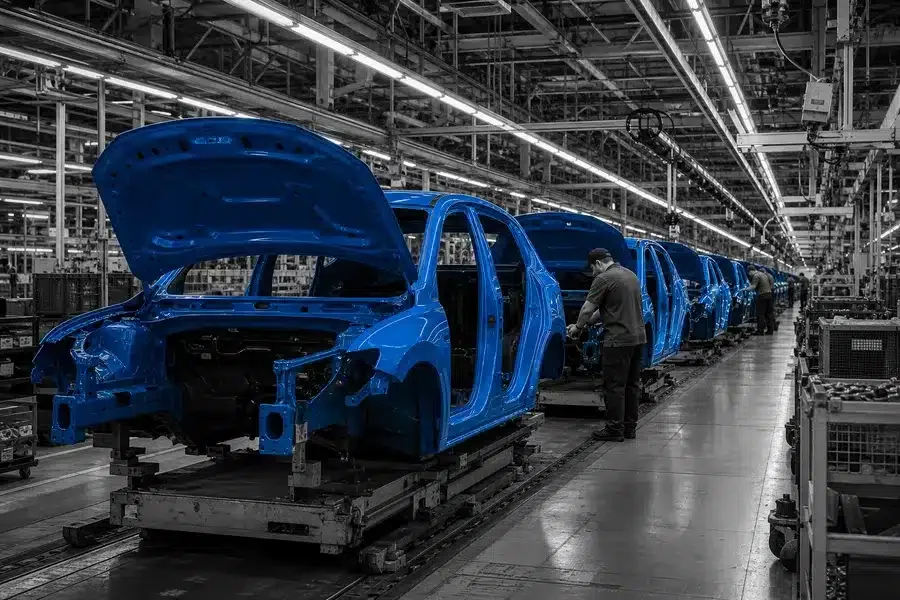
Micron Technology (MU) and Ford Motor (F) signed a long-term strategic supply agreement on Monday for automotive memory and storage, with MU shares up roughly 0.93% as investors weighed the deal’s implications for Micron’s automotive revenue durability.
For long-horizon investors, the agreement signals that Micron is systematically converting one-time automotive chip sales into recurring, contracted revenue streams – a structural shift that could meaningfully reduce earnings volatility tied to cyclical memory pricing.
Key Takeaways
- Micron and Ford ink long-term memory and storage supply pact.
- Deal is one of 16 strategic customer agreements from Micron’s Q3 2026.
- DRAM prices have surged roughly 70% since December amid AI-driven demand.
Market Reaction & Context
MU shares gained approximately 0.93% on Monday to around $984.65, modestly outpacing a broader Nasdaq rally of 0.97% 1. Ford (F) climbed 3.63% on the session, while peer General Motors (GM) added 2.43%, suggesting investor sentiment across the Detroit automakers is broadly positive as supply-chain certainty improves.
The Ford deal follows a near-identical agreement Micron struck with General Motors just days earlier, highlighting an accelerating trend of automakers seeking long-horizon chip commitments. According to an S&P Global Mobility report cited in Reuters coverage, DRAM prices have risen about 70% since December, driven by surging AI data-center investment – a dynamic that is spilling directly into automotive procurement costs 1.
Why Contracted Supply Matters More Than the Headline
Memory chips have historically been treated as commodities, leaving automotive manufacturers exposed to spot-price swings – a vulnerability that contributed to the industry-wide chip shortage of 2021-2022. Long-term supply agreements effectively floor Micron’s automotive revenue while giving Ford production visibility across multiple model cycles.
Advanced driver-assistance systems (ADAS) and power-hungry infotainment platforms have dramatically expanded per-vehicle memory content, adding automakers to the same pool of buyers competing with hyperscale cloud operators for limited DRAM supply. Ford’s ability to maintain production continuity now depends partly on precisely these kinds of upstream agreements.
Micron’s U.S. Manufacturing Expansion as a Structural Catalyst
The Ford partnership is explicitly tied to Micron’s expansion of advanced DRAM production in Virginia, which the company has positioned as a cornerstone of its domestic semiconductor manufacturing push 1. That capacity investment directly supports the long product lifecycles and production-continuity requirements that automakers demand, distinguishing it from Micron’s faster-turning AI memory business.
Micron disclosed 16 strategic customer agreements during its fiscal third-quarter earnings call – a figure that, taken together, points to a deliberate effort to lock in diversified end-market demand ahead of new U.S. fab capacity coming online 2. For investors focused on pipeline durability, the breadth of those agreements reduces the risk that automotive revenue remains hostage to any single customer relationship or commodity cycle.
Management Perspective
“We are proud to extend our collaboration with Ford to help ensure a reliable, long-term supply of memory and storage solutions. As vehicles become more intelligent and data-intensive, the importance of advanced memory and storage continues to grow, making collaboration and long-term supply increasingly important.” – Sanjay Mehrotra, Chairman, President and CEO of Micron Technology 2
Ford’s chief executive offered a complementary view on domestic supply-chain resilience. “Producing the high-volume vehicles of the future in the U.S. will require a resilient supply chain. We applaud Micron’s commitment to manufacturing in America, expanding its domestic production and investing in a skilled workforce,” said Jim Farley, President and CEO of Ford Motor Company 2.
Outlook
With 16 strategic agreements now on the books and Virginia DRAM capacity ramping, Micron is building an automotive revenue mix that is less exposed to spot-market volatility than its legacy business model. Whether that shift registers meaningfully in margin metrics will depend on the pricing terms embedded in these contracts – details neither company disclosed publicly.
Investors tracking Micron’s long-term revenue composition should watch for automotive segment disclosure in upcoming quarters to assess whether contracted volumes are translating into stable gross-margin contributions alongside the company’s higher-profile AI memory growth story.
Not investment advice. For informational purposes only.
References
1Reuters (July 6, 2026). “Micron, Ford sign semiconductor supply agreement for vehicles”. Yahoo Finance. Retrieved July 6, 2026.
2Hardik Shah (@AIStockSavvy) (July 6, 2026). “JUST IN: Micron, Ford Sign Long-Term Supply Agreement for Next-Generation Vehicles”. X (formerly Twitter). Retrieved July 6, 2026.