

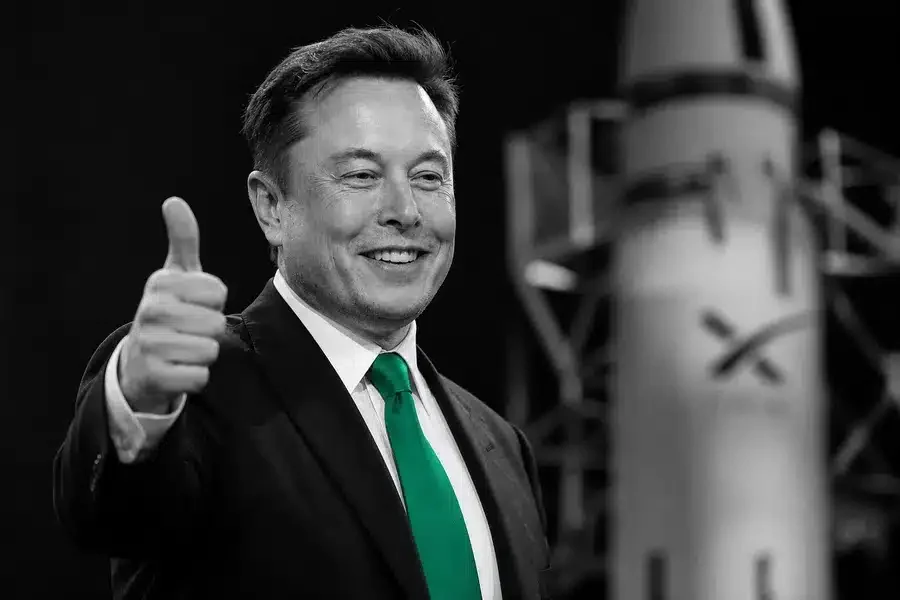
SpaceX (SPCX) began trading on the Nasdaq on Friday after raising a record $75 billion in its IPO, pushing Elon Musk’s net worth above $1.1 trillion and redefining the ceiling for technology-company valuations.
For investors with multi-year horizons, the listing introduces a company whose near-term cash burn is substantial but whose addressable markets – orbital launch, satellite broadband, and space-based AI infrastructure – dwarf those of most listed peers. 1
Key Takeaways
- SpaceX raised $75 billion, the largest IPO on record.
- Musk’s stake alone is worth roughly $866 billion at listing.
- Revenue grew 30%-plus last year; net loss was $4.9 billion.
Market Reaction & Context
SpaceX’s IPO valuation of roughly $1.5-$2 trillion eclipses Alibaba’s 2014 record-setting $25 billion raise and positions the company as one of the largest publicly traded entities in the world on day one. 2 For comparison, Tesla (TSLA) carries a market cap above $1 trillion, meaning Musk now presides over two separately listed companies each in that rarified tier.
Prior to the share sale, Forbes valued Musk’s total holdings at approximately $780 billion – already more than double the next wealthiest individual. 1 The IPO proceeds and opening-day valuation lifted his combined net worth past the $1.1 trillion mark, according to Reuters calculations based on company filings.
Financial Profile: Growth Paired With Heavy Investment
SpaceX reported revenue of $18.7 billion last year, up more than 30% year-over-year, but swung to a net loss of $4.9 billion as losses at its xAI unit deepened to $6.4 billion. 3 Starlink, the satellite-broadband division, provided a partial offset, more than doubling its operating profit to $4.4 billion – a figure long-horizon investors will watch closely as the unit scales.
The company controls more than 80% of global rocket launches and operates upwards of 10,000 Starlink satellites, giving it structural advantages that would be difficult for any rival to replicate quickly. SpaceX also holds prime-contractor status with NASA and the Pentagon, providing recurring government-revenue visibility that many pure-play space start-ups lack.
Valuation Framework: The “Elon Premium”
Analysts have wrestled openly with how to price a company whose stated ambitions include Mars colonisation and space-based data centres. 2 “A market cap of $1.5 trillion-$2 trillion would certainly throw all traditional valuation methodologies out the window, and is instead best characterised as the ‘Elon Musk premium,'” said Matt Kennedy, senior strategist at Renaissance Capital.
Musk’s incentive structure reinforces that long-term orientation: company filings show he could receive up to 200 million additional Class B shares if SpaceX reaches a $7.5 trillion valuation and establishes a one-million-person Mars colony, as well as a further 60 million shares tied to a $6.6 trillion valuation and a space-based computing network with 100 terawatts of capacity. 3
Risks Long-Term Investors Should Monitor
SpaceX remains cash-hungry, and much of its valuation rests on technologies that may take years or decades to achieve commercial scale. 1 The company’s governance structure grants Musk near-unchecked executive authority – a concentration of control that has drawn scrutiny even as institutional investors lined up for allocations.
Political risk is a second variable: Musk’s role in the Trump administration’s Department of Government Efficiency weighed on Tesla sales in several international markets in 2025, triggering consumer boycotts that only partially reversed in early 2026. 1 Any repeat controversy could create headline drag on both SPCX and TSLA simultaneously, given the degree to which market sentiment toward both companies tracks Musk’s public standing.
Outlook
JPMorgan Chase CEO Jamie Dimon, a former legal adversary of Musk, captured the prevailing institutional sentiment succinctly: “Elon is the Edison of our time.” 1 Whether that enthusiasm translates into durable shareholder returns will depend on Starlink’s ability to sustain profitability growth while xAI’s losses moderate – two metrics that should sit at the top of every SPCX earnings checklist.
Forbes deputy editor Matt Durot put the wealth gap in blunt terms: “The second richest person has been hovering around $300 billion, so about less than one-third of what Musk can potentially be worth tomorrow.” 1
Not investment advice. For informational purposes only.
References
1Saini, Manya; Nishant, Niket; Sriram, Akash (June 11, 2026). “SpaceX IPO makes Elon Musk the world’s first trillionaire”. Reuters. Retrieved June 12, 2026.
2(June 3, 2026). “SpaceX files for IPO in move that could make Elon Musk the world’s first trillionaire”. NBC News via YouTube. Retrieved June 12, 2026.
3Ma, Jason (May 22, 2026). “Musk may already be a trillionaire while these SpaceX employees and investors will hit multibillion-dollar jackpots after blockbuster IPO”. Fortune. Retrieved June 12, 2026.