

Taiwan Semiconductor Manufacturing Co. (TSM) pledged an additional $100 billion for its Arizona buildout on Thursday, lifting total U.S. commitments to $265 billion as surging AI chip demand pushes high-performance computing to 58% of annual revenue.
For long-horizon investors, the scale of capital deployment signals a structural shift in TSMC’s geographic and product revenue mix that could anchor earnings growth well into the next decade.
Key Takeaways
- Total U.S. investment rises to $265 billion, covering six Arizona fabs.
- Full-year 2025 revenue hit $122.4 billion, up 35.9% year over year.
- High-performance computing now comprises 58% of net revenue, up from 51%.
Revenue Mix & Market Context
TSMC’s 2025 net revenue of $122.4 billion – a 35.9% year-over-year gain – outpaced the broader semiconductor sector’s growth and widened the company’s lead over peers including Samsung Foundry and Intel Foundry Services 1. High-performance computing, the segment encompassing AI accelerator chips for customers such as NVIDIA and Apple, climbed to 58% of net revenue, up from 51% in 2024, while smartphones slipped to 29% from 35% 2.
That mix shift matters to long-term investors because high-performance computing typically carries higher average selling prices and more stable long-term supply agreements than consumer handset orders. TSMC’s Q2 2025 results already signalled this revenue-mix acceleration, with quarterly revenue up 36% year on year.
The Arizona Buildout: Scope and Timeline
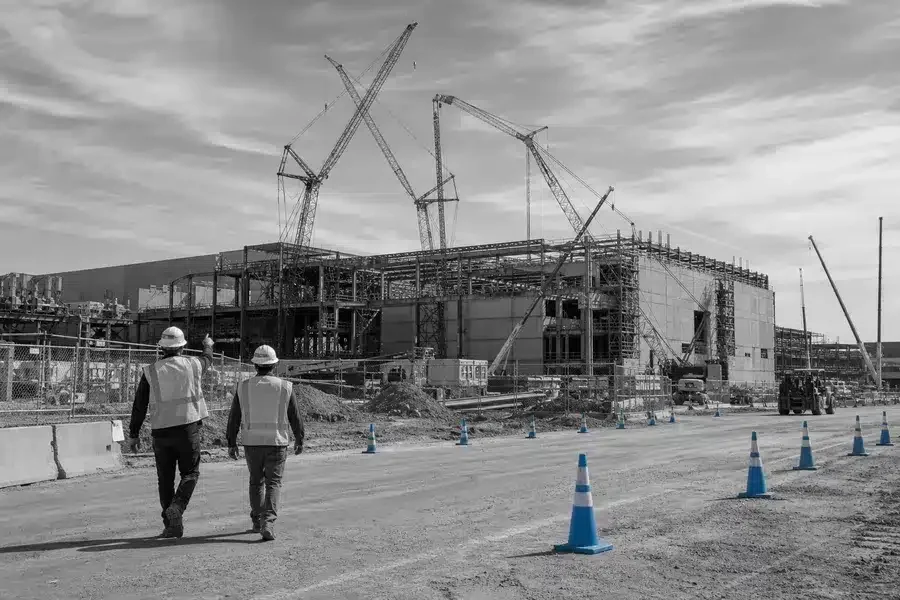
The additional $100 billion announced in July 2026 builds on the $165 billion commitment made in March 2025, which itself expanded an original $65 billion pledge 3. The enlarged programme covers six advanced wafer fabs, two advanced packaging facilities and a research-and-development centre in the Phoenix area 4.
Construction of the second fab is complete; tool installation is scheduled for later in 2026, with high-volume manufacturing targeted for the second half of 2027. The third fab, slated to use 2-nanometer and A16 process technologies, is already under construction, and permit applications for a fourth fab are in progress 2.
CFO Commentary and AI Conviction
CFO Wendell Huang framed the spending acceleration as a deliberate strategic response to a structural demand shift rather than a cyclical bet.
“We have strong conviction on the AI mega trend, and that is the reason we are stepping up the capital expenditures to expand in Taiwan and in the U.S.,” Huang said in an interview with CNBC.
Chairman and CEO C.C. Wei echoed the supply-side urgency, noting that capacity is “very tight” and that the Arizona gigafab cluster would help improve productivity, lower costs and serve U.S. customers more efficiently 2. Wei also said TSMC completed the purchase of a second large land parcel near the existing facilities, providing flexibility to address what he described as “very strong AI-related demand.”
Capital Expenditure and Forward Guidance
TSMC raised its 2026 capital expenditure forecast to between $60 billion and $64 billion, up from a prior ceiling of $56 billion, to fund the expanded fab programme 3. The company guided Q1 2026 revenue of $34.6 billion to $35.8 billion, ahead of the $33.7 billion reported in Q4 2025, and said it expects full-year 2026 revenue to increase nearly 30% 2.
Cloud service providers are sending “strong signals” and reaching out directly to request capacity, Wei said, a dynamic that suggests demand visibility extends well beyond near-term quarterly bookings 2.
Geopolitical and Trade Backdrop
The investment acceleration is also shaped by U.S. trade policy. A U.S.-Taiwan bilateral deal announced in January 2026 lowered tariffs on Taiwan imports to 15%, providing a more stable cost environment for TSMC’s cross-border operations 3. The deal was reported to include provisions tied to further U.S. semiconductor manufacturing commitments from TSMC 2.
As a parallel hedge, TSMC said it is accelerating a new wafer fab in Japan’s Kumamoto prefecture, which will deploy 3-nanometer process technology, further diversifying its manufacturing footprint beyond Taiwan 3.
Conclusion
For investors with a long time horizon, the clearest signal from TSMC’s current trajectory is the durability of AI-driven demand converting into concrete capacity commitments – not promises. With $265 billion committed to U.S. soil, a rising share of high-performance computing revenue, and Q1 2026 guidance ahead of consensus, TSMC appears to be translating the AI megatrend into a decade-long infrastructure buildout with measurable milestones.
The core risk remains execution: ramping multiple fabs simultaneously in a geography with higher labour costs than Taiwan, against a backdrop of shifting trade policy, will test operational discipline at scale.
Not investment advice. For informational purposes only.
References
1Dylan Butts, Emily Tan (Jan. 16, 2026). “TSMC is set to expand its $165 billion U.S. investment – here’s what we know”. CNBC. Retrieved July 19, 2026.
2Sara Samora (Jan. 16, 2026). “TSMC ramps up Arizona production as AI demand drove 2025 revenue to $122B”. Manufacturing Dive. Retrieved July 19, 2026.
3Iris Deng (Jul. 16, 2026). “TSMC pledges extra US$100b for Arizona fab expansion amid soaring AI chip demand”. South China Morning Post. Retrieved July 19, 2026.
4Alice Chambers (Apr. 13, 2026). “TSMC Accelerates Arizona Expansion as AI Demand Surges”. Technology Magazine. Retrieved July 19, 2026.
5Amy Edelen/Phoenix Business Journal (Jul. 18, 2025). “TSMC to accelerate production at Arizona fabs amid surging AI demand”. KTAR News. Retrieved July 19, 2026.