

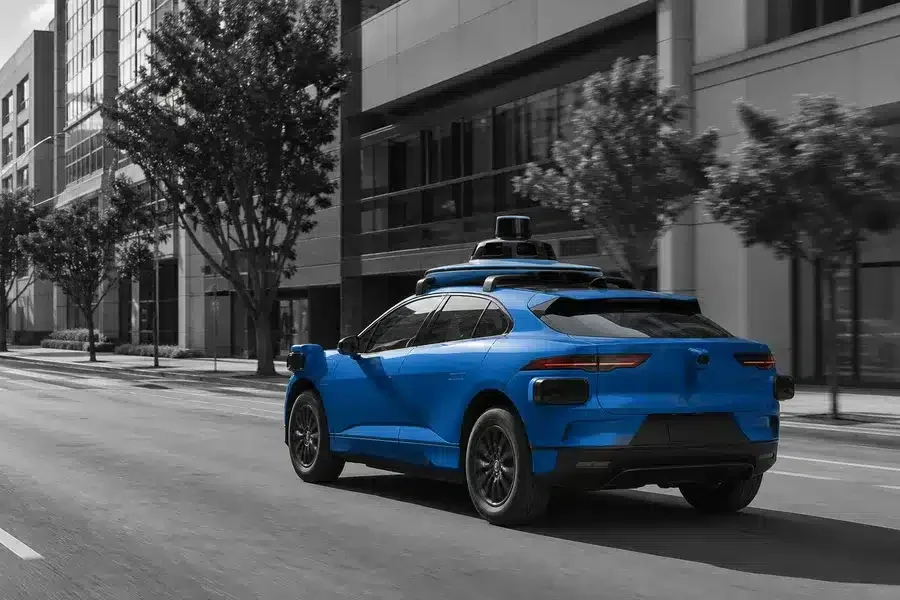
Alphabet’s autonomous-vehicle unit Waymo (GOOGL.O) plans to quintuple its robotaxi fleet to 20,000 vehicles by end-2027, funded by $5 billion in freshly raised private-credit debt, a scale-up that could materially shift the parent company’s revenue profile over the coming decade.
For long-horizon investors, the expansion signals Waymo’s transition from a research project into an operationally intensive, capital-heavy business – one whose unit economics and margin contribution will increasingly matter to Alphabet’s consolidated results.
Key Takeaways
- Fleet to double to 8,000 vehicles by end-2026, then reach 20,000 by end-2027.
- $5 billion raised as non-recourse private-credit debt, no Alphabet guarantee required.
- Chinese-made Zeekr (Geely) vehicles underpin the hardware ramp across 15 U.S. cities.
Scale in Context
Waymo currently operates roughly 4,000 robotaxis, placing it well ahead of domestic rivals but still a fraction of the scale needed to generate meaningful consolidated revenue for Alphabet, whose annual sales exceeded $300 billion in 2025. 1 The planned expansion to 20,000 units would make Waymo’s fleet larger than many traditional taxi operators in major U.S. metros combined, a benchmark that analysts say begins to make unit-economics modelling credible.
The $5 billion financing is structured as non-recourse private-credit debt, meaning lenders have no claim on Alphabet’s broader balance sheet if Waymo underperforms. 2 That structure limits contagion risk for GOOGL shareholders while preserving Waymo’s ability to tap additional capital through future lease securitisation, according to reporting by Semafor.
Detailed Analysis
The two-stage ramp – 8,000 vehicles by December 2026, then 20,000 by December 2027 – implies a sustained monthly vehicle-addition rate that requires a reliable, high-volume supply chain. 2 Waymo has placed orders for thousands of Zeekr-branded electric vehicles manufactured by China’s Geely, a supplier relationship that introduces both cost efficiency and geopolitical concentration risk worth monitoring.
Geographic expansion is running in parallel with fleet growth. Waymo reportedly targets operations in 15 U.S. cities, with Toronto identified as the next international market. 2 Broader city coverage accelerates data collection, which feeds the machine-learning models underpinning the autonomy stack – a compounding advantage that is difficult for later entrants to replicate quickly.
The non-recourse debt structure also carries implications for how investors should read Alphabet’s balance sheet. Because the obligation sits at the Waymo subsidiary level, it may not visibly stress Alphabet’s leverage ratios, but the operational cash demands of running a 20,000-unit fleet – insurance, maintenance, mapping, remote assistance – will flow through Alphabet’s “Other Bets” segment losses until Waymo reaches breakeven. 1
Outlook
Semafor, citing people familiar with the matter, said lease securitisation remains available as an additional borrowing mechanism once the fleet reaches sufficient scale, suggesting Waymo’s capital access could expand without further equity dilution. 1 The report did not disclose a timeline for profitability or a targeted revenue run-rate at 20,000 vehicles.
“Waymo plans to grow its fleet from 4,000 vehicles today to 8,000 by the end of 2026 and 20,000 by the end of 2027, operating across 15 U.S. cities with Toronto next,” Semafor reported, citing people familiar with the company’s plans. 2
The absence of an Alphabet guarantee on the debt is a deliberate structural choice that frames Waymo increasingly as a standalone commercial entity rather than an internal R&D division – a framing that could eventually support a separate public valuation event, though no such plan has been disclosed.
Conclusion
For investors focused on pipeline durability, Waymo’s phased fleet ramp backed by ring-fenced debt represents a credible, if still early-stage, pathway to meaningful revenue contribution within Alphabet’s “Other Bets” segment. The key variables to track over the next 24 months are vehicle-delivery pace from Geely’s Zeekr unit, per-ride economics as coverage density increases, and the rate at which “Other Bets” losses narrow – or widen – as operational complexity scales alongside the fleet.
Not investment advice. For informational purposes only.
References
1(2026, October 19). “Waymo plans to quintuple fleet to 20,000, Semafor reports”. Reuters. Retrieved October 20, 2026.
2Alexis Dufresne (2026, October 20). “Waymo Targets 8K Robotaxis by Year-End and 20K by End of 2027, Backed by $5B Non-Recourse Debt”. AI Weekly. Retrieved October 20, 2026.