


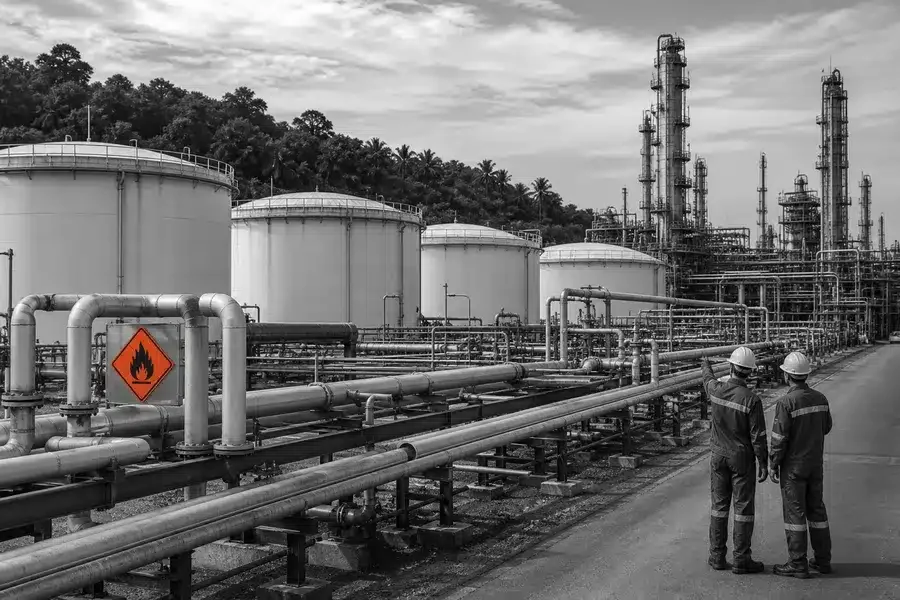
Crude oil shed roughly 5% in Asian trade Monday as Washington halted strikes on Iran and Tehran opened Strait of Hormuz negotiations with Oman, erasing a significant portion of the conflict-driven supply-risk premium.
For long-horizon energy investors, the move matters because Brent crude had already fallen around 10% from its recent conflict high – a rapid repricing that signals markets view the ceasefire as more than a brief tactical pause, potentially reshaping the forward curve and upstream capital-allocation decisions for months ahead.
Key Takeaways
- WTI fell 4.9% to $84.93; Brent dropped 4.6% to $92.30.
- Trump halted a planned multi-week Iranian strike campaign.
- Iran-Oman Hormuz talks raised hopes of shipping resumption.
Market Reaction & Context
Front-month West Texas Intermediate crude futures slipped 4.9% to $84.93 a barrel, while front-month Brent crude fell 4.6% to $92.30, according to ICE data 1. The twin declines extended a broader retreat: Maybank analysts noted Brent has now surrendered roughly 10% from its recent conflict-driven peak as hostilities moved into what they described as “an interim pause.” 1
The sell-off in crude contrasted with mild risk appetite elsewhere in Asia-Pacific equity markets. Hong Kong’s Hang Seng Index rose 0.8%, Japan’s Nikkei Stock Average added 0.2%, and Singapore’s FTSE Straits Times Index edged 0.2% higher, while Thailand’s SET and Indonesia’s JCI posted modest losses 1.
The divergence is notable: equity markets treated the ceasefire as a net positive for risk assets, while crude traders focused on the removal of the supply-disruption premium that had propped up oil prices during two weeks of U.S. air strikes on Iranian military and nuclear targets 3. Investors tracking energy-sector earnings should note that the speed of this drawdown suggests the war premium was substantial – and that any diplomatic reversal could rapidly reinstate it. Earlier coverage of the tanker-market impact can be found in our look at how Gulf oil transit volumes plummeted amid the initial Iranian threats.
Detailed Analysis: What Drove the Pause
The immediate catalyst was a White House decision, confirmed by U.S. officials, to stand down a planned series of strikes against Iran that had been set to launch Friday and could have lasted up to two weeks 1. The decision reflected a debate within the administration over depleting munitions stocks alongside a renewed push for diplomacy, officials said.
Simultaneously, Iranian and Omani officials held talks over the weekend focused specifically on navigation through the Strait of Hormuz – the chokepoint through which roughly one-fifth of the world’s seaborne oil passes 1. Commerzbank Research analysts said the combination of the halted strikes and Hormuz negotiations “raised hopes of some de-escalation” 1.
The Hormuz dimension is the critical variable for energy investors with long time horizons. Extended closure or partial restriction of the strait has historically caused non-linear price spikes; its reopening – even on a provisional basis – could suppress the risk premium structurally if a formal framework emerges. Background on the earlier disruption to shipping flows is detailed in our prior report on the initial crude price drop when the U.S.-Iran truce first emerged.
Management & Analyst Quotes
“Crude oil prices were on the slide after the U.S. halted strikes on Iran while the latter held talks with Oman over the Strait of Hormuz. Brent has fallen around 10% from its recent high as the conflict comes to an interim pause,” – Maybank analysts, FX Research & Strategy report. 1
President Trump, speaking to reporters Friday before the pause was confirmed, framed the decision in deal-making terms. “There’s a military exit where we just keep going just the way we are, and we can even make it a heavier dose, and it’s knocking out everything they have,” Trump said. “Or there’s a smarter strategy that you make a deal. And they want to make a deal.” 1
Outlook for Long-Horizon Investors
The scale and speed of crude’s drawdown – nearly 10% from peak within days of a ceasefire signal – highlights how much of the recent oil price elevation was geopolitical premium rather than fundamental supply tightening. If diplomacy progresses and Hormuz navigation resumes at full capacity, downstream pressure on energy-sector margins and upstream producer cash flows could intensify, particularly for producers whose break-even economics assumed elevated prices 2.
Risks to the downside scenario remain material. The pause is explicitly provisional; U.S. officials have not ruled out resuming strikes, and no formal agreement on Iran’s nuclear program exists. Investors in energy equities and commodity-linked instruments should monitor the progress – or breakdown – of the Iran-Oman-U.S. diplomatic channel as the primary near-term price driver, with the Hormuz shipping corridor serving as the most direct real-time indicator of whether the de-escalation holds.
Conclusion
Crude’s sharp Monday retreat underscores the dominant role geopolitical risk has played in energy pricing over the past fortnight. The convergence of a U.S. strike pause, an open diplomatic channel, and direct Hormuz navigation talks has, for now, shifted the balance of probability away from sustained supply disruption – and the futures market priced that shift immediately. Whether the premium returns depends entirely on whether Washington and Tehran can convert a tactical ceasefire into a durable framework.
Not investment advice. For informational purposes only.
References
1Harui, Ronnie (2026-07-27). “Oil Falls Amid Signs of Pause in U.S.-Iran Conflict – Update”. MarketWatch / Dow Jones Newswires. Retrieved 2026-07-27.
2(2026-07-27). “Oil prices dip over 6% after US, Iran pause fighting”. Reuters via Facebook. Retrieved 2026-07-27.
3(2026-07-27). “Oil prices tumble amid a pause in fighting between the U.S. and Iran”. SABC News via YouTube. Retrieved 2026-07-27.