


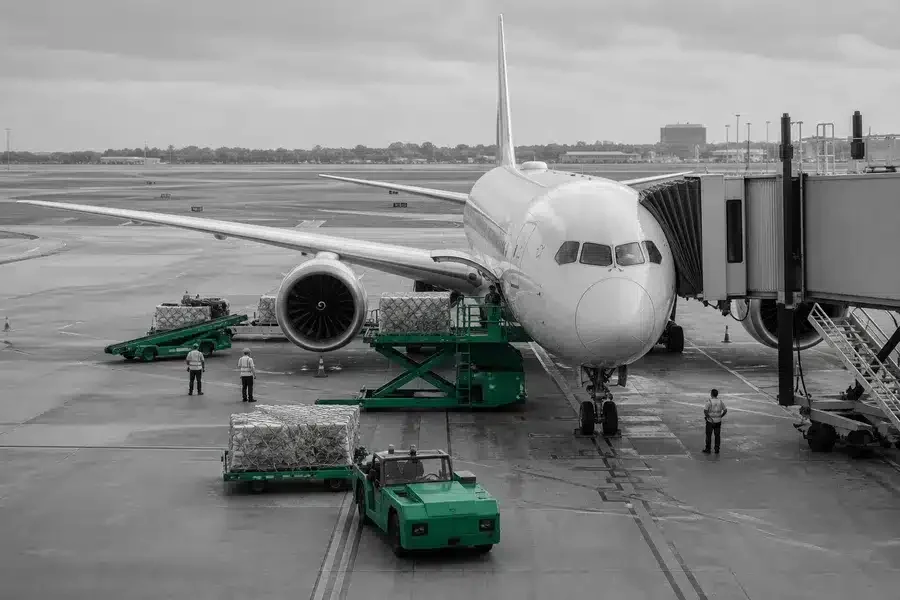
Ground workers at Qantas Airways (QAN.AX) launched a 24-hour strike Thursday across four major Australian airports, intensifying labour pressure on an airline still absorbing a record A$90 million court penalty.
For long-horizon investors, the action raises questions about recurring operational disruptions, the durability of Qantas’s cost structure, and whether the airline’s multi-subsidiary labour model can withstand continued legal and industrial challenge.
Key Takeaways
- Strike hits Sydney, Brisbane, Adelaide and Perth simultaneously on Thursday.
- Workers cite pay, job security and fragmented subsidiary structure as core grievances.
- Qantas already carries a court-ordered A$90 million fine over illegal outsourcing.
Market Context & Operational Exposure
The work stoppage spans Qantas Ground Services (QGS), Australian air Express (AAE) freight operations, and regional carrier QantasLink – three units that form a critical backbone of the airline’s domestic and freight network 1. Rival carriers including Virgin Australia have faced their own periodic industrial disputes, but Qantas’s exposure is compounded by the legal legacy of its 2020 mass outsourcing, which a court later deemed unlawful.
In Sydney, up to 400 safety screeners are conducting two separate two-hour stoppages on Thursday, with a further three-hour stoppage planned for September 28, according to the Transport Workers’ Union (TWU) 1. That layered disruption pattern suggests the industrial action is not a single event but part of an escalating campaign that could weigh on on-time performance metrics and freight reliability. Investors tracking how Qantas freight operations are holding up under strike pressure should note that AAE handles time-sensitive cargo flows across the domestic network.
The Workforce Structure at the Heart of the Dispute
Workers are demanding pay increases in line with industry standards, more full-time positions, and the consolidation of multiple work groups under a single Qantas enterprise agreement 1. The union argues that Qantas’s use of at least 21 external companies and 17 subsidiaries has fragmented the workforce, suppressed wages, and weakened safety oversight 2.
Current base pay for ground workers sits at roughly A$26-A$30 per hour, close to the national minimum wage, while the cost of living has risen approximately 31.4% over the past decade against wage growth of only 19.4-25.6% for this cohort 2. That real-wage erosion is the arithmetic backdrop to the dispute – and the gap makes a swift, low-cost resolution unlikely.
Legal Overhang and Penalty Precedent
A court last year ordered Qantas to pay a record A$90 million ($64 million) civil penalty related to the illegal outsourcing of more than 1,800 ground workers during the COVID-19 pandemic – action the High Court ultimately found unlawful 1. The airline also agreed to a separate A$120 million compensation scheme for affected workers, averaging roughly A$66,000 per employee 2.
Those figures set a material financial precedent: prolonged industrial disputes at Qantas carry real balance-sheet consequences, not merely reputational ones. Investors should factor ongoing litigation risk into any cost-of-labour assumptions embedded in consensus earnings models.
Management Stance and Union Position
Qantas did not immediately respond to a request for comment on the strike 1. The airline has previously said it is offering annual pay increases and more full-time opportunities, though it has not publicly quantified either commitment 2.
“Strike action is always a last resort, but we are literally seeing workers maimed and killed keeping these critical services going,” TWU National Secretary Michael Kaine said 1.
The union also called for a “fundamental reset” of Qantas’s labour structure after what it described as years of cost-cutting through subsidiary fragmentation 1. With a 97% strike mandate voted in late August and further stoppages already scheduled, the TWU’s posture suggests protracted bargaining rather than imminent settlement 2.
Conclusion
The 24-hour strike is the most visible symptom of a deeper structural tension at Qantas: a labour model built around subsidiaries and outsourcing that courts have found illegal and workers are now challenging through sustained industrial action. Until the airline offers quantified wage commitments and a credible path to workforce consolidation, further disruption remains the baseline scenario – a risk that long-term holders of QAN.AX should price into their operational assumptions.
Not investment advice. For informational purposes only.
References
1Reuters (September 24, 2026). “Qantas workers begin 24-hour strike at four Australian airports, union says”. Reuters. Retrieved September 24, 2026.
2(September 22, 2026). “Australia: Qantas ground workers set to strike”. World Socialist Web Site. Retrieved September 24, 2026.