


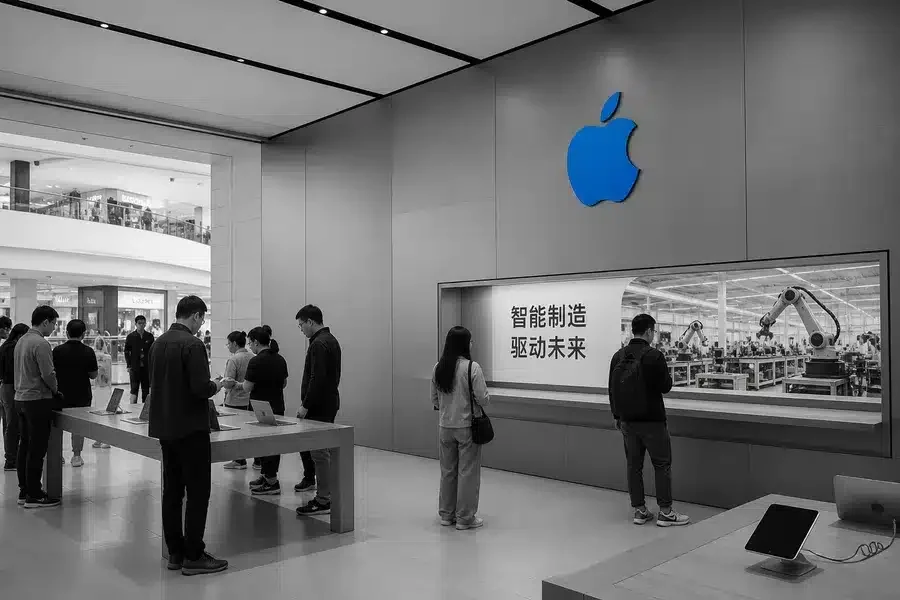
Apple (AAPL.O) has quietly trained a China-specific large language model with Alibaba Group’s (9988.HK) support, sources said Thursday, making it the first foreign firm cleared by Beijing to deploy a proprietary AI model in the country.
For long-horizon investors, the move signals a meaningful strategic pivot: rather than depending entirely on third-party Chinese AI providers, Apple is building direct control over the AI layer on devices sold in its most competitive overseas market – a shift that could defend revenue in a region where domestic rivals have been gaining ground fast.1
Key Takeaways
- Apple trained a proprietary LLM for China, backed by Alibaba infrastructure.
- Apple Intelligence suite expected to launch in China within months.
- Apple would be the first foreign firm with a Beijing-approved proprietary AI model.
Market Reaction & Context
Alibaba’s U.S.-listed shares jumped roughly 4% in premarket trading last month when China’s Cyberspace Administration of China (CAC) registered Apple’s generative AI service – an early signal of how much investors value the tie-up.1 Apple itself has faced sustained competitive pressure in China from Huawei and other domestic brands that have shipped AI-enabled handsets, contributing to a well-documented softening of iPhone sales in the market.
China’s broader technology sector has struggled with mixed economic signals. Manufacturing contraction and weakening domestic demand have clouded the outlook for consumer hardware, making any credible AI catalyst in the iPhone lineup particularly relevant for investors tracking Apple’s Greater China segment.
Detailed Analysis
Three people familiar with the matter told Reuters that Apple trained the China-specific model with Alibaba’s technical support, a departure from its earlier strategy of routing AI features through third-party domestic models such as Alibaba’s Qwen or Baidu’s offerings.1 The CAC registration, completed in July 2026, cleared the principal regulatory hurdle that had blocked Apple Intelligence from reaching Chinese iPhones since the feature launched elsewhere.
Under the arrangement now taking shape, Alibaba’s Qwen model is still set to be incorporated into Apple Intelligence on compatible iPhone, iPad, Mac, and Vision Pro devices in China, alongside technology from Baidu – but Apple’s proprietary model would sit alongside those partnerships rather than replace them.1 The precise division of labour between Apple’s own model and third-party Chinese models had not been disclosed as of publication.
Apple published – and then quietly deleted – a Chinese-language guide in early August explaining how eligible Mac users in mainland China could connect Qwen to Siri and Writing Tools, a Mac-specific arrangement that analysts viewed as a beachhead in China’s AI PC market.1 No explanation for the deletion was given.
The dual-track strategy – proprietary model plus licensed domestic models – is notable because it mirrors, at a deeper level of technical integration, the approach other foreign consumer brands have attempted in China’s regulated digital environment. Companies such as Nike have restructured their China operations around digital-first distribution to retain relevance; Apple’s play is architecturally similar but executed at the AI infrastructure layer.
Regulatory Dimension
If confirmed, Apple would become the first foreign company approved by Beijing to offer a proprietary generative AI model inside China – a milestone that carries both commercial and geopolitical weight given the widening trade and technology rift between Washington and Beijing.1 The CAC’s approval process, which ended in July, required Apple to register its service formally before any consumer rollout could proceed.
Regulatory uncertainty is not entirely resolved: sources cautioned that the exact timing of the Apple Intelligence launch in China, expected “in the coming months” following an iOS update, remains subject to further regulatory steps.1
Management Perspective
Neither Apple nor Alibaba responded to Reuters’ requests for comment on the proprietary model.1 The partnership’s existence, however, has been publicly acknowledged since February 2025, when Alibaba chairman Joe Tsai, speaking at the World Governments Summit in Dubai, confirmed the selection.
“They talked to a number of companies in China. In the end they chose to do business with us,” Tsai said at the time.
Tsai’s remarks underscore that the Apple-Alibaba tie-up was the result of a competitive process among China’s major AI players, and that Alibaba views the arrangement as a meaningful commercial opportunity, not merely a regulatory necessity.
Conclusion
Apple’s decision to train its own China-specific LLM, rather than relying entirely on domestic partners, represents a long-term bet that owning more of the AI stack – even in a heavily regulated market – is worth the complexity of a dual-track deployment model. For investors monitoring Apple’s ability to defend its premium positioning in China against Huawei and other local competitors, the success of Apple Intelligence in the country now depends not only on regulatory execution but on whether a proprietary model can close the perceived AI gap with domestic alternatives quickly enough to influence the next iPhone upgrade cycle.
Not investment advice. For informational purposes only.
References
1Reuters (August 14, 2026). “Apple trains its own AI model for China market with Alibaba’s support, sources say”. Reuters. Retrieved August 14, 2026.