


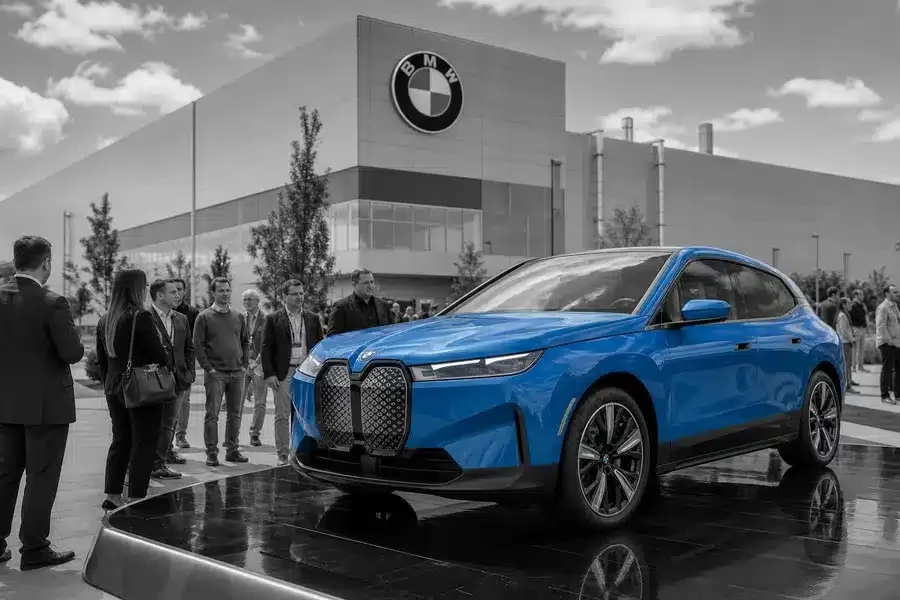
BMW AG confirmed it will produce at least three all-electric SUVs at its Spartanburg, South Carolina plant beginning in 2026, anchoring a $1.7 billion U.S. manufacturing commitment as rivals scale back EV ambitions amid mounting losses.
For long-horizon investors, the strategy signals a structurally different approach to electrification: vertical integration of battery supply, local manufacturing, and tariff insulation – all within a single U.S. state.
Key Takeaways
- First U.S.-built BMW EV, the iX5, enters production in 2026.
- $700 million battery plant in Woodruff, S.C., supports six EVs by 2030.
- Local cell supply from AESC shields BMW from tariff disruption.
Investment Thesis: Manufacturing Durability Over Speed
While General Motors and Ford have each disclosed billions in EV losses and delayed or pared back electric-vehicle programs, BMW has held its U.S. electrification timeline largely intact.1 Spartanburg already generates more than $10 billion in annual export value – making BMW the largest U.S. automotive exporter by value for nine consecutive years – giving any EV ramp-up there an immediate global revenue base.2
That export leverage matters to investors tracking margin durability: roughly 60% of Spartanburg output ships to approximately 120 global markets, meaning electric X-model revenues will not depend solely on domestic U.S. EV demand. Readers following the broader EV policy environment may note that local production also offers a buffer against the kind of trade restrictions seen in the U.S. EV market’s evolving import-ban landscape.
The Supply-Chain Architecture
BMW broke ground on “Plant Woodruff,” a more than one-million-square-foot high-voltage battery assembly facility in Woodruff, South Carolina, funded by $700 million of the total $1.7 billion commitment.1 The remaining $1 billion is earmarked to retool Plant Spartanburg’s assembly lines for battery-electric-vehicle production.
Battery cells will be sourced domestically from AESC (formerly Envision AESC), which is constructing a 30 GWh cell factory in Florence, South Carolina – with BMW as its anchor customer.1 The sixth-generation cylindrical cells promise more than 20% greater energy density and up to 30% improvement in charging speed and range versus current units, while cutting cell-production CO₂ emissions by up to 60% through use of secondary lithium, cobalt, and nickel and renewable energy.1
Model Pipeline and Production Timeline
The all-electric iX5 is slated to roll off Spartanburg’s lines in 2026, followed by the full-size iX7 in 2027 – BMW’s first zero-emissions large luxury SUV, which will compete against the Cadillac Escalade IQ in a high-margin segment.3 An iX6 coupe and a high-performance iX5 M70 are targeted for 2028, with a flagship iX7 M70 reportedly exceeding 800 horsepower also in the pipeline.3
By 2030, BMW said Plant Spartanburg will manufacture at least six fully electric X models, building on the three plug-in hybrid variants – the X3 xDrive30e, X5 xDrive50e, and XM – already in production there.1 More than 300 jobs will be created at Plant Woodruff alone, with further growth projected as capacity scales.1
Management View
“Every second vehicle built at our Spartanburg plant is exported, generating an export value of over $10 billion in 2024 alone. Over the past 10 years, our total export value has exceeded $100 billion. Now, we are investing over $1.7 billion to bring Spartanburg up to speed for e-mobility. The first e-model from Spartanburg will already roll off the assembly line next year.”
– Oliver Zipse, Chairman of the Board of Management, BMW AG, May 20252
Plant CEO Dr. Robert Engelhorn added that Plant Woodruff “will be state-of-the-art in terms of sustainability, flexibility, and digitalization,” including 100% green electricity and a fossil-fuel-free operating model.1
Sustainability and Cost Structure
Plant Woodruff will operate without fossil fuels and targets only 67 kWh per square meter per year in energy consumption – a figure BMW said reflects best-in-class industrial efficiency.1 The facility will also use CarbonCure technology, which injects captured CO₂ into concrete during mixing, permanently sequestering carbon at the molecular level while increasing structural strength.1
For investors focused on ESG metrics and long-term operating costs, the integrated renewable energy design and water-harvesting systems could reduce lifecycle cost pressures as carbon pricing regulations tighten globally.
Conclusion
BMW’s South Carolina ecosystem – spanning cell production in Florence, battery assembly in Woodruff, and vehicle manufacturing in Spartanburg – represents one of the most vertically integrated EV supply chains being built by a legacy automaker on U.S. soil. The structure is designed to withstand tariff volatility, hedge against import-cost inflation, and leverage an existing export network worth more than $10 billion annually.
Whether BMW’s premium SUV EV lineup can sustain margins comparable to its combustion counterparts remains the central long-term question for shareholders tracking the transition’s earnings impact.
Not investment advice. For informational purposes only.
References
1BMW Group PressClub (2023). “BMW Group Breaks Ground on New High-Voltage Battery Assembly Factory in South Carolina.” BMW Group PressClub USA. Retrieved June 30, 2026.
2(June 9, 2025). “BMW to build three EVs at Spartanburg plant beginning in 2026.” Repairer Driven News. Retrieved June 30, 2026.
3(June 9, 2025). “Electric BMW X5, X6, and X7 SUVs to Be Produced at the Automaker’s U.S. Plant.” EV.com. Retrieved June 30, 2026.
4The Globe and Mail (October 20, 2022). “BMW to invest $1.7-billion to build electric vehicles in U.S.” The Globe and Mail via Facebook. Retrieved June 30, 2026.
5The Electric Viking (November 1, 2022). “BMW’s $1.7B EV Investment in South Carolina + Giga Kentucky.” YouTube. Retrieved June 30, 2026.