


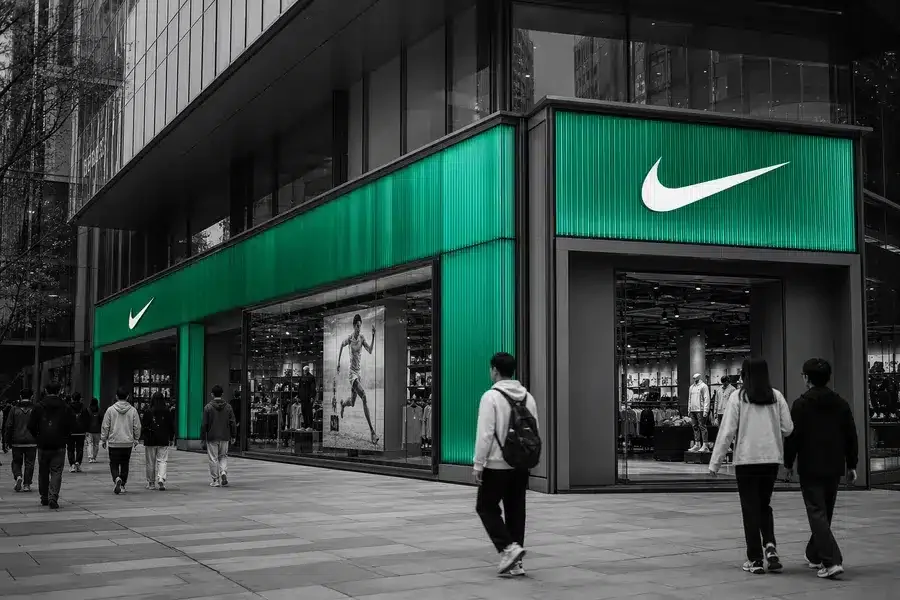
Nike (NKE) confirmed Tuesday it will cut off thousands of Chinese online distributors starting January 2027, consolidating sales into four official storefronts in a bid to reclaim pricing control over a market that has shed roughly 30% of its revenue in five years.
The move carries meaningful margin implications: funnelling volume through direct and curated channels could lift average selling prices, but analysts warn a sharp near-term revenue drop in Greater China-already down 17% on a constant-currency basis last quarter-may accelerate before any recovery takes hold.
Key Takeaways
- Nike will limit China online sales to Tmall, JD.com, Douyin and Nike-owned channels.
- Greater China revenue has contracted ~30% over the past five years.
- BNP Paribas keeps an underperform rating, calling the strategy a potential misstep.
Market Context & Distribution Stakes
Nike’s Greater China segment reported a 17% constant-currency decline in its most recent fourth quarter, steeper than the 10% drop recorded in the prior period, leaving the brand trailing domestic rivals Anta and Li Ning that have aggressively captured share with localized product lines. 1 Investors tracking China’s structural shift toward homegrown consumer brands-a dynamic explored in recent coverage of China’s strategic pivot and its portfolio implications-will recognise that Nike’s challenge extends beyond channel management.
The restructuring will affect most of Nike’s 16 store partners in mainland China, which have built significant online businesses on top of their brick-and-mortar operations. 2 Topsports, Nike’s largest mainland distributor, disclosed in a Hong Kong exchange filing that online Nike sales represent 22% of its total revenue, and its board flagged a “significant” short-term negative impact. 4
The Fragmentation Problem
Nike’s China e-commerce landscape currently spans thousands of third-party storefronts operated by brick-and-mortar partners and secondary distributors, creating what Greater China VP and GM Cathy Sparks called a cluttered marketplace. Starting January, authorised digital sales will flow exclusively through Nike.com, the Nike app, and official brand flagships on Tmall, JD.com and Douyin. 1
The proliferation of storefronts has contributed to inconsistent pricing-a structural drag on margins and brand equity that Nike’s management says undermines the premium positioning the company is trying to rebuild under CEO Elliott Hill. 2
Analyst Pushback & Historical Parallel
BNP Paribas senior analyst Laurent Vasilescu drew an explicit comparison to Nike’s ill-fated decision to pull back from North American wholesalers several years ago, a move that opened shelf space for competitors and contributed to a prolonged market-share erosion. 3
“We don’t think Nike has a distributor problem but rather a product problem which also applies in other markets,” Vasilescu said, reiterating a formal underperform rating on the stock. 3
That parallel will weigh on long-horizon investors who recall how the North America direct-to-consumer pivot initially suppressed revenue before failing to deliver the promised margin uplift. For companies attempting structural channel resets-a dynamic also visible in VW’s stakeholder-tested cost-cut strategy-execution risk typically peaks in the first four to six quarters after launch.
Management View & Distributor Response
Sparks framed the consolidation as a brand-quality initiative rather than a volume reduction. 2
“This is not about reducing access. It is about reducing fragmentation and strengthening the consumer journey. When the experience is consistent, the brand becomes stronger,” Sparks said in a letter to partners. 1
Topsports CEO Yu Wu said the 27-year-old partnership with Nike leads his company to support the direction despite the near-term pain. “We firmly believe that, over the medium- to long-term, this direction will help promote a healthier, more orderly, and more sustainable retail ecosystem in China,” Wu said. 1 The distributor indicated it will lean into offline concept stores and tiered-city physical retail to offset lost digital volume.
Outlook for Long-Horizon Investors
Nike has also appointed a vice president of local product creation in Greater China, signalling that channel cleanup is only part of the turnaround thesis-product relevance is the other. 4 Whether a tighter digital footprint can translate into higher average selling prices and improved gross margin in the region remains the central question for investors, with the January 2027 implementation date marking the first measurable checkpoint.
The company’s ability to migrate consumers from thousands of third-party storefronts to four curated destinations-without ceding further volume to Anta, Li Ning, On or Hoka-will determine whether the strategy registers as a margin catalyst or a repeat of the North America wholesale miscalculation. 3
Not investment advice. For informational purposes only.
References
1Fonrouge, Gabrielle (2026-07-21). “Nike to cut off thousands of online distributors in China, restructure digital footprint”. CNBC. Retrieved 2026-07-22.
2Kaye, Danielle (2026-07-21). “Nike to tighten online sales in China amid ‘cluttered’ marketplace”. Reuters via MSN. Retrieved 2026-07-22.
3Young, Vicki M. (2026-06-24). “Nike Could Be Shaking Up Its China Business: Here’s How”. WWD / Footwear News. Retrieved 2026-07-22.
4(2026-07-22). “Nike to Shut Down Thousands of Online Distributors in China in Bid to Revive Brand”. BigGo Finance. Retrieved 2026-07-22.