


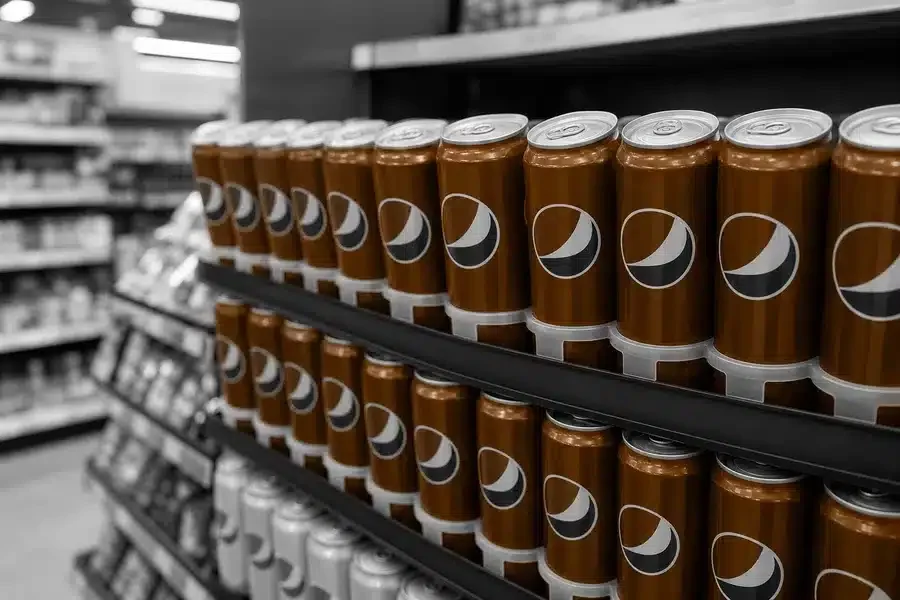
PepsiCo (PEP.O) shares fell roughly 5% on Thursday after the snack-and-beverage giant posted second-quarter core earnings per share of $2.20 – slightly below consensus – as North American food sales dropped 2% and the company flagged higher commodity costs ahead.
For long-horizon investors, the more consequential signal is management’s admission that the improvement in North American performance trends will be “more gradual” than expected through year-end, raising questions about how durable the company’s margin recovery can be while it simultaneously cuts prices and ramps up marketing spend.1
Key Takeaways
- Core EPS of $2.20 missed estimates; North America food sales fell 2%.
- Higher H2 commodity costs threaten margins despite productivity offsets.
- Full-year organic revenue growth guidance of 2%-4% left unchanged.
Market Reaction & Context
The roughly 5% share decline on Thursday morning placed PepsiCo among the worst-performing large-cap consumer staples names of the session, a notable underperformance relative to the broader S&P 500 Consumer Staples index, which was broadly flat.2
Revenue rose 6.4% year-on-year to $24.18 billion, beating analyst forecasts of $23.95 billion compiled by LSEG, and organic revenue grew 2.4% – but the top-line beat was largely driven by international markets rather than the company’s core North American franchise.1
Global food volumes rose 3% and beverage volumes climbed 2%, yet North American beverage volumes fell 4% – a divergence that underscores how reliant the company has become on overseas growth to compensate for weakness at home.
Detailed Analysis: Where the Pressure Is Building
PepsiCo has been fighting a two-front cost war: rising packaging and logistics expenses driven in part by elevated oil prices, and the need to lower shelf prices on marquee brands – including Lay’s, Doritos, Tostitos, and Cheetos – by as much as 15% to recapture value-seeking shoppers.1
Chief Financial Officer Steve Schmitt said North American food results were “softer than expected” in the second quarter, with the division reporting flat volume despite the price reductions – a sign that demand elasticity has been slower to respond than the company modelled.2
High gasoline prices compounded the problem, with CEO Ramon Laguarta acknowledging they had “dented consumer demand more than anticipated.” Elevated fuel costs reduce discretionary spending on packaged snacks, particularly for lower-income households that skew toward PepsiCo’s core convenience-store channel.
Looking into the second half, Schmitt warned of higher input-cost inflation but said tariff refund claims from the prior year and ongoing productivity savings should partly cushion the hit – a hedge that analysts will be watching closely for evidence it materialises in reported margins.1
Outlook & Management Commentary
PepsiCo kept its full-year 2026 guidance intact, expecting organic revenue growth of 2% to 4% and core constant-currency EPS growth of 4% to 6% – a decision that signals confidence in the international business and the back-half marketing push, even as North America recovers more slowly than hoped.
“The North America advertising and marketing expense is projected to increase in the second half,” Schmitt said on the analyst call. “So we’re going to continue to play offense.”
Laguarta credited portfolio evolution and international strength for positive organic volumes overall, while noting that brand relevance remains the key battleground. eMarketer analyst Suzy Davidkhanian put it plainly: “Pepsi’s challenge isn’t building iconic brands, it’s keeping them relevant – consumers are becoming more intentional about where they spend, and they expect the brands they already know to evolve with them by giving them more choice.”1
On the product side, PepsiCo is reformulating offerings to remove artificial colors and flavors – such as Gatorade Lower Sugar – and launching protein-focused lines like Propel powder and Quaker Protein Rice Crisps, moves aimed at capturing health-conscious shoppers who are trading up in quality even as they trade down in price.
Conclusion: A Patience Test for Long-Horizon Holders
Thursday’s results reinforce a pattern familiar to investors tracking consumer staples through inflationary cycles: volume recovery is non-linear, and price investment takes multiple quarters to rebuild purchasing habits.2 The guidance hold provides a floor, but the combination of rising second-half input costs, a gradual North American turnaround, and a heavier marketing spend commitment means free cash flow visibility is narrower than it was a quarter ago.
Long-horizon investors will need to weigh whether PepsiCo’s international momentum and portfolio repositioning can bridge the gap until North American consumers regain spending confidence – a dynamic not unlike the recovery calculus facing other consumer brand giants navigating tighter household budgets, as seen recently with Nike‘s own struggle to determine whether its earnings inflection represents a true turning point.
Not investment advice. For informational purposes only.
References
1Anuja Bharat Mistry and Alexander Marrow (July 9, 2026). “PepsiCo warns of higher commodity costs amid faltering North American food sales”. Reuters. Retrieved July 9, 2026.
2(July 9, 2026). “PepsiCo earnings miss estimates as North America demand weakens”. ANews. Retrieved July 9, 2026.
3CNBC (@CNBC) (July 9, 2026). “PepsiCo earnings miss estimates as North American consumers tighten their budgets”. X (formerly Twitter). Retrieved July 9, 2026.