


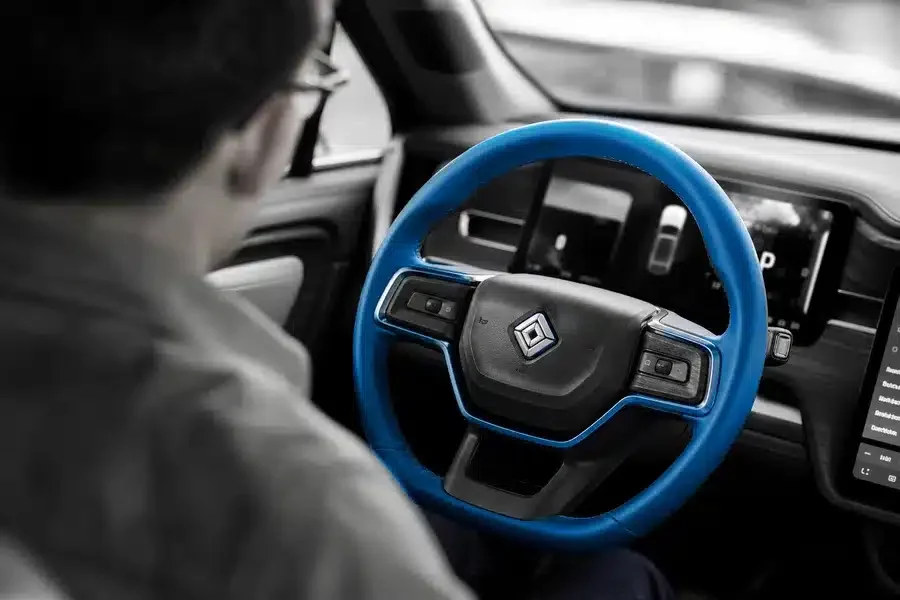
Rivian Automotive (RIVN) is targeting a supervised point-to-point self-driving feature for Gen 2 vehicles later in 2026, a move CEO RJ Scaringe said positions the company to compete directly with Tesla’s Full Self-Driving suite and open a software revenue stream that could reshape the EV maker’s long-term margin profile.
For long-horizon investors, the announcement matters because autonomous-driving software-sold via subscription or one-time licence-carries structurally higher margins than vehicle hardware, making RIVN’s pipeline credibility on this front a potential inflection point for its path to profitability.
Key Takeaways
- Point-to-point supervised driving targets Gen 2 Rivians in 2026.
- Rivian’s “Large Driving Model” uses end-to-end AI training similar to Tesla FSD.
- Lidar-equipped R2 crossovers, due late 2026, underpin the next capability leap.
Market Reaction & Context
RIVN shares have lagged the broader EV cohort in 2026, with Tesla (TSLA) retaining a commanding lead in deployed autonomous-driving miles and a subscriber base that gives it a continuous data advantage. Rivian’s current hands-free offering, Universal Hands-Free, covers approximately 3.5 million miles of roadway-a fraction of the geographies Tesla’s FSD (Supervised) navigates-underscoring the gap that Scaringe’s roadmap is designed to close 1.
Among non-Tesla U.S. EV makers, Rivian is one of the few pursuing end-to-end neural-network autonomy in-house rather than licensing third-party systems, a strategic distinction that could prove decisive if regulators eventually draw a line between truly integrated and bolt-on solutions.
How the Technology Works
Rivian’s system, branded internally as the Large Driving Model (LDM), ingests real-world driving data primarily from existing customers and trains end-to-end-absorbing sensor inputs on one side and emitting vehicle-control outputs on the other, with structured safety guardrails layered on top 1. Nick Carlevaris-Bianco, senior director of perception on Rivian’s autonomy team, said the model learns implicitly: speed-bump behaviour, for example, was never explicitly coded but emerged from training data alone.
That architecture mirrors Tesla’s approach to FSD and contrasts with older rule-based systems that required engineers to manually program responses to every edge case. The upside is generalisability; the risk is that imperfect human driving embedded in training data can introduce unwanted habits-Rivian engineers said early models would accelerate hard on open roads and roll through stop signs, tendencies the team has since trained out.
Pipeline Durability: Near-Term vs. Long-Term Milestones
In the near term, Rivian plans supervised point-to-point driving-destination entered, vehicle executes the entire journey with a human ready to intervene-for current Gen 2 R1 and commercial-van customers sometime in 2026 2. An InsideEVs journalist who rode in a prototype R1S described the experience as “uneventful in a good way,” noting smooth stops, respected traffic signals and mostly fluid lane changes, though minor hesitations at speed bumps and green lights required the safety driver to nudge the accelerator 1.
The longer-duration bet rests on the lidar-equipped Rivian R2, slated for late 2026, which the company says will deliver meaningfully richer perception data and accelerate LDM training quality. Beyond that, Scaringe has outlined a roadmap toward eyes-off driving in defined scenarios, with Level 4 autonomy as a longer-horizon ambition.
Management Outlook
“Today on an R1 you can get on the highway and take your hands off the wheel, and the vehicle drives itself. That’s going to expand from highways to point-to-point so you get in your car in your driveway, put in an address, and it drives itself. Then we expand from there to not just hands off point-to-point, but hands off, eyes off where you can take your hands off the wheel and eyes off the road.” – RJ Scaringe, CEO, Rivian Automotive 2
Scaringe’s phased framing is notable for investors because it separates near-term deliverable features from aspirational capabilities, a communication approach that reduces the risk of guidance overpromise that has historically punished EV stocks. Whether the timeline holds will depend heavily on how quickly the LDM accumulates high-quality miles from the Gen 2 fleet and, subsequently, from lidar-equipped R2 vehicles.
Conclusion
Rivian’s autonomy push is still early-stage relative to Tesla’s years of fleet data accumulation, and independent observers remain sceptical about the compressed timeline 3. However, the structural logic-building a high-margin software layer on top of an existing hardware business-is precisely the kind of revenue-mix shift that long-horizon investors should monitor as a potential catalyst for RIVN’s long-delayed turn to sustained profitability.
Not investment advice. For informational purposes only.
References
1Levin, Tim (Dec 31, 2025). “I Got A Sneak Peek At Rivian’s Answer To Tesla Full Self-Driving”. InsideEVs. Retrieved June 15, 2026.
2Katsudon (May 12, 2025). “RJ: Rivian ADAS will expand to Tesla style FSD – full self driving on highway and roads (from driveway to destination)”. Rivian Forums. Retrieved June 15, 2026.
3DennisCW (Jun 14, 2026). “Rivian CEO Gives BIG Update to Autonomy+ (FSD Competitor)”. YouTube. Retrieved June 15, 2026.
4Tdp Alpha (Dec 14, 2025). “What do we think rivian FSD pricing $2500 or $50 a month”. Tesla Model Y Owners Worldwide (Facebook Group). Retrieved June 15, 2026.