


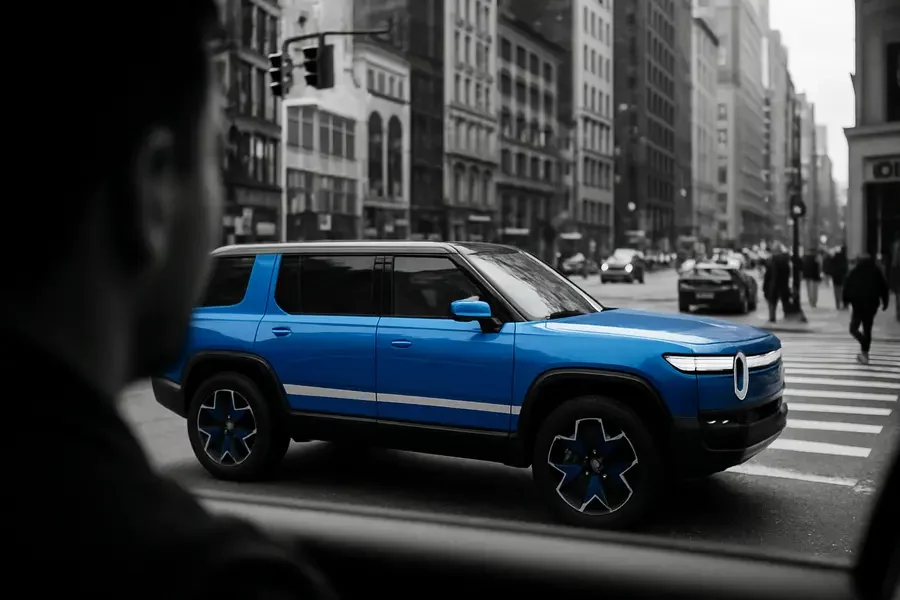
Rivian (RIVN.O) unveiled ambitious autonomous driving plans Thursday including custom chips and robotaxi goals, challenging Tesla’s technology leadership in self-driving vehicles.
The announcements signal Rivian’s push beyond traditional electric trucks into high-margin autonomous services that could significantly boost long-term revenue potential.
Key Takeaways
- Rivian developing custom autonomy computer chip for future vehicles
- R2 model getting lidar sensors for enhanced self-driving capabilities
- Company targets fully autonomous robotaxi service in future
Market Context and Technology Push
The electric vehicle startup’s autonomous driving ambitions put it in direct competition with Tesla’s Full Self-Driving technology and other established players like Waymo 1. Rivian’s approach differs by incorporating lidar sensors, which Tesla has famously avoided in favor of camera-only systems.
The company’s R2 electric SUV, expected to launch in 2026, will feature the new lidar technology and Rivian’s first in-house developed computer chip designed specifically for autonomous driving functions 2.
AI Assistant and Custom Development
Separate from its 5.8 billion partnership with Volkswagen, Rivian has spent nearly two years developing its own AI assistant for vehicles 3. The company developed much of the AI software stack in-house, including custom models and what it calls the “orchestration layer” – essentially the traffic control system for AI functions 4.
This vertical integration strategy mirrors Tesla’s approach of controlling key technologies internally rather than relying on third-party suppliers.
Autonomous Vehicle Strategy
Rivian’s autonomy computer will enable what the company describes as “hands-off driving” capabilities, with the ultimate goal of launching a robotaxi service 5. The integration of lidar sensors represents a significant technological bet, as these laser-based systems provide precise distance measurements that complement traditional cameras.
The announcement comes as the autonomous vehicle industry faces growing investor scrutiny over timelines and profitability, with several companies scaling back ambitious self-driving promises.
Financial Implications
While Rivian provided technical details about its autonomous driving plans, the company did not disclose development costs or expected timelines for full autonomy deployment. The custom chip development represents a significant capital investment that could differentiate Rivian’s vehicles but also increases execution risk.
Autonomous driving capabilities could eventually generate recurring revenue through software subscriptions and robotaxi services, potentially transforming Rivian from a vehicle manufacturer into a mobility services provider.
Not investment advice. For informational purposes only.
References
1“Rivian announces new AI tech, in-house chip and robotaxi ambitions”. CNBC. Retrieved December 11, 2025.
2“The Rivian R2 Is Getting Lidar. Here’s Why It’s An Even Bigger Deal”. InsideEVs. Retrieved December 11, 2025.
3“Rivian is building its own AI assistant”. TechCrunch. Retrieved December 11, 2025.
4“Rivian Is Stepping up to Challenge Tesla’s Key Technology: FSD”. Business Insider. Retrieved December 11, 2025.
5“Rivian Autonomy AI Day Live – The Big Future Reveal”. YouTube. Retrieved December 11, 2025.