


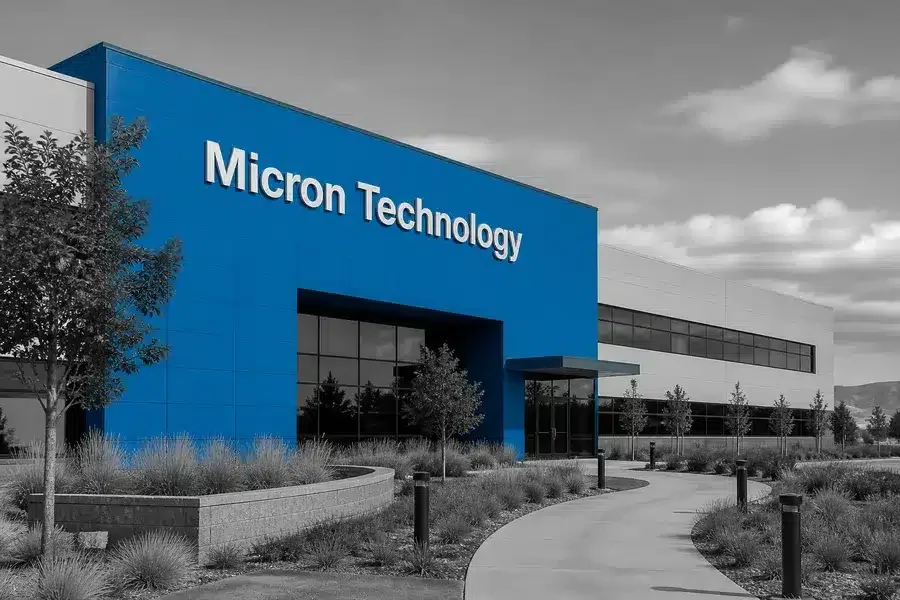
Semiconductor shares staged a broad premarket recovery on Monday, Oct. 19, with Micron Technology (MU) up 3.9% and Advanced Micro Devices gaining 4%, as investors looked past a nearly two-week selloff driven by Chinese competition fears.
The rebound matters for long-horizon investors because it tests whether the AI-driven demand thesis that powered outsized gains earlier in 2026 can survive a sustained pressure campaign from Chinese memory chipmakers and tightening capital conditions.
Key Takeaways
- Micron, AMD, Intel and SanDisk all gain 3%-5% in premarket Monday trading.
- Prior selloff triggered by China’s CXMT memory-chip architecture advance.
- Nvidia conference and Meta earnings loom as near-term sentiment catalysts.
Market Reaction & Context
The recovery was broad-based across the semiconductor complex. Intel (INTC) climbed 4.5%, SanDisk (SNDK) advanced 5%, and the iShares Semiconductor ETF (SOXX) rose 3.8% before the open, benchmarking the sector’s relief rally against a period of sustained losses that had wiped significant value from AI-exposed names. 1
Nvidia (NVDA) added 2.1% in premarket action, a more modest gain that reflects its relatively smaller exposure to the memory-specific concerns that catalysed the original selloff. South Korean memory giant SK Hynix’s U.S.-listed shares (SKHY) also pointed higher, up 4.77% after-hours, partially reversing the prior session’s double-digit plunge.
What Sparked the Original Selloff
The nearly two-week decline originated over the weekend of Oct. 11-12, when China’s ChangXin Memory Technologies (CXMT) said it had made significant progress developing a new chip architecture designed to increase memory density by packing more data into a smaller physical space. 2
The news rattled investors already on edge about AI-financing headwinds flagged by Intel and Broadcom executives, who cautioned that access to capital could emerge as a major drag on the artificial intelligence buildout. Elon Musk amplified anxiety when he posted on X that China’s ability to scale production, once it masters manufacturing, often exceeds the rest of the world combined.
The result was a global wave of selling. SK Hynix plunged more than 10% and Samsung Electronics shed 7.4%, each hitting lows not seen since August. European names were not spared: ASML dropped 3.3%, STMicroelectronics and Infineon both fell 5%, and SoftBank Group sank 8.5% in Tokyo trading. 2
Analysts: Reaction Disproportionate to Immediate Threat
Several market strategists argued the selloff overshot the underlying competitive reality. Rayliant Global Advisors chief market strategist Phillip Wool said CXMT’s advance marked a meaningful milestone but cautioned that the firm has yet to demonstrate large-scale production and remains well behind Samsung and SK Hynix in market share.
“More importantly, we’re not even talking about HBM here, and the Korean chipmakers are still unquestionably dominating that space, with very little threat at all from the likes of CXMT or anyone else for the foreseeable future,” Wool said.
UBP senior equity advisor Vey-Sern Ling echoed that view, saying investors were “looking for excuses to take profit on AI-related stocks that have outperformed this year, especially memory stocks.” 2 He added that in the short run, Chinese memory makers continue to face technology hurdles, particularly in advanced high-bandwidth memory.
For context on how quickly AI chip demand dynamics can shift, TSMC’s recent record earnings illustrated the durable appetite for leading-edge silicon, suggesting the broader AI capex cycle remains intact even as individual supply-chain risks fluctuate. Separately, Samsung’s margin pressures in memory chips had already signalled that competitive intensity was building well before the CXMT announcement.
Outlook: Catalysts Ahead
The week ahead carries two significant events that could consolidate or unwind Monday’s recovery. Nvidia is gearing up for a European conference, where any commentary on data-centre demand or export-control navigation could move the stock materially. Meta Platforms is scheduled to report earnings, and a strong result would likely provide a read-through for AI infrastructure spending broadly. 1
Wool warned that volatility could persist as investors reassess chip demand and how long semiconductor manufacturers can sustain pricing power – a concern that is especially acute for memory producers, whose margins are closely tied to supply-demand balance. Wool said the sharp selloff “reflected broader anxiety over the AI trade rather than a fundamental shift in the competitive landscape.” 2
Conclusion
Monday’s premarket bounce suggests the market views the CXMT-triggered selloff as an overreaction rather than a structural turning point for AI-driven memory demand. However, with capital-cost warnings from chip-industry CEOs still fresh and Chinese competitors narrowing the technology gap – however gradually – long-term holders of names like Micron and Intel face a more complex risk calculus than the straightforward AI-demand story of early 2026.
Not investment advice. For informational purposes only.
References
1Britney Nguyen (Oct. 19, 2026). “Micron and other chip stocks spring back to life after bruising selloff”. MarketWatch. Retrieved Oct. 19, 2026.
2Arjun Kharpal, Lee Ying Shan (Oct. 13, 2026). “Micron sinks, other memory-linked names dip for a second day”. CNBC. Retrieved Oct. 19, 2026.