


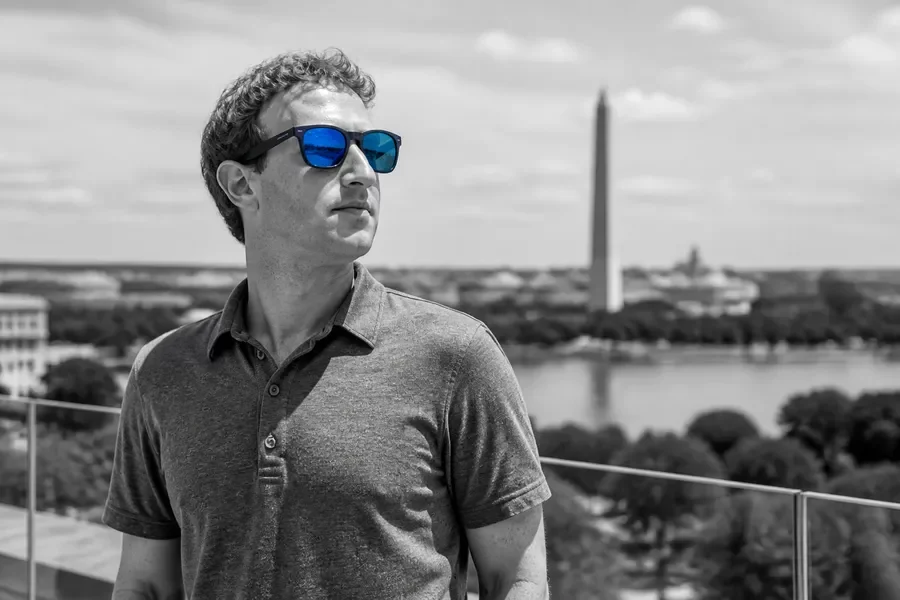
Meta Platforms (META.O) CEO Mark Zuckerberg said Tuesday that blocking Chinese AI models would be ineffective, directly challenging the Trump administration’s tightening tech-export posture and raising fresh questions about the regulatory environment facing U.S. frontier AI companies.
For long-horizon investors, the remarks matter because they crystallise a growing rift between open-source AI advocates – led by Meta – and closed-model rivals such as OpenAI and Anthropic, a split that could reshape competitive dynamics and the regulatory cost structure across the sector.
Key Takeaways
- Zuckerberg calls banning Chinese AI “not an effective solution.”
- He warns of “regulatory capture” favouring U.S. frontier labs.
- Washington separately unveiled new bans on Chinese robots and inverters.
Market Reaction & Context
META.O shares have outperformed the Nasdaq Composite by a wide margin in 2026, buoyed by strong advertising revenue and investor enthusiasm for the company’s open-source Llama model family. Zuckerberg’s public stance against Chinese AI restrictions aligns Meta strategically with a broader coalition that, according to one Facebook commenter citing industry sources, includes Nvidia, Microsoft, Google, IBM and Amazon – all of which reportedly support open access to frontier models – while Anthropic and OpenAI have pushed for restrictions. 1
The contrast is commercially significant: Meta distributes its AI models freely under an open-source licence, meaning Chinese competition does not threaten its distribution model the way it might threaten closed-model subscription revenues at rival labs.
Detailed Analysis
In an interview published Tuesday by the Financial Times, Zuckerberg said U.S. companies should “systematically” identify bottlenecks and roadblocks to better compete with Chinese AI firms rather than seek government protection. 2 He warned against “regulatory capture” – a scenario in which American frontier labs use Washington’s national-security apparatus to erect barriers that suppress domestic competition as much as foreign rivals.
The remarks land at a sensitive moment. Beijing-based Moonshot AI’s recently released Kimi K3 model has drawn attention in Washington for its coding capabilities, intensifying debate over whether Chinese developers are copying U.S. models or closing the gap through independent research. 3 U.S. Treasury Secretary Scott Bessent has separately warned that Chinese companies could face financial sanctions or placement on the Commerce Department’s Entity List, which restricts access to U.S. technology.
On the same day Zuckerberg’s interview appeared, the Trump administration unveiled import bans targeting new Chinese robots and power inverters, framing the measures as protection for the U.S. AI buildout from national-security threats. 3 That move illustrates just how wide the gap has become between Washington’s restrictive posture and the open-competition philosophy Zuckerberg is advocating.
Management Quote & Outlook
“Banning cutting-edge Chinese AI would not be an effective solution,” Zuckerberg said, according to the Financial Times, adding that identifying and removing bottlenecks represented a more durable path to American competitiveness. 2
When asked for comment on the FT interview, Meta referred reporters to an opinion piece by Zuckerberg published in the Wall Street Journal, suggesting the position reflects a deliberate, public communications strategy rather than an off-the-cuff remark.
Conclusion
For investors with long time horizons, the key risk to monitor is whether Washington moves toward mandatory restrictions on Chinese AI model usage – a step that could create compliance costs and fragment the global developer ecosystem that Meta’s open-source strategy depends on. Equally, if Zuckerberg’s “regulatory capture” framing gains traction with policymakers, it could blunt legislative momentum favouring closed-model competitors, potentially widening Meta’s structural advantage in the open-source AI market over the next several years.
Not investment advice. For informational purposes only.
References
1(July 29, 2026). “Mark Zuckerberg says US should not ban Chinese AI”. Financial Times. Retrieved July 29, 2026.
2Rajan, Gnaneshwar (July 29, 2026). “Meta’s Zuckerberg warns against curbs on Chinese AI models, FT reports”. Reuters. Retrieved July 29, 2026.
3Thomson Reuters (July 28, 2026). “Meta’s Zuckerberg warns against curbs on Chinese AI models, FT reports”. WTVB | 1590 AM · 95.5 FM. Retrieved July 29, 2026.