

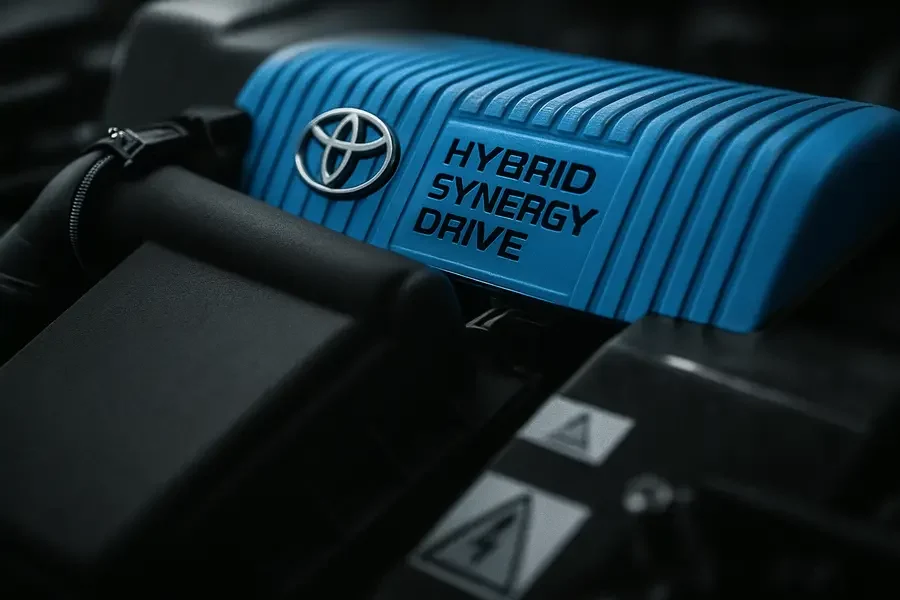
Dateline: LIBERTY, N.C., Nov 12, 2025 – Toyota Motor (TM) started production at its 13.9 billion North Carolina battery plant and announced up to 10 billion in additional U.S. investments to boost hybrid vehicle production 1. The move signals Toyota’s commitment to localized battery manufacturing as automakers face intensifying competition in the electrified vehicle market.
Key Takeaways
- Toyota opens first U.S. battery plant with 14 billion investment
- Additional 10 billion pledged for expanded electrified vehicle production
- Plant will supply batteries for Camry, RAV4, and Corolla Cross hybrids
Market Context
The new Liberty facility represents Toyota’s largest manufacturing investment in North America and marks the company’s 11th U.S. plant 2. The investment comes as automakers collectively pour billions into domestic battery production to reduce reliance on Asian suppliers and qualify for federal tax incentives.
Toyota’s approach contrasts with rivals like General Motors and Ford, which have prioritized all-electric vehicles over hybrids. The Japanese automaker maintains that hybrids offer a more practical transition technology for consumers.
Production Details
The state-of-the-art facility will house 14 battery production lines supporting both hybrid electric vehicles and battery electric vehicles 3. Initial production will focus on batteries for hybrid versions of popular models including the Camry, Corolla Cross, and RAV4 4.
The plant will also produce batteries for a yet-to-be-announced all-electric three-row SUV, marking Toyota’s gradual expansion into fully electric vehicles 4. The facility is designed to eventually support Toyota’s broader electrification strategy across its U.S. lineup.
Strategic Investment
With the additional 10 billion investment commitment, Toyota aims to further localize production of electrified vehicles in the United States 5. This brings Toyota’s total planned U.S. investment for electrified vehicles to approximately 24 billion.
The investment strategy positions Toyota to capture growing hybrid demand while building infrastructure for future electric vehicle production. Industry analysts view the move as Toyota hedging its bets on multiple electrification technologies rather than betting solely on battery-electric vehicles.
Industry Implications
Toyota’s battery manufacturing expansion reflects broader industry trends toward supply chain localization and reduced dependence on international suppliers. The move also positions the company to benefit from federal incentives that favor domestically produced batteries and vehicles.
The Liberty plant represents Toyota’s first in-house battery manufacturing facility outside Japan, signaling the company’s commitment to scaling battery production globally 6. This vertical integration strategy could provide cost advantages and supply chain security as battery demand accelerates.
Not investment advice. For informational purposes only.
References
1“Toyota opens new U.S. battery plant, confirms 10 billion in new investments” (Nov 12, 2025). MSN. Retrieved Nov 12, 2025.
2“Toyota starts production at its first battery plant and 11th overall plant in the U.S.” (Nov 12, 2025). MSN. Retrieved Nov 12, 2025.
3“Toyota Charges into U.S. Battery Manufacturing” (Nov 12, 2025). GuruFocus. Retrieved Nov 12, 2025.
4“Toyota opens US battery plant, confirms 10 billion investment plan” (Nov 12, 2025). MSN. Retrieved Nov 12, 2025.
5“Toyota to Invest Additional 10 B. Dollars in U.S.” (Nov 12, 2025). JIJI PRESS. Retrieved Nov 12, 2025.
6“Toyota’s first US battery factory is now operational” (Feb 5, 2025). Facebook. Retrieved Nov 12, 2025.