

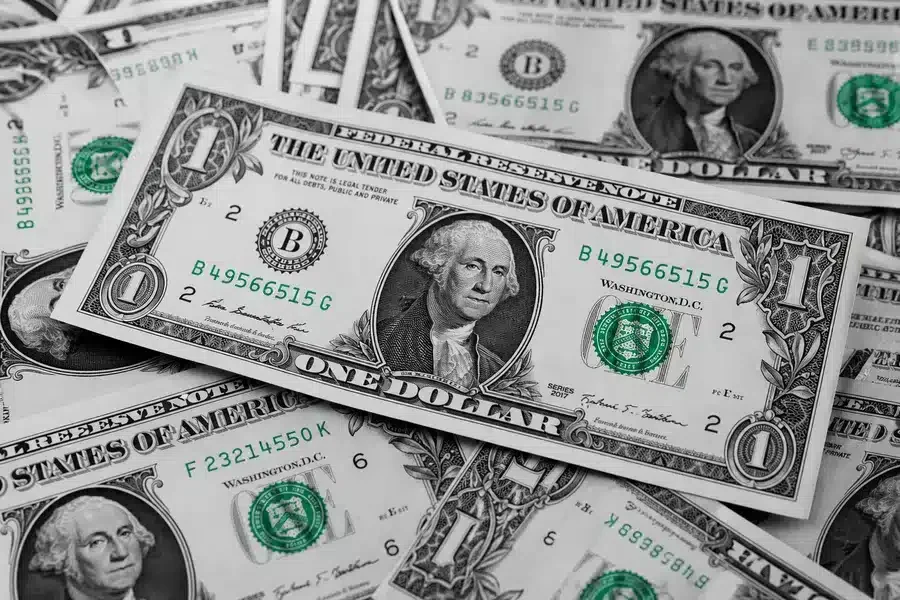
Jensen Huang’s reinstatement as Nvidia (NVDA) chief executive reignited the AI rally on Tuesday, lifting the U.S. dollar to a 20-month high and amplifying bets that a resilient economy will give the Federal Reserve room to push rates higher.
For long-horizon investors, the dollar’s surge reshapes the calculus on earnings repatriation, emerging-market debt servicing, and the relative attractiveness of rate-sensitive assets – making currency moves as consequential as the equity headlines driving them.
Key Takeaways
- Dollar reaches 20-month high on renewed AI optimism.
- Huang’s reinstatement at Nvidia revives broad AI-sector momentum.
- Stronger growth narrative reinforces Fed rate-hike expectations.
Market Reaction & Context
The dollar index hovered near its strongest level since March 2025, outpacing a basket of G10 peers as equity markets rallied in tandem with the Nvidia news 1. The move extended what had already been a notable run for the greenback – a streak that analysts had begun framing as a structural reassessment of U.S. rate policy rather than a purely sentiment-driven trade, a dynamic explored in an earlier look at the dollar’s eight-session surge and its implications for safe-haven logic.
Nvidia’s stock led technology benchmarks higher, with the AI chip sector broadly advancing as markets interpreted Huang’s return as a signal of strategic continuity at the company most closely associated with the generative-AI infrastructure build-out.
Detailed Analysis
The link between AI euphoria and Fed rate expectations runs through the growth channel: a technology-led economic expansion raises nominal GDP projections, keeps labor markets tight, and sustains consumer spending – all factors that reduce the urgency for the Fed to cut and increase the probability of additional hikes 1. Market pricing shifted meaningfully on Tuesday, with interest-rate futures reflecting a higher terminal-rate assumption than the prior session.
Dollar strength of this magnitude carries compounding effects for multinational corporations, particularly those with large overseas revenue bases. A persistently strong dollar compresses foreign earnings when translated back to U.S. reporting currency, a headwind that disproportionately affects large-cap technology firms – the same cohort driving the AI rally.
The dynamic also pressures emerging-market economies with dollar-denominated debt obligations, tightening financial conditions globally even without a formal Fed action. Investors tracking the inflation and rate-hike fears already embedded in bond markets will recognize that this dollar move reinforces rather than contradicts the broader tightening narrative.
Currency strategists noted that the dollar’s advance was broad-based, with the yen and euro both weakening as capital flows favored U.S. assets offering higher carry. The Bank of Japan’s own rate deliberations added a secondary layer of complexity, given that any divergence between Fed and BOJ policy trajectories tends to amplify dollar-yen moves.
Outlook & Management Quote
The primary source for the story noted that Huang’s reinstatement “breathed new life into the AI rally and stoked expectations that the recovery would give the Federal Reserve greater scope to raise rates further” 1. That framing places the AI trade and monetary policy on a shared trajectory – a convergence that could sustain dollar strength well beyond a single session if earnings data and labor-market releases confirm the growth narrative.
Investors monitoring the Fed’s internal posture may also find context in recent reporting on the Fed’s cost-containment measures, which some analysts read as an institution calibrating for a prolonged period of elevated rates rather than an imminent pivot.
Conclusion
Tuesday’s dollar move illustrates how a single corporate catalyst – Nvidia’s leadership continuity – can ripple across asset classes with enough force to reprice rate expectations. For investors with long time horizons, the more durable question is whether the AI infrastructure cycle can sustain the kind of nominal growth that keeps the Fed in a hawkish stance, or whether the dollar rally ultimately becomes a drag on the very earnings momentum fueling it.
Until that tension resolves, currency risk deserves as much attention in portfolio construction as the equity valuations commanding the headlines.
Not investment advice. For informational purposes only.
References
1(2026-11-23). “Dollar climbs as renewed AI euphoria fuels Fed hike bets”. Reuters. Retrieved November 23, 2026.