


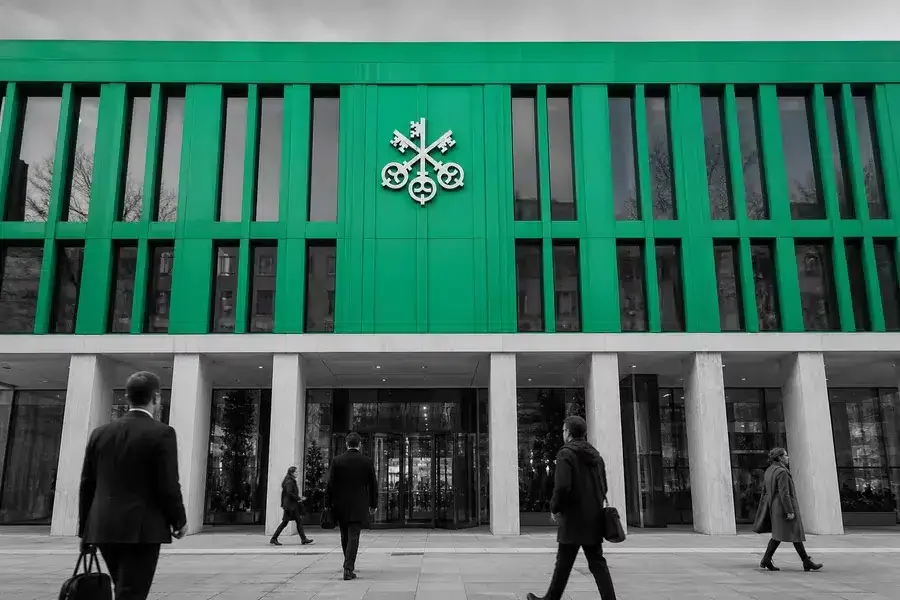
UBS Group (UBSG.S) posted a 17% jump in second-quarter net profit to $2.8 billion on Wednesday, crushing consensus by nearly $410 million, as record investment-bank trading underscored the breadth of its post-Credit Suisse earnings recovery.
For long-horizon investors, the result matters because it demonstrates that wealth management and trading revenues are compounding simultaneously – reducing dependence on any single business line and reinforcing the bank’s capacity to return capital even as Swiss regulators debate tougher capital rules.
Key Takeaways
- Q2 net profit of $2.8B beat the $2.39B analyst consensus by 17%.
- New $3B buyback programme to run through end-June 2027.
- Swiss capital-rule uncertainty remains the key structural risk.
Market Context & Peer Benchmark
The $2.8 billion headline profit compares with a company-compiled analyst forecast of $2.39 billion – a beat of roughly 17% – placing UBS well ahead of the mid-single-digit upside surprises typical among European universal banks this reporting season 1. The trading desk delivered what UBS described as a record second quarter, a metric that puts it in conversation with Wall Street peers that have also reported outsized fixed-income and equities revenues in the period.
Analysts had pencilled in approximately $4.45 billion in total UBS buybacks for the full year 2026; the bank had already completed $3 billion in repurchases during July alone, meaning the freshly announced $3 billion programme represents an incremental shareholder return above prior-year run rates 2.
Earnings Detail: Two Engines Firing
Profit growth was driven by twin pillars: expansion in global wealth management fee income and a standout performance in the investment bank’s trading division 1. UBS said the trading unit posted a record second quarter, a signal that the integration of Credit Suisse’s markets infrastructure is generating tangible revenue synergies rather than merely cost savings.
Net profit attributable to shareholders reached $2.8 billion against a year-ago base that already reflected meaningful post-merger improvement, making the 17% year-on-year rise particularly notable 2. The result echoes the broader pattern seen at diversified financial groups – where scale in wealth management amplifies fee leverage during periods of strong asset prices and client activity.
Buyback Mechanics & the Capital-Rules Wildcard
Under the new programme, UBS intends to repurchase at least $1 billion of shares within the next three months, with the remainder to follow by the end of June 2027 at the latest 1. The bank was explicit, however, that the pace and ultimate size of repurchases will depend on both near-term financial performance and the resolution of Swiss “too big to fail” legislation currently being drafted in response to Credit Suisse’s 2023 collapse.
Switzerland’s government has pushed for UBS to hold roughly $20 billion in additional Common Equity Tier 1 capital – a figure UBS has called excessive and competitively damaging 2. Lawmakers are expected to soften that requirement when they begin drafting the bill next month, with many parliamentarians wary that an outsized permanent buffer could deter long-term investors from holding the stock.
“The amount and pace of buybacks would depend on its short-term financial performance as well as the outcome of Swiss banking rules,” UBS said in its results statement, according to Reuters.
Long-Term Revenue Mix: Why It Matters for Patient Investors
For investors focused on durable earnings, the composition of this quarter’s beat is arguably more important than the headline number. Wealth management generates recurring fee income that is less volatile than trading revenues, while a record trading quarter adds a near-term earnings kicker that accelerates the bank’s capital generation timeline.
UBS has built a business model where wealth management assets – accumulated during and after the Credit Suisse integration – act as a structural growth driver, while investment banking provides cyclical upside. That combination, if sustained, reduces the earnings volatility discount that European banks have historically traded at relative to U.S. peers. The regulatory backdrop is the single most important variable for shareholders to monitor in the second half of 2026, as the Swiss capital-rules outcome will directly determine how much of the earnings stream can be distributed rather than retained.
Conclusion
UBS delivered a clean beat on profit and followed it with a credible, if conditioned, return-of-capital commitment – a combination that reinforces the investment thesis for holders willing to look through near-term regulatory noise. The key watchpoint for the coming quarters is the Swiss parliament’s capital-rules legislation: a diluted requirement would unlock the upper end of UBS’s buyback capacity, while a stricter outcome could force the bank to rebuild its distribution timeline from scratch.
Not investment advice. For informational purposes only.
References
1Ariane Luthi / Reuters (2026-07-29). “UBS logs forecast-beating quarterly profit, flags US$3 bil in new buybacks by end-June”. The Edge Malaysia. Retrieved 2026-07-29.
2(2026-07-29). “UBS logs forecast-beating quarterly profit, flags US$3bil in new buybacks by end-June”. KLSE Screener / The Star. Retrieved 2026-07-29.
3(2026-02-04). “UBS Beats Q4, Launches $3 Billion Buyback”. Yahoo Finance. Retrieved 2026-07-29.
4Ruxandra Iordache, CNBC (2025-02-04). “UBS shares retreat 6% as fourth-quarter profit beat, $3 billion buyback fail to impress”. NBC Philadelphia / CNBC. Retrieved 2026-07-29.
5(2025-02-04). “UBS trounces profit forecasts, US$3 billion share buyback conditional on capital rules”. The Business Times. Retrieved 2026-07-29.